
What is HoloDreamer
HoloDreamer is an AI text-driven 3D scene generation framework launched by Peking University in collaboration with Pengcheng Laboratory. Through two core modules: stylized panorama generation and enhanced two-stage panorama reconstruction, it rapidly generates immersive, view-consistent, fully enclosed 3D scenes from text descriptions. HoloDreamer has broad application prospects in fields such as virtual reality, gaming, and film production.
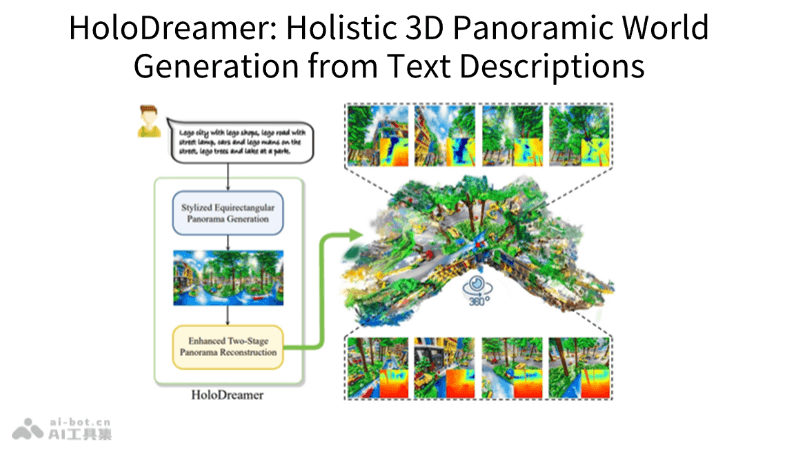
Main Features of HoloDreamer
- Text-Driven 3D Scene Generation: Users can generate immersive 3D scenes through text prompts.
- Stylized Panorama Generation: Combines multiple diffusion models to generate stylized and detailed panoramas from complex text prompts.
- Enhanced Two-Stage Panorama Reconstruction: Rapidly reconstructs panoramas through 3D Gaussian splatting technology, enhancing scene completeness and view consistency.
- Multi-View Supervision: Utilizes panoramas generated by 2D diffusion models as comprehensive initialization for the full 3D scene, optimizing to fill in missing areas.
- High-Quality Rendering: The generated 3D scenes have high-quality visual effects, suitable for the virtual reality, gaming, and film industries.
Technical Principles of HoloDreamer
- Text-to-Image Diffusion Models: Uses powerful text-to-image diffusion models to provide reliable prior knowledge, creating 3D scenes using only text prompts.
- Stylized Panorama Generation(Stylized Equirectangular Panorama Generation): Combines multiple diffusion models to generate stylized and high-quality panoramas. The model can understand complex text prompts and generate panorama images that match the text descriptions.
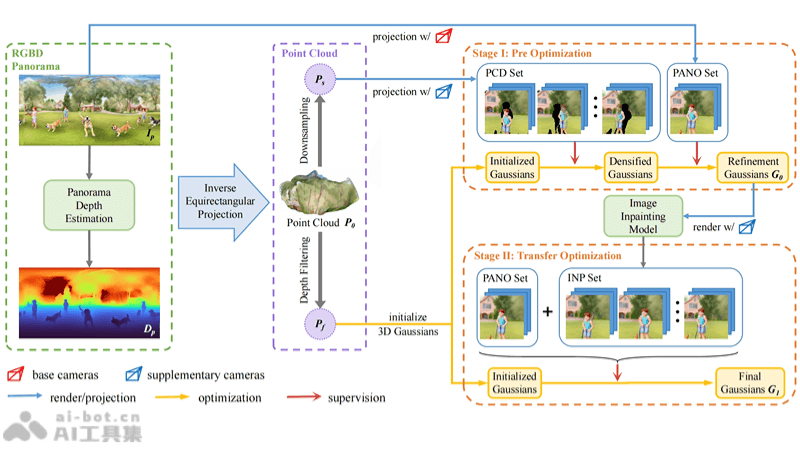
- 3D Gaussian Splatting(3D Gaussian Splatting, 3D-GS): After generating the panorama, 3D-GS technology is used to quickly reconstruct the 3D scene. By projecting the RGBD data of the panorama into 3D space, a point cloud is generated, and the 3D scene is further constructed.
- Enhanced Two-Stage Panorama Reconstruction(Enhanced Two-Stage Panorama Reconstruction): Performs depth estimation, using a base camera and auxiliary cameras to project and render in different scenarios. It also includes three image sets, each used for supervision at different stages of 3D-GS optimization.
- Optimization and Refinement: The rendered images of the reconstructed scene generated in the pre-optimization stage are used for optimization in the transfer optimization stage, filling in missing areas and enhancing scene completeness.
- Multi-View Supervision: The panoramas generated by 2D diffusion models serve as comprehensive initialization for the full 3D scene, conducting multi-view supervision to ensure that the generated 3D scene has consistency and completeness from different viewpoints.
- Circular Blending Technique: To avoid seams in the panorama when rotating, circular blending technique is applied.
HoloDreamer Project Address
-
GitHubRepository:https://zhouhyocean.github.io/holodreamer/
-
arXivTechnical Paper:https://arxiv.org/pdf/2407.15187
Application Scenarios of HoloDreamer
- Virtual Reality (VR): Provides immersive 3D environments for VR experiences, enhancing user immersion and interactivity.
- Game Development: Rapidly generates game scenes, reducing the time and cost of traditional 3D modeling, while providing diverse and personalized scene designs.
- Film and Visual Effects: Generating realistic 3D backgrounds and environments in film production for visual effects or scene construction.
- Architectural visualization: Helping architects and designers quickly preview 3D models of buildings and urban landscapes through text descriptions.
- Education and training: In the field of education, used to create historical scenes, scientific models, etc., improving learning efficiency and interest.