
What Is Hojo-ASR-V1
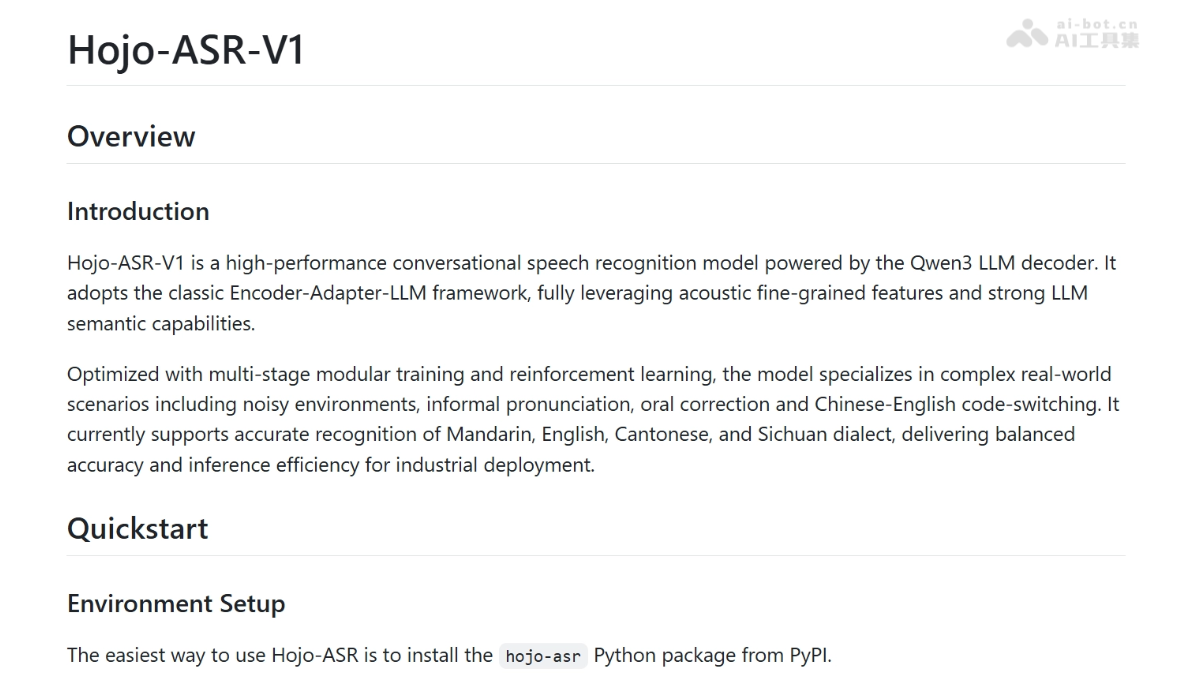
Hojo-ASR-V1 is an automaticspeech recognitionmodel open-sourced by the startup team Hojo. It adopts an architecture of Whisper feature extraction + Qwen3-Omni audio encoding + Conformer adaptation + Qwen3-4B language model decoding. On the LibriSpeech Clean dataset, the model achieves a word error rate of only 1.74%, with 7.6% on GigaSpeech and 7.02% on VoxPopuli, performing at a level close to that of top major companies. The model supports local deployment and is aimed at Agent workflows and voice input scenarios.
Main Features of Hojo-ASR-V1
-
High-Precision Speech Transcription: Converts audio into text in real time, supporting long sentences and complex semantic understanding.
-
Mixed Chinese-English Recognition: Highly robust for colloquial expressions and scenarios with mixed Chinese and English.
-
Noisy Environment Adaptation: With the help of the language model's semantic judgment, it still maintains a high recognition rate in noisy environments.
-
Professional Terminology Understanding: Uses the semantic capabilities of Qwen3-4B to accurately recognize proper nouns in fields such as healthcare, law, and technology.
-
Local Offline Operation: Supports fully local deployment, enabling speech recognition without an internet connection and ensuring data privacy.
Technical Principles of Hojo-ASR-V1
- Acoustic Feature Extraction: Audio is processed through OpenAI Whisper's feature extractor, converting the raw waveform into high-dimensional acoustic feature vectors, preserving phoneme and spectral information.
- Audio Semantic Encoding: The feature vectors are input into the Qwen3-Omni audio encoder for deep semantic encoding, transforming sound information into hidden state representations aligned with the text semantic space.
- Feature Adaptation and Compression: The intermediate layer adopts a Conformer structure to perform feature adaptation and temporal compression between the encoder and the language model, balancing computational efficiency and information fidelity.
- Large Language Model Decoding: The Qwen3-4B large language model receives the processed features and generates the final text by combining semantic context, enabling the model to use language priors to correct errors caused by similar pronunciation or noise interference.
How to Use Hojo-ASR-V1
-
Download the Model: Visit the HuggingFace repository
HojoAI/Hojo-ASR-V1or GitHubHojoAI/Hojo-ASRto obtain the weights and code. -
Install Dependencies: Configure the Python environment and install
hojo_asrand related dependency libraries. -
Load the Model: Through the
hojo.load_model()interface, load the model onto a local GPU or CPU. -
Input Audio: Pass in an audio file path or real-time audio stream and call the transcription interface.
-
Get Results: The model returns the recognized text, which can be connected to large models such as DeepSeek and GPT for secondary polishing and format optimization.
Core Advantages of Hojo-ASR-V1
-
Top-Tier Recognition Accuracy: LibriSpeech Clean WER 1.74%, close to the level of leading models on the leaderboard such as NVIDIA Canary and IBM Granite.
-
Semantic-Level Error Correction: Unlike traditional ASR, which relies only on acoustic matching, the Qwen3-4B language model can infer the correct words based on contextual semantics, greatly reducing homophone errors.
-
Chinese Scenario Optimization: Deeply tuned for details such as colloquial Chinese expressions, neutral tones, and erhua, delivering a better experience than general multilingual models.
-
Privacy and Security: Supports fully local deployment, so sensitive speech data does not need to be uploaded to the cloud, making it suitable for enterprise meetings and medical scenarios.
Project address of Hojo-ASR-V1
- GitHub repository:https://github.com/HojoAI/Hojo-ASR
- HuggingFace model library:https://huggingface.co/HojoAI/Hojo-ASR-V1
Comparison of Hojo-ASR-V1 with similar competing products
| Dimension | Hojo-ASR-V1 | OpenAI Whisper |
|---|---|---|
| Model architecture | Encoder + adapter + LLM decoding | Encoder-Decoder |
| Semantic understanding | Strong (supported by the Qwen3-4B language model) | Moderate (pure acoustic mapping) |
| Chinese optimization | Deep optimization, strong colloquial recognition | General multilingual, average Chinese details |
| Open-source license | Apache-2.0 | MIT |
| Local deployment | Supported, requires a certain amount of VRAM/memory | Supported, mature ecosystem |
| Leaderboard WER | LibriSpeech Clean 1.74% | Large-v3 about 2.1% |
Application scenarios of Hojo-ASR-V1
-
AI Agent voice entry point: As the "ears" of an intelligent agent, it converts voice commands into executable text, replacing the keyboard as the main interaction method.
-
System-level voice input method: Takes over global input for the operating system, enabling voice typing in any text box such as browsers, ChatGPT, Claude, Notion, etc.
-
Real-time meeting transcription: Local deployment enables offline meeting minutes generation, avoiding the external transmission of confidential business voice data.
-
Podcast and video subtitles: Quickly converts long audio content into text transcripts, supporting subsequent polishing and structured organization by large models.
-
Intelligent customer service and telephone quality inspection: In call center scenarios, recognizes customer speech in real time and extracts key information and emotional keywords.