
What is HMoE
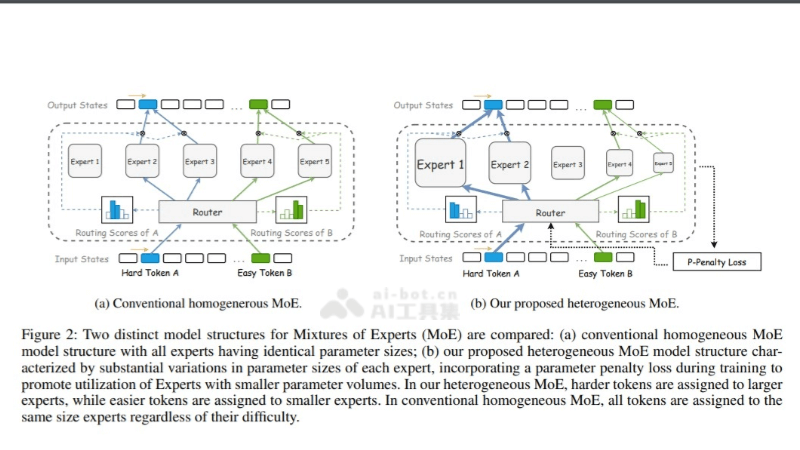
HMoE (Hybrid Mixture of Heterogeneous Experts) is a novel neural network architecture proposed by the Tencent Hunyuan team, aimed at improving the performance and computational efficiency of large language models. By introducing experts of different sizes to handle input data of varying complexity, it enhances the model's degree of specialization. HMoE adopts new training objectives and strategies, such as P-Penalty Loss, to encourage frequent activation of smaller experts, thereby improving parameter utilization and computational efficiency. Experiments demonstrate that HMoE achieves excellent performance on multiple pre-training evaluation benchmarks, providing a new direction for large model research.
Features of HMoE
- Heterogeneous Expert Design: The experts in the HMoE model vary in size, and can allocate experts with different capabilities to process input data based on its complexity, improving the model's specialization and flexibility.
- Computational Efficiency Optimization: By activating smaller experts to handle simple tasks, HMoE can concentrate computational resources on more complex tasks while maintaining efficient computation.
- Parameter Utilization Efficiency: Through training strategies such as P-Penalty Loss, HMoE optimizes the allocation and activation of parameters, reduces dependence on large experts, and improves the model's overall parameter usage efficiency.
- Dynamic Routing Strategy: By combining Top-P and Top-K routing strategies, HMoE can dynamically activate the corresponding number of experts based on the importance of each token, achieving more fine-grained model control.
- Performance Improvement: On multiple pre-training evaluation benchmarks, HMoE demonstrates performance surpassing traditional homogeneous MoE models, proving its effectiveness in handling complex language tasks.
Technical Principles of HMoE
- Heterogeneous Expert Structure: The HMoE model consists of multiple experts of different sizes, each of which is an independent neural network that can handle different aspects of the input data. This allows the model to dynamically allocate computational resources based on task complexity.
- Routing Mechanism: HMoE uses routing strategies (such as Top-K and Top-P routing) to determine which experts will be activated to process a specific input. Top-K routing activates a fixed number of K experts, while Top-P routing dynamically determines the number of activated experts based on a probability threshold.
- Parameterized Loss Function: To address the problem of imbalanced expert activation, HMoE introduces a parameterized loss function (P-Penalty Loss), which adjusts the weight of experts in the total loss according to their size, encouraging the model to activate small experts more often.
- Training Objective Optimization: By optimizing the training objective, HMoE considers not only model performance but also efficient parameter utilization. This is achieved by combining language model loss, P-Penalty Loss, and router entropy loss (Lentropy).
HMoE Project Address
- arXiv Technical Paper:https://arxiv.org/pdf/2408.10681
Application Scenarios of HMoE
- Natural Language Processing (NLP): HMoE can be applied to NLP tasks such as machine translation, text summarization, sentiment analysis, text classification, and question answering systems, based on the ability of heterogeneous experts to handle different language characteristics.
- Content Recommendation Systems: In recommendation systems, HMoE can analyze user behavior and preferences to provide personalized content recommendations.
- Speech Recognition: HMoE can be applied to speech recognition technology to handle the characteristics of different speakers and complex information in speech.
- Image and Video Analysis: Although HMoE is primarily designed for language models, its concept of heterogeneous experts can also be extended to the fields of image and video analysis, handling different aspects of visual data.
- Multimodal Learning: When handling tasks that combine multiple data types such as text, images, and sound, HMoE can effectively allocate experts to process data from different modalities.