
What is HiDream-O1-World
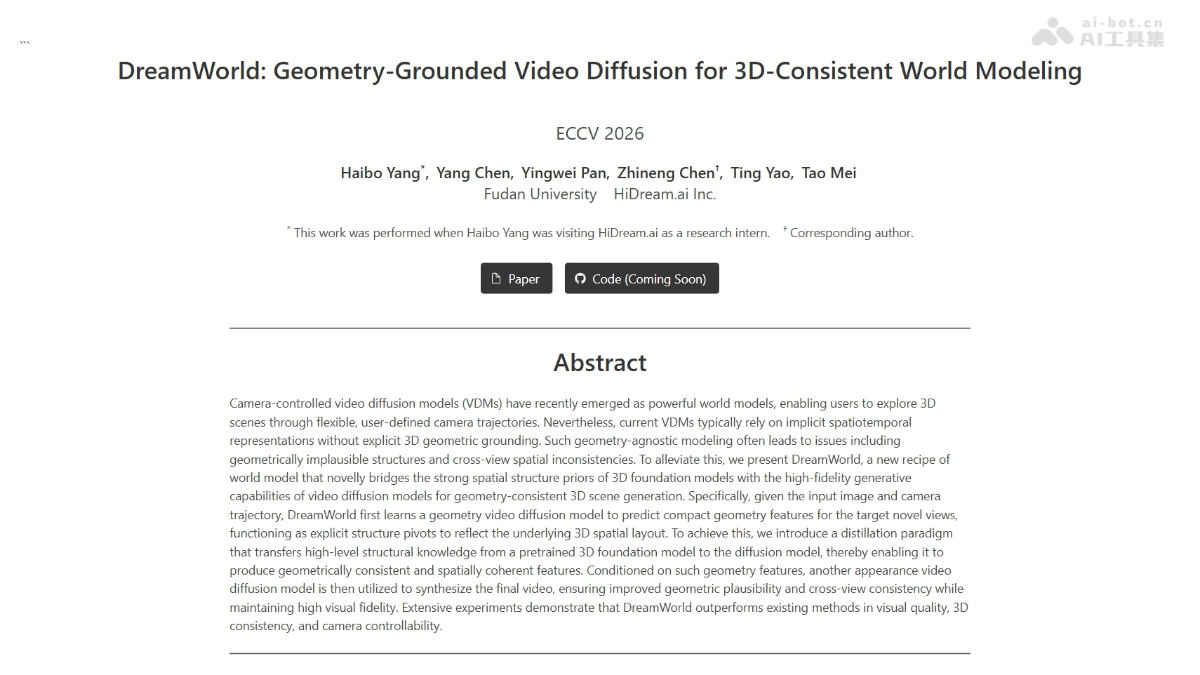
HiDream-O1-World is an native omni-modal interactive world model launched by HiDream.ai (智象未来), built on its self-developed UiT architecture. It supports multimodal inputs such as text, images, and interactive control, and features three major functions: roaming, editing, and interaction. It can generate a complete world with spatiotemporal consistency, conformity to physical laws, and long-horizon simulation in one click. The core breakthrough lies in the synergistic design of "3D prior injection into Memory context + Test-Time Training online adaptation," which effectively solves the problems of object drift, scene amnesia, and physical distortion during long-term interaction.
Main Features of HiDream-O1-World
-
Multimodal Input Generation: Supports multiple input methods such as text descriptions, image uploads, and interactive control, generating a structurally complete and finely textured interactive world in one click; for example, uploading an indoor photo can automatically complete the panorama and construct a high-precision digital twin space.
-
Immersive Roaming: Provides both first-person and third-person perspectives. Users can freely drive the character to walk and adjust the viewing direction at will. The camera movement remains stable throughout with no drift, and lighting and details change in sync.
-
Real-Time Editing and Interaction: Can drive the character to perform actions such as grabbing, running, crouching, and jumping, or schedule environmental changes (such as triggering rainfall or falling objects), and each modification maintains global consistency in geometry, lighting, materials, and physical logic.
-
Multi-Character Construction: Supports multiple character types such as humans, animals, and fictional characters, precisely adapting to their respective forms and motion patterns.
-
Rich Scenes and Stylized Creation: Can highly restore real scenes such as city streetscapes, natural landforms, and indoor spaces, and can also generate diverse artistic styles such as fantasy otherworlds, anime cartoons, and AAA game rendering.
-
Long-Horizon Spatiotemporal Consistency: Based on the "3D prior injection into Memory + Test-Time Training" mechanism, objects do not disappear, drift, or become "amnesiac" after multiple rounds of viewpoint switching.
-
Physical Consistency Guarantee: Physical responses such as collisions, occlusions, gravity, and fluids conform to real-world causal logic, and visual physical plausibility is improved by 13.6% compared with the industry average.
How to Use HiDream-O1-World
-
Choose an Input Method : Supports three multimodal inputs: enter a text description (such as a scene setting), upload a reference image (such as an indoor photo), or start directly through interactive control.
-
One-Click World Generation : The model automatically constructs a complete interactive world based on the input, including spatial structure, material lighting, and physical rules; when an image is uploaded, it can also automatically complete the panorama and generate a digital twin space.
-
Roaming and Exploration : Choose a first-person or third-person perspective, drive the character to walk freely in the world, adjust the viewing direction at will (push, pull, pan, tilt), and observe environmental details and lighting changes.
-
Real-Time Interactive Editing: Through instructions, drive the character to complete actions such as grabbing, running, crouching, and jumping, or schedule environmental events (such as rainfall or falling objects). The model maintains global self-consistency in geometry and physical logic.
-
Long-Horizon Simulation and Continuous Creation:Relying on the "Memory + TTT" mechanism, the model can remember explored spatial structures and support multiple rounds of interaction and long-horizon continuous simulation without losing the world state.
Core Advantages of HiDream-O1-World
-
Native Omni-Modal UiT Architecture: Based on a self-developed native omni-modal architecture, it achieves unified understanding and generation of text, images, and interaction, rather than simple multimodal concatenation.
-
Breakthrough in Spatiotemporal Consistency: The first collaborative mechanism of "3D prior injection into Memory context + Test-Time Training online maintenance" ensures that objects do not drift, disappear, or deform during long-horizon interactions.
-
Breakthrough in Physical Consistency: During training, inductive bias learning is driven by physics simulation data; during inference, TTT online adapts to scene physical properties, achieving visual plausibility 13.6% above the industry average.
-
Top-Tier Evaluation Results: On its first entry into WBench, it topped the Navi sub-leaderboard with an overall score of 80.9, ranking first in both the physics dimension at 73.3 and the consistency dimension at 88.0.
-
Flexible Multimodal Input: Supports multiple inputs such as text descriptions, image uploads, and interactive control, generating in one click a complete world that supports dual-view roaming and real-time editing.
-
Character and Style Generalization: Accurately adapts to the forms and movement rhythms of humans, animals, and fictional characters, while supporting both real-scene reproduction and diverse artistic styles such as anime and AAA games.
HiDream-O1-World Project Address
- Project Official Website:https://yanghb22-fdu.github.io/DreamWorld/
- Technical Paper:https://yanghb22-fdu.github.io/DreamWorld/asserts/DreamWorld.pdf
Comparison of HiDream-O1-World with Similar Competitors
| Comparison Dimension | HiDream-O1-World | LingBot-World |
|---|---|---|
| Developer | HiDream.ai | Ant Group (Open Source) |
| WBench Ranking | 1st Place | 5th Place |
| Overall Score | 80.9 | 78.5 |
| Quality Dimension | 81.0 | 78.9 |
| Setting Dimension | 82.2 | 72.6 |
| Interaction Dimension | 80.0 | 80.1 |
| Consistency Dimension | 88.0 | 89.9 |
| Physics Dimension | 73.3 | 71.2 |
| Core Architecture | Self-developed native omni-modal UiT architecture, 3D prior injection into Memory + TTT online maintenance | Specific architecture details not disclosed |
| Open Source Status | Not open source | Open source |
| Core Advantages | Strongest overall performance, leading physical realism, breakthrough in spatiotemporal consistency | Highest in the consistency single item (89.9), open source and available for secondary development |
| Relative Weaknesses | Not open source, ecosystem yet to be built | Weaker overall performance, with gaps in both setting capability (72.6) and physics (71.2) |
| Applicable Scenarios | High-precision simulation, embodied intelligence, AI interactive film-games, and industrial applications with high requirements for physical self-consistency | Rapid developer integration, open-source customization, and scenarios with high consistency requirements but moderate physics requirements |
Application Scenarios of HiDream-O1-World
-
AI Interactive Film-Games: Users shift from passive viewers to active narrative participants; the world evolves branching storylines in real time as they explore, enjoying an immersive experience with multiple endings amid film-grade visual quality.
-
Embodied Intelligence Simulation: Builds high-precision city, factory, and indoor simulation spaces that follow physical rules, providing a low-cost, highly safe virtual testing foundation for intelligent robot training and replacing high-risk real-world testing.
-
3D Digital Content Production: Rapidly generate 3D figurines, home scenes, and artistic spaces for designers and creators, with support for structural fine-tuning, instant style switching, and intelligent completion, greatly shortening the iteration path from creativity to finished product.
-
Autonomous Driving Virtual Testing: Build road environments that highly restore real traffic rules and physical laws, simulate rare scenarios such as extreme weather and complex road conditions, and accelerate the training and validation of autonomous driving algorithms.
-
Microcosm Life Simulation: Extend to the microscopic scale, accurately simulate life processes such as cell behavior and protein interactions, and provide a new digital simulation path for drug discovery, disease mechanism research, and biological experiments.