
What is HiCo
HiCo is a hierarchical controllable layout-to-image generation model based on diffusion models, launched by 360 AI Research Institute. HiCo is designed with a multi-branch structure to achieve precise control over object positions and text descriptions. The key feature of HiCo lies in spatial decoupling, effectively handling complex layouts and reducing issues such as missing objects and viewpoint conflicts. HiCo performs excellently in multi-object controllable layout generation in natural scenes, and introduces the HiCo-7K benchmark test set. The HiCo model demonstrates compatibility with fast generation plugins (such as LoRA and LCM), can generate high-resolution images, and still has room for improvement when handling multi-concept composite layouts.
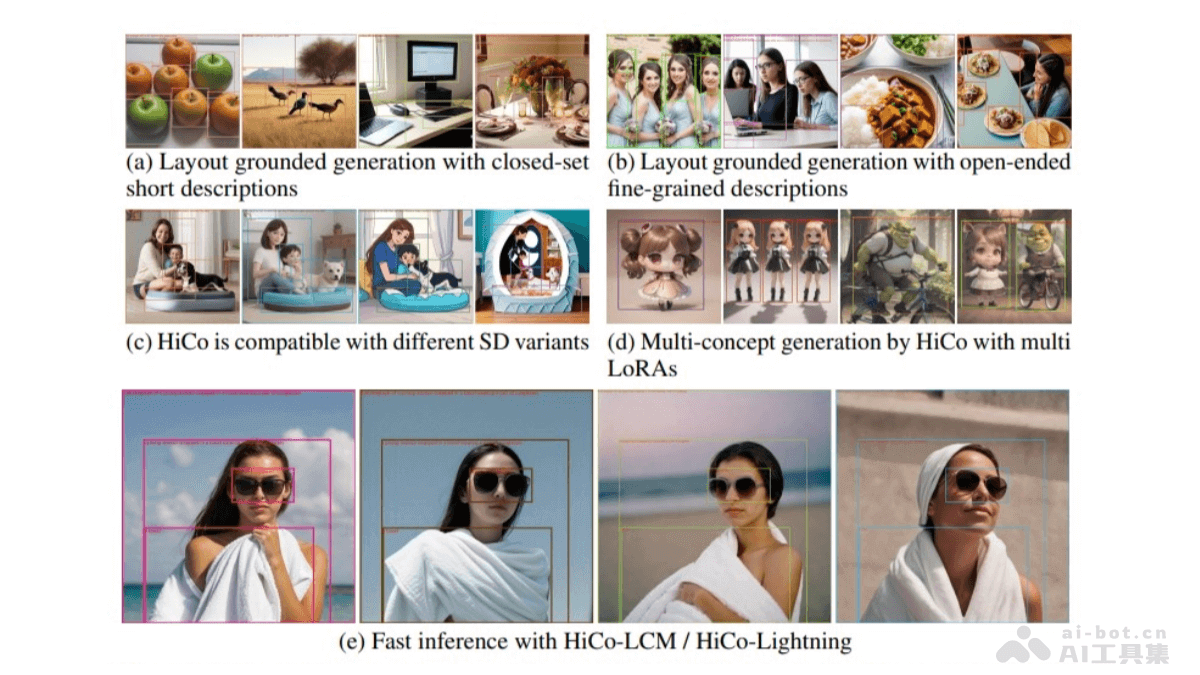
HiCo's Main Features
- Hierarchical Layout Control: HiCo models layouts based on a hierarchical structure, achieving fine-grained control over the background, foreground, and spatial relationships.
- Object-Level Controllable Generation: The model independently generates each object according to the object's text description and spatial position conditions, ensuring the accuracy and consistency of the generated image.
- Multi-Branch Structure Fusion: Uses a multi-branch network to independently process different regions, merges features based on a fusion module (Fuse Net), and generates images with complex layouts.
- Fast Generation Plugin Compatibility: HiCo is compatible with fast generation plugins (such as LoRA and LCM), accelerating the image generation process while maintaining high-quality output.
- HiCo-7K Benchmark Test: Introduces the HiCo-7K benchmark test set to evaluate the model's performance in multi-object controllable layout generation.
- Flexible Scalability: The model supports integrating different plugins or adjusting parameters to adapt to different generation tasks, such as personalized generation or multilingual control.
HiCo's Technical Principles
- Hierarchical Modeling: HiCo models the input layout information with a hierarchical structure, capturing spatial layout details from coarse to fine.
- Separable Object Condition Branches: Each branch independently processes and generates the content of a specific region, generating images according to the object's text description and spatial position conditions.
- Diffusion Model: Based on diffusion models, the iterative denoising process recovers clear images from noisy data, using conditions to guide the generation process.
- Fusion Module (Fuse Net): Masking technology separates the content of different foreground and background regions, maintaining their respective independence during the merging process.
- Low-Rank Adaptation (LoRA): Compatible with LoRA technology, quickly adapting to new tasks or styles without needing to train the entire model from scratch.
- Fast Inference Capability: Designs fast inference mechanisms, such as HiCo-LCM (Lightning) and HiCo-Lightning, using parallel processing and optimized network structures to accelerate image generation.
HiCo's Project Address
- Project Official Website:360cvgroup.github.io/HiCo_T2I
- GitHub Repository:https://github.com/360CVGroup/HiCo_T2I(to be open-sourced soon)
- arXiv Technical Paper:https://arxiv.org/pdf/2410.14324
HiCo's Application Scenarios
- Image Editing and Synthesis: In image editing, precisely add, modify, or remove objects in an image according to text descriptions and position information, suitable for scenarios requiring fine control of visual layout.
- Games and Entertainment: In game design or film special effects production, generate complex scene layouts, including characters, props, and background elements, improving creative efficiency and visual effects.
- Virtual Reality (VR) and Augmented Reality (AR): In VR and AR applications, generate virtual environments that meet specific layout requirements, providing users with a more immersive experience.
- Advertising Design: Quickly generate attractive advertising images based on advertising creative concepts and layout requirements, improving the efficiency and quality of advertising design.
- Data Augmentation: In machine learning and computer vision tasks, generate training data, especially when datasets require specific layouts or scenes, to enhance the model's generalization ability.