
"Hermes Agent: From Beginner to Mastery" is an open-source AI Agent practical handbook written by Huashu, introducing Nous Research's Hermes Agent framework. Its core feature is "rein included from the factory": through a self-improvement learning loop, three-layer memory (session/persistent/Skill), and an automatically evolving Skill system, the Agent understands you better the more you use it. Hermes Agent supports 7×24 deployment on a $5 VPS, with 40+ tools + MCP connecting to 6000+ applications. Unlike OpenClaw's "nurture-based" approach, Hermes is "self-evolving," automatically distilling capabilities from experience rather than manual tuning. The tutorial covers practical scenarios including installation and configuration, multi-platform integration, and development automation.
Get free access to the 《Hermes Agent: From Beginner to Mastery》report PDF original file. Scan the QR code, follow, and reply with the keyword: Hermes Agent
Core Concepts
What Is Harness Engineering
- Instruction Layer → Skill system (Markdown files, auto-created + self-improving)
- Constraint Layer → Tool permissions + Sandbox
- Feedback Layer → Self-improvement learning loop (automatic review and optimization)
- Memory Layer → Three-layer memory (session/persistent/Skill) + Honcho user modeling
- Orchestration Layer → Sub-Agent delegation + Cron scheduling
Relationship with OpenClaw and Claude Code
| Dimension | Hermes Agent | OpenClaw | Claude Code |
|---|---|---|---|
| Core Philosophy | Autonomous background + self-improvement | Configuration as behavior (SOUL.md) | Interactive coding |
| User Role | Occasional checks after deployment | Write configuration files to define behavior | Sit at the terminal for real-time collaboration |
| Memory System | Three-layer self-improving memory | Multi-layer memory (mainly manually maintained) | CLAUDE.md + auto-memory |
| Operating Mode | 24/7 background operation | Launched on demand | Launched on demand |
| Skill Source | Agent-created + community Hub | ClawHub 44000+ (manually written) | Manual installation |
Core Mechanism
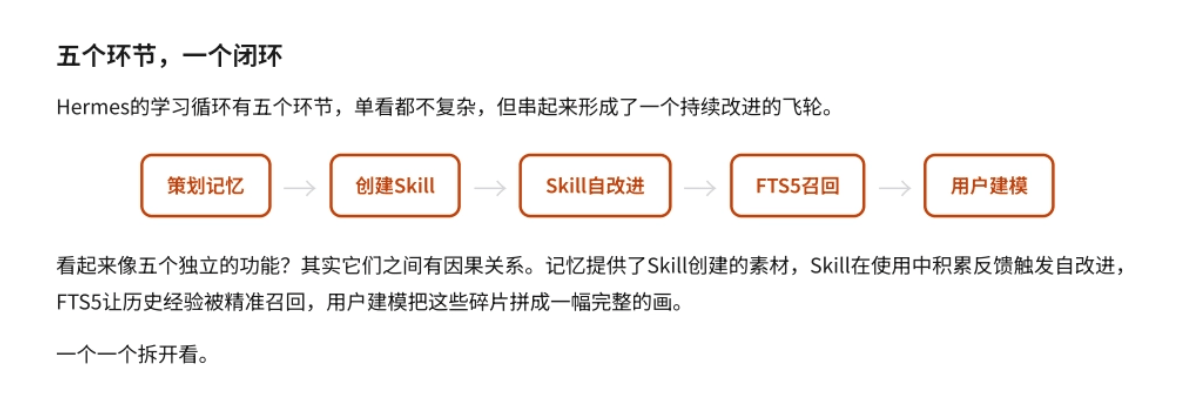
Self-improvement learning loop (Learning Loop)
- Curate Memory: after a conversation ends, actively decide which information is worth remembering (similar to a human writing a diary, not storing everything)
- Create Skill: after completing a complex task, automatically distill it into
~/.hermes/skills/Markdown files under - Skill Self-Improvement: Automatically modify Skill rules based on user feedback (e.g., if the user says "check whether the table exists before importing CSV", Hermes will update the Skill file and execute it automatically next time)
- FTS5 recall: When a new conversation starts, retrieve relevant history on demand based on the SQLite FTS5 full-text index (rather than loading the full context)
- Honcho user modeling: Infer the user's deep characteristics (such as skill level, work rhythm, and inconsistencies between words and actions) and inject them into subsequent conversations
Three-layer memory architecture
| Layer | Stored content | Technical implementation | Purpose |
|---|---|---|---|
| Session memory | Original conversation text, tool call results | SQLite + FTS5 index | Retrieve scenario details on demand |
| Persistent memory | User preferences, project structure, coding habits | SQLite (pure local file) | Maintain the user profile across sessions |
| Skill memory | Methodology for doing things, operating standards | ~/.hermes/skills/*.md |
Procedural memory, self-improving |
Skill system
-
Format: Pure Markdown, readable and editable, using the agentskills.io standard (interoperable with Claude Code and Cursor)
-
Source: 40+ built-in Bundled Skills, Agent-created autonomously, installed from the Skills Hub community
-
Feature: Unlike OpenClaw's manual maintenance, Hermes Skill willautomatically evolve from experience
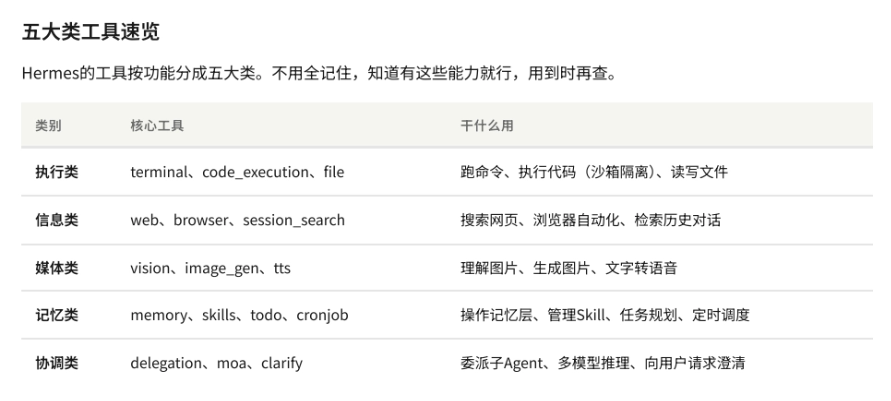
40+ tools and MCP integration
-
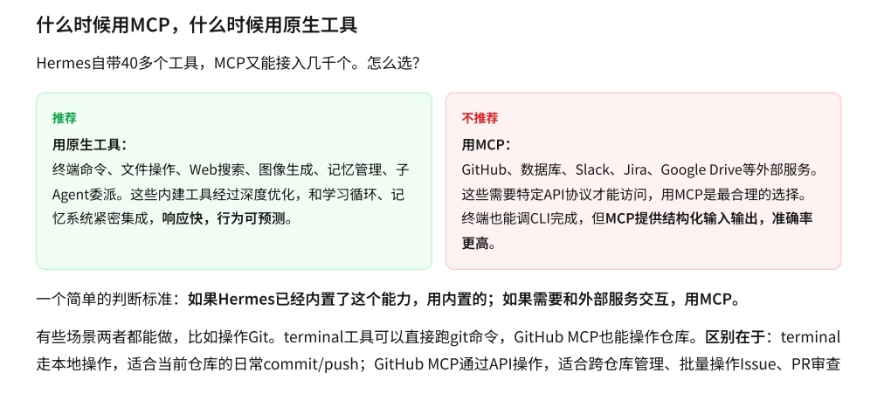
Five major tool categories: execution (terminal/code_execution), information (web/browser), media (vision/image_gen), memory (memory/skills), coordination (delegation/moa/cronjob)
-
MCP(Model Context Protocol): Supports connecting to 6000+ external applications (GitHub, Slack, Jira, databases, etc.), via
stdioorHTTPfor plug-and-play use -
Sub-Agent delegation: Up to 3 sub-Agents concurrently, each with independent context + a restricted toolset, used for parallel research/coding/testing
Hands-on setup
Three installation paths
-
Local one-click script: Completed in 5 minutes, supports macOS/Linux/WSL2
-
Docker: Data volume mapped to
~/.hermes, state is not lost when the container is rebuilt -
$5 VPS: Hetzner/DigitalOcean, etc., memory <500MB, enabling 24/7 online availability
Minimal configuration
-
Only a single
~/.hermes/config.yamlfile is needed -
Just fill in the model API (OpenRouter/Nous Portal recommended) and the messaging platform token to get started
Cognition is established from the first conversation
-
No need to hand-write CLAUDE.md like with Claude Code, nor write SOUL.md like with OpenClaw
-
Direct conversation: self-introduction is written automaticallyPersistent memory, and after completing the first task, automatically in
~/.hermes/skills/generate a Skill file in Markdown format -
Instant feedback triggers Skill self-improvement, automatically reusing the optimized version next time
Seamless multi-platform expansion
-
Based on a unified Gateway architecture, it supports integration with 12+ platforms including Telegram, Discord, Slack, and more
-
All platforms share the same SQLite memory store, enabling cross-platform continuity: for a task started on Telegram, entering "continue" in the CLI seamlessly picks it up
MCP capability enhancement
-
Through the Model Context Protocol standardized interface, you can connect to 6000+ external applications such as GitHub and PostgreSQL without writing adapter code
- Supports per-server tool filtering (e.g., only granting GitHub read-only permission), following the principle of least privilege while extending capabilities
Real-world scenarios
- Personal knowledge assistant: For deep research lasting several weeks (e.g., "research AI Agent deployment options"). Traditional AI requires re-explaining the background every time a new conversation starts, while Hermes relies on three-layer memory to automatically associate context—your mention last week that "the Docker option was ruled out" and yesterday's confirmation of a "preference for low cost" mean that this week you can directly ask "let's continue looking at Serverless" and it will pick up seamlessly, with no need to re-establish context.
- Development automation: Enables a 7×24 unattended DevOps pipeline. Through Cron scheduled triggers + GitHub MCP, Hermes can automatically review new PRs while you sleep (checking naming and test coverage according to the standards defined in the Skill), run regression tests, monitor coverage changes, and generate a daily report with causal relationships (e.g., "the architecture was changed on Wednesday because of Monday's port conflict") rather than a simple list of commits.
- Content creation: Suitable for long-term output of series topics. The style preferences established in the first article (e.g., "do not use 'in summary'", "paragraphs must not exceed 3 lines") are automatically inherited by the fifth article; for competitive analysis tasks, you can delegate 3 sub-Agents to research different products simultaneously, completing in 20 minutes the data collection that originally took 40 minutes, and automatically accumulating your editing habits to form an exclusive editing manual.
- Multi-Agent orchestration: Parallel acceleration for handling complex tasks. Through delegate_task, tasks are split among up to 3 sub-Agents executing simultaneously (e.g., A researches the architecture, B writes code, C runs tests), each with its own independent context and restricted toolset (the research Agent has no terminal permissions, ensuring safety), while the main Agent focuses on integrating results, avoiding context explosion in a single Agent.
Deep thinking
- On tool positioning, the manual proposes the "three horses" theory: Claude Code is the "craftsman" for real-time coding, Hermes is the "steward" on background duty, and OpenClaw is the "specification" that defines behavior. The three are not substitutes for one another; they achieve Skill interoperability through the agentskills.io standard, and users should combine them according to task characteristics (requiring real-time collaboration, running in the background, requiring audit and compliance).
- On the boundaries of self-improvement, the author points out that its ceiling hinges on feedback quality: the Agent can continuously optimize "how to do it" (execution efficiency), while directional judgments about "what to do" and "what not to do" still require human control. Skill files are plaintext and auditable, and data is stored locally, but there is a fundamental contradiction: "the value of automation lies in not having to watch it, while security requirements demand that you must watch it." The best practice is to maintain On the Loop—the Agent is responsible for autonomous execution and accumulating experience, while humans periodically audit and steer, rather than letting go entirely or intervening line by line.
Summary
"Hermes Agent From Beginner to Mastery" is an installation and configuration manual, a systematic work on the design philosophy of autonomous AI Agents. It fully presents how to productize the Harness Engineering methodology, how to make the Agent understand the user better the more it is used through the "self-improving learning loop," and how to deploy a 24/7 personal AI infrastructure at an extremely low hardware cost ($5 VPS). For developers who wish to advance from "using AI tools" to "owning an autonomous AI assistant," it is currently the most detailed practical guide in the Chinese-language community.
Get free access to the "Hermes Agent From Beginner to Mastery" report PDF original file, scan the QR code to follow and reply with the keyword: Hermes Agent