
What is HeadGAP
HeadGAP is a 3D avatar generation model jointly launched by ByteDance and ShanghaiTech University, which can quickly generate realistic 3D avatars using only a small number of images. It adopts a framework of a prior learning stage and a personalized creation stage, based on 3D head prior information derived from a large-scale multi-view dynamic dataset. Through a Gaussian Splatting auto-decoding network and part-based dynamic modeling, combined with identity-shared encoding and personalized latent codes, HeadGAP achieves high-fidelity and animatable 3D avatars, with multi-view consistency and stable animation effects.
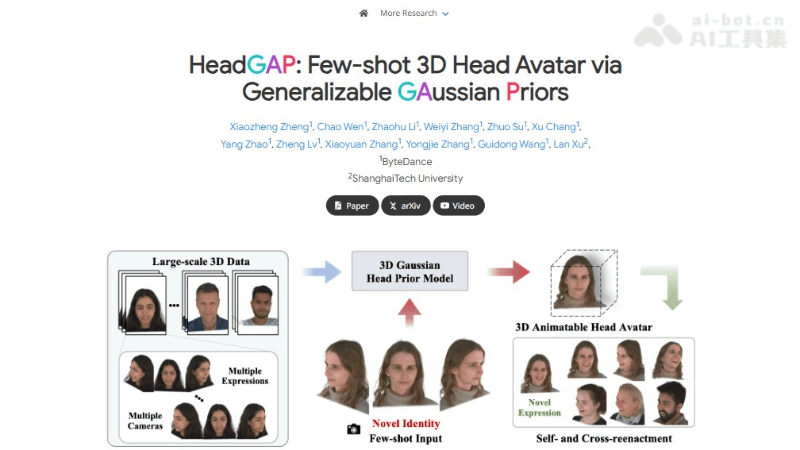
Main Features of HeadGAP
- Few-shot learning: It can create realistic 3D avatars from very few images (even just one).
- High fidelity: The generated 3D avatars have photo-level rendering quality, with rich and realistic details.
- Animation robustness: The avatars are not only visually realistic, but can also perform smooth animations and adapt to different facial expressions and movements.
- Personalized customization: Through the prior learning and personalization stages, customized processing can be performed according to the user's specific features.
- Multi-view consistency: The avatar can maintain consistency under different viewpoints, whether frontal, side, or oblique views.
Technical Principles of HeadGAP
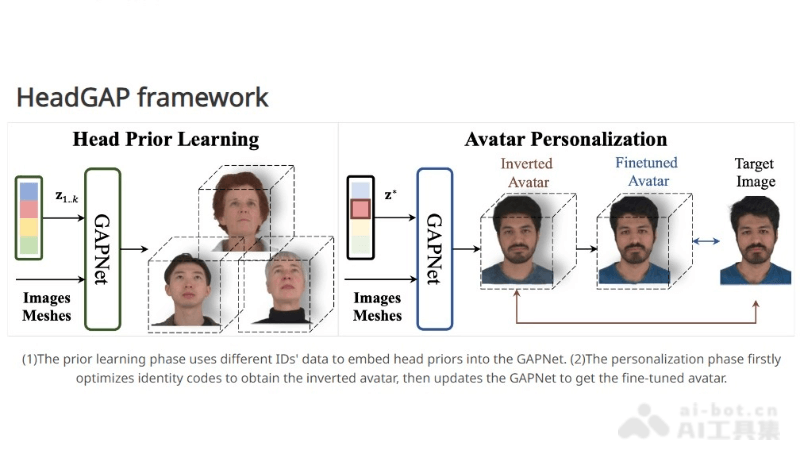
- Prior learning stage: In this stage, the system analyzes 3D head models in a large-scale multi-view dynamic dataset to learn and extract general head features and shape priors.
- Gaussian Splatting network: An auto-decoder network based on Gaussian distributions that can represent the distribution of 3D head data as a collection of Gaussian primitives, capturing the complex geometric structure of the head.
- Identity-shared encoding and personalized latent codes: It uses shared encoding to learn common features among different identities, while generating personalized latent codes for each individual to learn individual unique attributes.
- Part-based dynamic modeling: Through a part-based modeling method, it can dynamically adjust various parts of the avatar to adapt to different facial expressions and movements.
Project Address of HeadGAP
- Project official website:headgap.github.io
- GitHub repository:https://github.com/headgap/headgap.github.io
- arXiv technical paper:https://arxiv.org/pdf/2408.06019
How to use HeadGAP
- Data preparation: Prepare a small number of images of the target person. The images can be taken from different angles, and HeadGAP can learn the person's features from multiple viewpoints.
- Upload images: Upload these images to the HeadGAP system. This can be done by visiting the official website or through the provided API interface.
- Prior learning: The system will use the uploaded images for prior learning, extracting 3D head prior information from a large-scale multi-view dynamic dataset.
- Avatar creation: Based on the learned prior information, the system will enter the avatar creation stage. In this stage, the system will generate an initial 3D avatar model.
Application Scenarios of HeadGAP
- Virtual social networking: In virtual reality or augmented reality social platforms, users can use 3D avatars generated by HeadGAP as their virtual personas.
- Game development: Game developers can use HeadGAP technology to create realistic 3D avatars for game characters, enhancing the immersion and personalized experience of the game.
- Film and animation production: For film or animation production, HeadGAP can generate or reconstruct characters' facial features, enabling more realistic and vivid performance capture.
- Education and training: In simulation training or educational software, HeadGAP can be used to create realistic avatars of virtual teachers or trainees, improving the learning experience.