
What is Halo
Halo is an open-source DIY health tracking project that uses low-cost smart rings and open-source software to let users build their own private health monitoring applications. Halo supports activity tracking, heart rate monitoring, sleep analysis, and other features, and fully respects user privacy. With Halo, users can gain deeper insight into their own health data and enjoy a customized health tracking experience. The project code is open source, encouraging community participation and contributions to promote the popularization and innovation of health tracking technology.
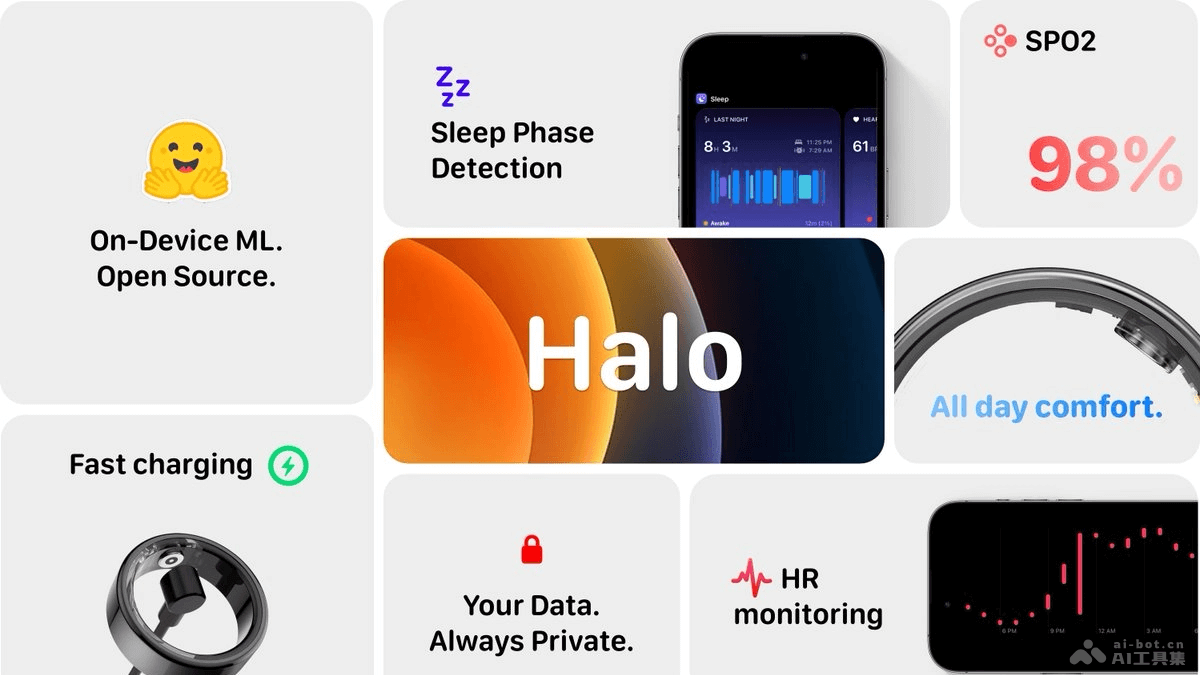
Main features of Halo
- Activity tracking: Monitors the user's daily activity, including steps, distance, and calories burned.
- Heart rate monitoring: Tracks the user's heart rate in real time, helping users understand their heart health and exercise intensity.
- Sleep analysis: Analyzes the user's sleep quality, including sleep duration, deep sleep, and light sleep stages.
- Health data visualization: Displays collected health data in the form of charts and graphs, making it easier for users to understand and analyze.
- Open source and customizable: Users can modify and extend Halo's features according to their needs.
- Extensibility: Halo supports adding more health monitoring features, such as blood pressure monitoring and blood glucose tracking.
Technical principles of Halo
- Bluetooth Low Energy (BLE): Communicates with wearable devices based on BLE technology, a wireless communication protocol with low energy consumption and short transmission distance, suitable for health tracking devices.
- Client-server model: In the BLE architecture, Halo acts as a central device (Central) and communicates with peripherals such as the COLMI R02 ring.
- Services and Characteristics:
- Services: Collections of functions on the ring, such as heart rate monitoring or battery status, and each service has a unique UUID.
- Characteristics: Specific data points or control mechanisms within a service, read-only, write-only, or both.
- Data read and write operations: Halo sends commands or receives data by interacting with the ring's characteristics to implement data reading and writing.
- iOS application development: Uses Swift 5 to build the user interface, interact with the ring, and display tracking data.
Halo project address
- GitHub repository:https://github.com/cyrilzakka/Halo
Application scenarios of Halo
- Personal health monitoring: Users track personal health data such as heart rate, steps, and sleep quality to better understand and manage their health status.
- Fitness and exercise: During fitness and exercise, real-time monitoring of the user's physiological indicators helps users adjust training intensity and optimize exercise results.
- Telemedicine: Doctors and healthcare workers remotely monitor patients' health data, especially in chronic disease management, helping provide timely medical advice and intervention.
- Research and development: Researchers and developers collect data to conduct health-related research or develop new health tracking algorithms and applications.
- Education and training: In educational institutions, it can serve as a teaching tool to help students understand the principles and applications of health tracking technology.