
What is GRUtopia 2.0
GRUtopia 2.0 (Taoyuan 2.0) is a general embodied intelligence simulation platform released by Shanghai Artificial Intelligence Laboratory. The platform has been comprehensively upgraded based on GRUtopia 1.0, featuring three core innovations: a general modular framework, automated generation of scene assets, and an efficient data collection system. Users can define complex tasks with just "three lines of code," without needing to switch between multiple platforms. The platform integrates millions of standardized object assets, enabling "one-click generation" of complex scenes and reducing development costs. GRUtopia 2.0 supports various embodied intelligence tasks, such as navigation, manipulation, and motion control. As the core of the "virtual-real integration" technology system, the platform drives embodied intelligence from virtual to reality through high-performance simulation.
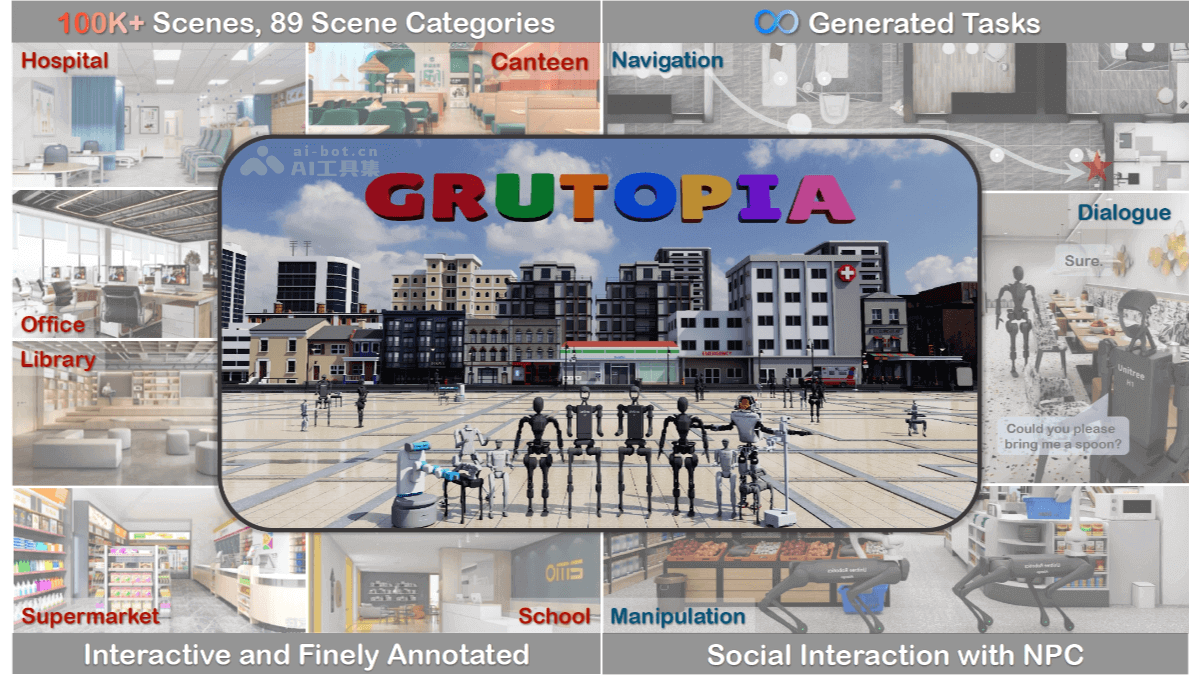
Main Features of GRUtopia 2.0
- General Modular Simulation Framework: GRUtopia 2.0 introduces a general modular simulation framework that supports various embodied tasks such as navigation, manipulation, and motion control. Users can define any task with just "three lines of code," without needing to switch between multiple platforms, greatly simplifying the development process.
- Automated Generation of Scene Assets: The platform integrates millions of standardized object assets, combined with automated generation and randomization tools, enabling "one-click generation" of complex scenes.
- Efficient Data Collection System: GRUtopia 2.0 provides various low-threshold teleoperation tools for manipulation tasks and batch data collection tools for navigation tasks. Compared with traditional methods, teleoperation efficiency is increased by 5 times, and navigation task data collection efficiency is increased by up to 20 times.
- Large-Scale Interactive 3D Scene Dataset (GRScenes): The platform includes 100,000 highly interactive and finely annotated scenes, which can be freely combined into city-scale environments. The scenes cover 89 different scene categories, filling the gap in service-oriented environments.
- NPC System (GRResidents): GRUtopia 2.0 introduces an NPC system driven by large language models (LLMs), responsible for social interaction, task generation, and task allocation. It simulates social scenarios, providing a new dimension for embodied AI applications.
- Benchmark Testing Platform (GRBench): The platform proposes GRBench, which supports various robots, especially with legged robots as the primary agents, to evaluate the ability to perform medium-difficulty tasks such as object navigation, social navigation, and mobile manipulation.
- Simulation-to-Reality (Sim2Real) Paradigm: GRUtopia 2.0 demonstrates through its simulation platform how simulation can alleviate the scarcity of high-quality data, promoting the expansion and application of robotics from virtual to reality.
- Support for Diverse Robots: The platform supports multiple types of robots, including humanoid robots and legged robots, and can meet multi-level research needs from low-level control to high-level decision-making.
Project Address of GRUtopia 2.0
- Github Repository:https://github.com/OpenRobotLab/GRUtopia
- arXiv Technical Paper:https://arxiv.org/pdf/2407.10943
Application Scenarios of GRUtopia 2.0
- Robot Training and Development: GRUtopia 2.0 provides a general modular simulation framework that supports various embodied tasks such as navigation, manipulation, and motion control. Developers can define tasks with simple "three lines of code," without needing to switch between multiple platforms.
- Complex Scene Construction: The platform integrates millions of standardized object assets and, combined with automated scene generation and randomization tools, can achieve "one-click generation" of complex scenes. The scenes cover a variety of environments such as homes, restaurants, offices, and public places, providing robots with diverse training scenarios.
- Social Interaction and Task Generation: GRUtopia 2.0 introduces an NPC system driven by large language models (LLMs), which can simulate social interaction, task generation, and task allocation.
- Data Collection and Optimization: The platform provides an efficient data collection system, supporting a variety of low-threshold teleoperation tools for manipulation tasks and batch data collection tools for navigation tasks.