
What is Grok 4.20
Grok 4.20 is a new-generation multi-agent AI system launched by Musk's xAI, featuring a revolutionary "four-agent collaborative architecture" with four specialized agents built in: Captain Grok, research expert Harper, logic expert Benjamin, and creative expert Lucas. Through parallel thinking, multiple rounds of internal discussion, and peer review mechanisms, the system achieves efficient collaboration similar to a human expert team while maintaining machine-level operating speed. Grok 4.20 has an MoE architecture with approximately 3T parameters and supports a 256K token context window. In the Alpha Arena live trading competition, it became the only AI model to achieve profitability, with a return rate of 10%-12%, significantly outperforming competing products from OpenAI and Google. It is currently in the Beta testing phase and is only available to SuperGrok and X Premium+ users.
Main Features of Grok 4.20
-
Four-Agent Collaborative System: Built-in four specialized Agents: Captain Grok, research expert Harper, logic expert Benjamin, and creative expert Lucas, which generate answers through parallel thinking and internal discussion.
-
Real-Time Information Retrieval: The Harper Agent connects in real time to the X platform (approximately 68 million English tweets per day) and the internet, ensuring information timeliness.
-
Deep Reasoning and Verification: The Benjamin Agent is responsible for step-by-step logical reasoning, mathematical calculation verification, and code generation, greatly reducing the hallucination rate.
-
Creative Content Generation: The Lucas Agent provides divergent thinking, identifies blind spots, and optimizes writing style, maintaining the humanity and balance of the output.
-
Multimodal Understanding: Natively supports unified processing and cross-modal reasoning for text, images, and video.
-
Long Context Processing: Supports a 256K token context window, and some API versions can reach 2 million tokens.
-
Financial Trading Decisions: Achieved a return rate of approximately 10%-12% in the Alpha Arena live competition, making it the only profitable AI model.
-
Complex Task Decomposition: Automatically breaks down complex problems into subtasks and assigns them to corresponding agents for parallel processing.
-
Conflict Resolution Mechanism: Captain Grok is responsible for coordinating conflicts among the opinions of various Agents and synthesizing the final consistent output.
-
Real-Time Data Visualization: Supports the generation of charts, images, and structured data displays.
Technical Principles of Grok 4.20
-
Mixture of Experts Architecture (MoE): The total parameter count is approximately 3T, and each forward pass activates a subset of expert sub-networks, balancing performance and computational efficiency.
-
Multi-Agent Parallel Architecture: Four specialized Agents run simultaneously, sharing intermediate results and reasoning paths through an internal message-passing mechanism.
-
Dynamic Task Routing: Captain Grok automatically assigns tasks to the corresponding expert Agents based on the type of question, achieving load balancing.
-
Iterative Peer Review: The outputs of each Agent undergo multiple rounds of cross-validation and critical evaluation, simulating the human academic peer review process.
-
Real-Time Data Pipeline: The Harper Agent directly connects to the X platform Firehose API and search engines, achieving millisecond-level information retrieval.
-
Reinforcement Learning Optimization: Conducts online learning based on user feedback and task completion quality, continuously optimizing collaboration strategies.
-
Consensus Synthesis Algorithm: Integrates opinions from four agents using a weighted voting mechanism, with weights dynamically adjusted based on historical accuracy.
-
Long-context compression technology: Processes 256K+ tokens through a hierarchical attention mechanism, with a key information retention rate exceeding 95%.
-
Colossus cluster training: Relies on a supercomputing cluster of 200,000+ GPUs for distributed training, supporting convergence of large-scale MoE models.
-
Adversarial safety alignment: Built-in red-team agents simulate attack scenarios to enhance model robustness and output safety.
How to use Grok 4.20
-
Obtaining subscription eligibility: Requires a SuperGrok subscription (about $30/month) or X Premium+ membership; currently in the Beta testing phase
-
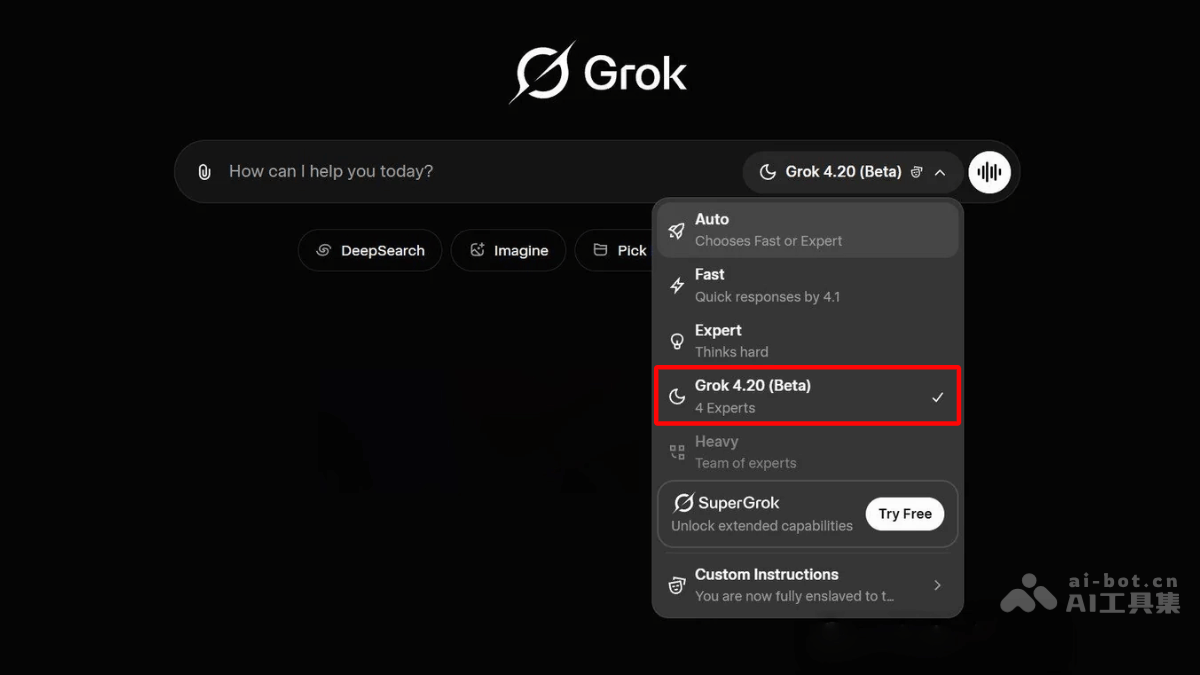
Web access: Log in to the official x.ai website and switch to the “Grok 4.20” version in the model selector to use it
-
X platform integration: Access directly through the Grok chat entry point in the X (Twitter) app or website, supporting asking questions while scrolling through posts
-
Mobile use: Access through the built-in Grok feature in the X App, supporting both iOS and Android platforms
-
API access (pending release): The official API has not yet been publicly released; enterprise users can follow subsequent updates on the xAI developer platform
Application scenarios of Grok 4.20
-
Financial investment analysis: Analyzes market trends and financial report data in real time, generates trading strategies, and has verified profitability through live trading in Alpha Arena.
-
News and public opinion monitoring: Uses real-time data streams from the X platform to quickly track trending events and analyze changes in public sentiment.
-
Scientific literature review: Multi-agent collaboration retrieves and cross-validates academic materials to generate high-quality literature review reports.
-
Code development and debugging: The Benjamin agent provides rigorous code generation, mathematical proofs, and logic flaw detection.
-
Creative content creation: The Lucas agent assists with copywriting, advertising creativity, script ideation, and other tasks requiring divergent thinking.
-
Enterprise decision support: Integrates multi-source information to provide data-driven business analysis and risk assessment recommendations.
-
Education and knowledge Q&A: Explains complex concepts step by step, suitable for students' self-directed learning and in-depth consultation in professional fields.