
What is Grok-1
Grok-1 is a large language model developed by Musk's artificial intelligence startup xAI. It is a Mixture of Experts (MoE) model with 314 billion parameters, making it the open-source large language model with the largest number of parameters currently. The development and training process of Grok-1 followed open-source principles; its weights and network architecture have been made public under the Apache 2.0 license, allowing users to freely use, modify, and distribute it for personal and commercial purposes.
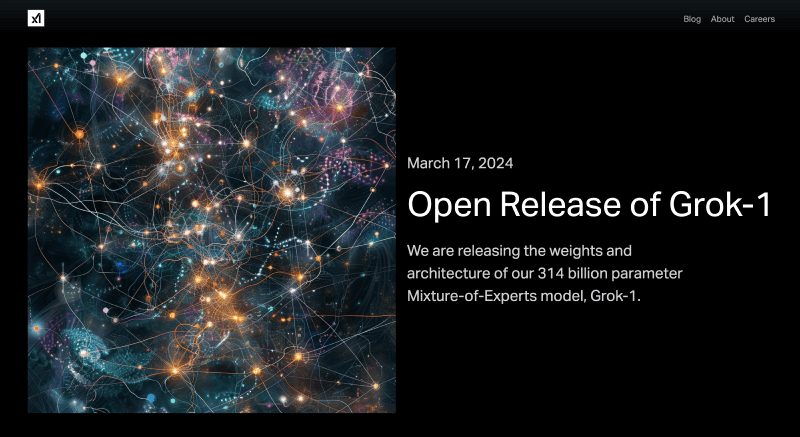
Grok-1 Official Website Entry
- Official Article Introduction:https://x.ai/blog/grok-os
- GitHub Address:https://github.com/xai-org/grok-1
- Hugging Face Address:https://huggingface.co/xai-org/grok-1
- Model Weight Download:
magnet:?xt=urn:btih:5f96d43576e3d386c9ba65b883210a393b68210e&tr=https%3A%2F%2Facademictorrents.com%2Fannounce.php&tr=udp%3A%2F%2Ftracker.coppersurfer.tk%3A6969&tr=udp%3A%2F%2Ftracker.opentrackr.org%3A1337%2Fannounce
Grok-1 Model Information
According to xAI's official model introduction (https://x.ai/model-card/), the information for Grok-1 is as follows:
| Item | Detailed Information |
|---|---|
| Model Details | Grok-1 is a Transformer-based autoregressive model pretrained for next-token prediction. The model was fine-tuned with extensive feedback from humans and the earlier Grok-0 model. The initial version of Grok-1 has a context length of 8192 tokens and was released in November 2023. |
| Intended Use | Grok-1 is intended to be used asGrokthe engine behind a chatbot, for natural language processing tasks including question answering, information retrieval, creative writing, and coding assistance. |
| Limitations | Although Grok-1 performs excellently in information processing, human review of Grok-1's work is needed to ensure accuracy. The Grok-1 language model does not have the ability to search the web independently. When deployed in Grok, search tools and databases enhance the model's capabilities and factuality. Even with access to external information sources, the model may still hallucinate. |
| Training Data | The training data used for the released version of Grok-1 comes from the internet up to the third quarter of 2023 and data provided by xAI's AI trainers. |
| Evaluation | Grok-1 was evaluated on a series of reasoning benchmark tasks and selected foreign math exam questions. xAI has engaged with early alpha testers and evaluated versions of Grok-1, including adversarial testing. xAI is expanding our early adopter base through Grok early access for closed beta testing. |
Technical Details of Grok-1
- Base Model and Training: Grok-1 was trained on a large amount of text data without fine-tuning for any specific task. This means it is a general-purpose language model that can be applied to many different natural language processing tasks. Its training was from scratch, using a custom training stack composed of the JAX library and the Rust language.
- Number of Parameters: Grok-1 has 314 billion parameters, making it the open-source large language model with the largest number of parameters currently. The activation weight of these parameters on a given token is 25%, indicating the scale and complexity of the model.
- Mixture of Experts (MoE): Grok-1 adopts a Mixture of Experts system design, a method that combines multiple expert networks to improve the model's efficiency and performance. In Grok-1, each token selects 2 out of 8 experts for processing.
- Activated Parameters: The number of activated parameters in Grok-1 is 86 billion, which is more than Llama-2's 70B parameters, indicating its potential capability in handling language tasks.
- Embeddings and Positional Embeddings: Grok-1 uses rotary embeddings instead of fixed positional embeddings, which is a method for processing sequence data that can improve the model's ability to handle long texts. The tokenizer vocabulary size is 131,072, similar to GPT-4, and the embedding size is 6,144.
- Transformer layers: The model contains 64 Transformer layers, each of which contains a decoder layer composed of a multi-head attention block and a dense block. The multi-head attention block has 48 heads for queries and 8 heads for keys/values (KV), with a KV size of 128. The dense block (dense feed-forward block) has a widening factor of 8 and a hidden layer size of 32,768.
- Quantization: Grok-1 also provides 8-bit quantized versions of some weights, which helps reduce the model's storage and computational requirements, making it more suitable for running in resource-constrained environments.
- Running requirements: Since Grok-1 is a relatively large model (314B parameters), a machine with sufficient GPU memory is required to run it. It is estimated that a machine with 628GB of GPU memory may be needed (2 bytes per parameter).