
What is GraphReasoning
GraphReasoning is a method based on artificial intelligence technology that converts large numbers of scientific papers into knowledge graphs. Through structured analysis, it calculates node degrees, identifies communities and their connectivity, evaluates the centrality of key nodes, and thereby reveals the architecture of knowledge. The method is based on graph properties such as transitivity and isomorphism to discover novel cross-disciplinary connections, which are used to answer questions, identify knowledge gaps, propose innovative material designs, and predict material behavior. The goal of GraphReasoning is to promote scientific innovation and discovery, reveal hidden connections through graph reasoning, and provide a broad application framework for multidisciplinary research.
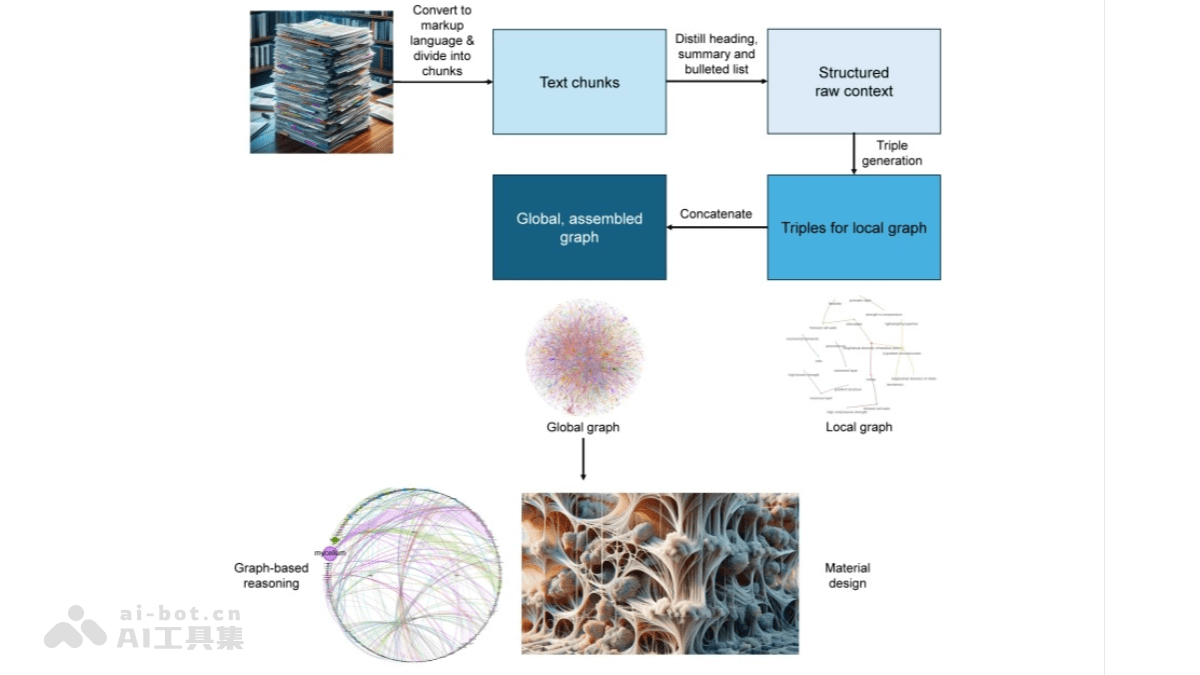
Main Features of GraphReasoning
- Knowledge Graph Construction: Converts large amounts of textual data such as scientific papers into structured knowledge graphs, forming a network of concepts and their relationships.
- Structural Analysis: Conducts in-depth analysis of knowledge graphs, including node degree calculation, community detection, clustering coefficient, and node betweenness centrality evaluation.
- Graph Reasoning: Based on the transitivity and isomorphism properties of graphs, reveals new connections between different disciplines, and is used to answer questions and predict material behavior.
- Multimodal Data Processing: Integrates multiple data modalities such as text, images, and numerical data to provide a more comprehensive analytical perspective.
- Path Sampling Strategy: By computing deep node representations and ranking node similarity, develops path sampling strategies to link different concepts.
- Cross-disciplinary Innovation: Through graph analysis, promotes cross-integration among different disciplinary fields and inspires new scientific discoveries and technological innovations.
- Material Design: Proposes material design schemes based on graph analysis, such as new composite materials for biomaterials and engineering materials.
- Intelligent Query Answering: Answers complex scientific questions based on knowledge graphs, provides research opportunities, and predicts new hypotheses.
- Data Augmentation: Through interaction with large language models, dynamically adds new data to the knowledge graph to discover new knowledge and connections.
- Visualization and Explanation: Provides visual representations of knowledge graphs to help users understand complex data and relationships, and supports explanatory analysis.
Technical Principles of GraphReasoning
- Natural Language Processing (NLP): Understands and analyzes textual data to extract key information.
- Graph Theory: Analyzes and interprets the network structure of nodes and edges in graphs.
- Machine Learning: Identifies patterns and trends in data.
- Reasoning Algorithms: Includes rule-based reasoning and statistical reasoning, used for prediction and decision-making.
- Multimodal Data Fusion: Combines information from different types of data sources to provide more comprehensive analysis.
- Automated Algorithms: Reinforcement learning or genetic algorithms, used to explore graphs without human intervention.
- Knowledge Representation Learning: Captures complex relationships by embedding entities and relations into vector space.
GraphReasoning Project Address
- GitHub Repository:https://github.com/lamm-mit/GraphReasoning
- arXiv Technical Paper:https://arxiv.org/pdf/2403.11996
Application Scenarios of GraphReasoning
- Scientific Research: Researchers use GraphReasoning to explore the intersections of different scientific fields, such as physics, biology, and materials science. Through graph analysis, they discover new research paths and promote interdisciplinary collaboration.
- Drug Discovery: Pharmaceutical R&D companies use GraphReasoning to analyze drug action networks. They predict drug side effects and discover new drug combinations or treatment methods.
- Materials Science: Materials engineers design composite materials with specific properties. Based on graph reasoning, they predict properties of new materials such as mechanical strength and thermal stability.
- Bioinformatics: Bioinformatics researchers study gene expression networks and protein-protein interaction networks. They understand the molecular mechanisms of complex diseases and discover potential biomarkers.
- Education: Educational institutions use GraphReasoning to build knowledge graphs of course content. They provide interactive learning tools to help students understand complex concepts and principles.
- Knowledge Management: Enterprises use GraphReasoning to integrate internal knowledge bases. This improves employees' knowledge retrieval efficiency and promotes knowledge sharing and innovation.