
What is Gradio
Gradio is an open-source Python library that simplifies the process of demonstrating and sharing machine learning models. It enables developers to quickly create user-friendly web interfaces based on simple code, so that anyone, anywhere can easily use machine learning models. Gradio supports a variety of input and output components, such as text, images, audio, etc., and is suitable for demonstrations, teaching, and prototyping. Gradio supports server-side rendering (SSR), making applications load faster in the browser. Gradio provides tighter integration with Hugging Face Spaces, simplifying the process of hosting and sharing models. The experimental AI Playground supports developers in generating and previewing Gradio applications based on natural language prompts, reducing the time and expertise required to create AI applications. The latest version released by Hugging Face, Gradio 5, further improves performance.
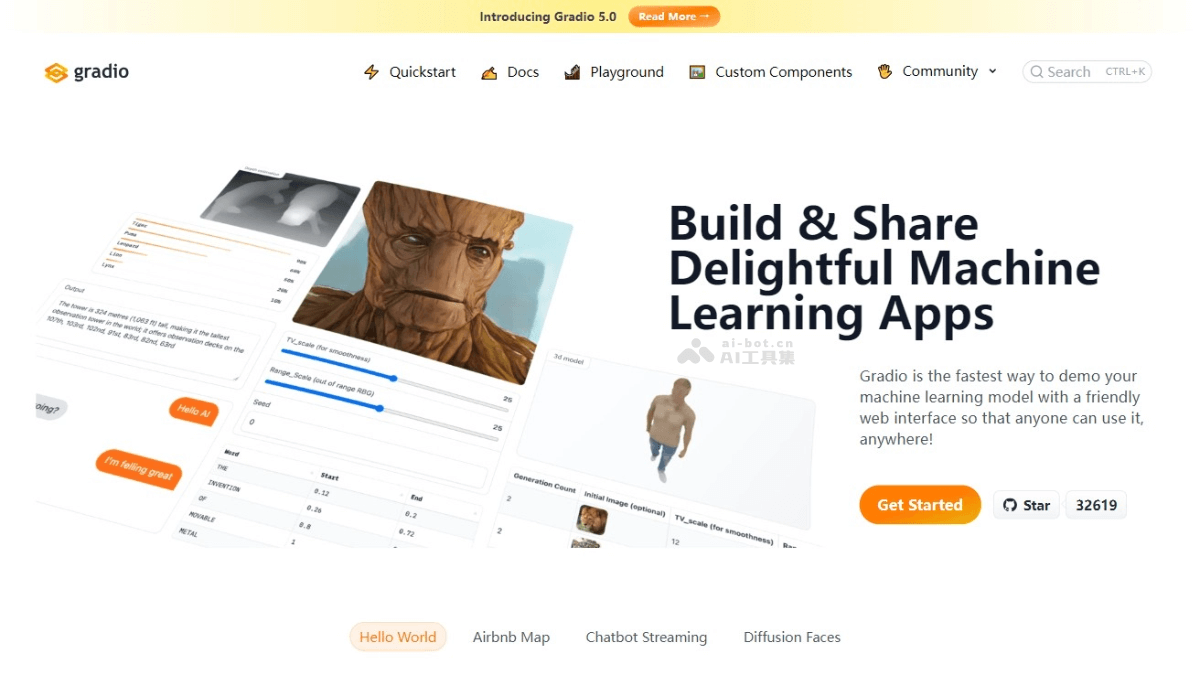
Main features of Gradio
- Rapid prototyping: Quickly create interactive web interfaces for machine learning models.
- Rich input and output components: Supports input and output of multiple data types, such as text, images, audio, etc.
- Real-time interaction: Users can see the model's prediction results in real time.
- Jupyter Notebook integration: Create and display interfaces directly in the Notebook.
- Sharing and remote use: Generate shareable links and support remote interaction.
- Permanent hosting: Host interfaces based on Hugging Face Spaces.
- New features of Gradio 5 include:
- Performance improvements: Through server-side rendering (SSR), Gradio 5 can achieve faster loading speeds and reduce loading delays.
- Interface updates: Gradio 5 updates core components, such as buttons, tabs, sliders, etc., and introduces new built-in themes, making the interface more modern and visually appealing.
- Real-time application support: Gradio 5 supports sending data using websockets and base64 encoding, reducing latency, and supports WebRTC through custom components, making the construction of real-time applications possible.
- Security improvements: Gradio 5 underwent a third-party security audit, and all discovered issues were fixed, ensuring enterprise-level security standards.
- LLM-powered AI Playground: Gradio 5 comes with an experimental AI Playground that supports developers in generating and previewing Gradio applications using natural language prompts, making app building more intuitive and convenient.
Technical principles of Gradio
- Separation of frontend and backend: Gradio uses Flask or FastAPI as the backend, and JavaScript, HTML, and CSS for the frontend, with frontend-backend communication based on HTTP requests.
- Event-driven: Gradio components respond to user events (such as clicks, input, etc.) and trigger the corresponding processing logic.
- Asynchronous communication: Real-time interaction is implemented based on AJAX or WebSocket, allowing content to be updated without reloading the page.
- Security measures:
- Input validation: Ensure that incoming data conforms to the expected format and prevent injection attacks.
- Sandbox environment: Run user code in a restricted environment to prevent the execution of malicious code.
- Server-side rendering (SSR): Generate the complete HTML page on the server side and send it to the client, improving first-screen loading speed.
Gradio project address
- Project official website:gradio.app
- GitHub repository:https://github.com/gradio-app/gradio
- AI Playground :https://www.gradio.app/playground
Gradio application scenarios
- Model demonstration: Developers create an interactive web interface to showcase machine learning models, allowing non-technical users to easily experience the model's functionality.
- Data collection: Based on Gradio applications, researchers can collect data, and the data entered by users can be used to train or evaluate models.
- Education and training: Teachers create interactive learning tools to help students understand complex machine learning concepts.
- Product prototyping: Product managers and designers build product prototypes to validate product concepts and user interface designs.
- Remote work: In remote work environments, support team members in sharing and collaborating on machine learning models.