
What is GPT-SoVITS
GPT-SoVITS is an open-sourcevoice cloning project, launched by Bilibili creator and RVC voice changer founder Hua'er Bu Ku. This speech synthesis tool combines the GPT (Generative Pre-trained Transformer) model and SoVITS (Speech-to-Video Voice Transformation System) voice changer technology, and can achieve high-quality voice cloning and text-to-speech conversion (TTS) with only a small amount of sample data. This tool is especially suitable for scenarios that require rapid generation of a specific human voice, and can help users train a model capable of imitating that speaker's voice (including emotion, timbre, and speaking rate) when there are no or only a few speech samples of the target speaker.
GPT-SoVITS official website entry
- GitHub code repository:https://github.com/RVC-Boss/GPT-SoVITS
- Hugging Face models:https://huggingface.co/lj1995/GPT-SoVITS
- CodeWithGPT AutoDL online experience:https://www.codewithgpu.com/i/RVC-Boss/GPT-SoVITS/GPT-SoVITS-Official
- Google Colab run address:https://colab.research.google.com/github/RVC-Boss/GPT-SoVITS/blob/main/colab_webui.ipynb
- GPT-SoVITS usage guide:https://www.yuque.com/baicaigongchang1145haoyuangong/ib3g1e
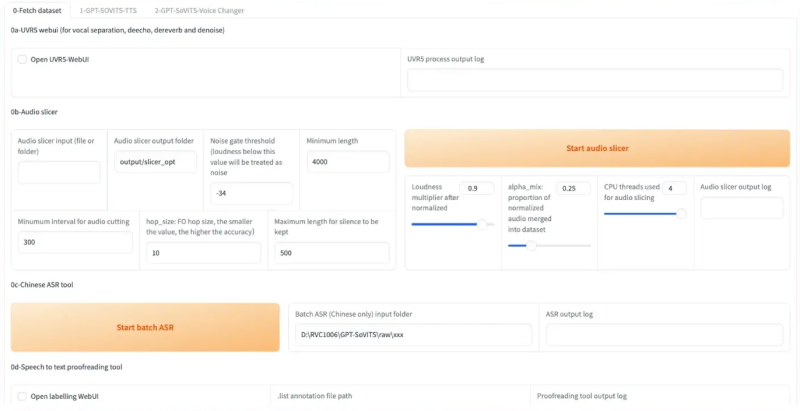
Main features of GPT-SoVITS
- Zero-shot TTS text-to-speech conversion: Users only need to input a 5-second voice sample to achieve instant text-to-speech conversion.
- Few-shot TTS text-to-speech conversion: By using 1 minute of training data, the model can be fine-tuned to improve voice similarity and realism.
- Voice cloning: Through training, GPT-SoVITS can learn and replicate the voice characteristics of a specific speaker, achieving voice cloning to generate synthesized speech extremely similar to the specific speaker's voice.
- Cross-language support: GPT-SoVITS supports speech synthesis in multiple languages, allowing users to use the tool in different language environments. It currently supports English, Japanese, and Chinese.
- WebUI tools: Integrates tools including vocal accompaniment separation, automatic training set segmentation, Chinese ASR (automatic speech recognition), and text annotation, helping beginners create training datasets and GPT/SoVITS models.
Application scenarios of GPT-SoVITS
- Personalized voice assistants: Can create personalized voices for intelligent assistants or chatbots, making them sound more like real people and improving user experience.
- Virtual character dubbing: In games, animation, or virtual reality (VR), generate realistic voices for virtual characters, achieving character voice performance without professional voice actors.
- Audiobook production: Convert text content into speech, providing high-quality reading services for audiobooks, podcasts, or educational materials.
- Accessibility services: Provide text-to-speech services for visually impaired people or people with reading difficulties, helping them better access information.