
What is GPT-Rosalind
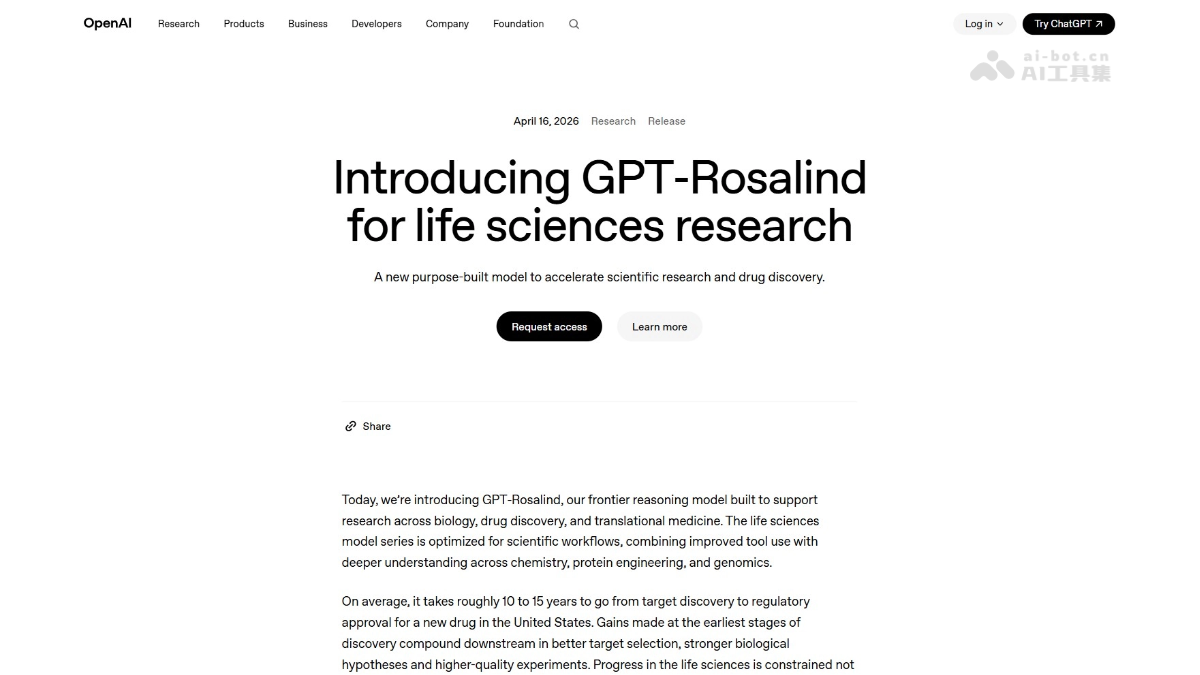
GPT-Rosalind is a reasoning model dedicated to life sciences launched by OpenAI, named after Rosalind Franklin, the discoverer of the DNA double helix structure. The model is deeply tuned for 50 biological workflows, possesses capabilities in hypothesis generation, experimental design, and evidence synthesis, can integrate more than 50 scientific databases, and surpasses 95% of human experts in tasks such as RNA function prediction. Through critical thinking tuning that reduces the tendency toward "sycophancy," the model's hallucination rate is 40% lower than that of general-purpose models. It is currently open to enterprises and academic institutions through a controlled access program to accelerate drug discovery and translational medicine research.
GPT-Rosalind's main features
- Evidence synthesis and hypothesis generation: Automatically integrates massive scientific literature, genomic data, and experimental results to accelerate hypothesis formulation in the early research stage.
- Experimental design and planning: Supports multi-step research tasks, assists in designing molecular cloning protocols, predicting RNA sequence functions, and other complex experimental workflows.
- Protein and molecular reasoning: Based on known pathways and regulatory mechanisms, infers protein structural and functional properties, connecting genotype and phenotype.
- Intelligent literature and database querying: Can access more than 50 scientific tools and public databases (such as protein structure repositories), and retrieve the latest scientific papers in real time
- Drug target screening and prioritization: Through mechanistic biological understanding, identifies and evaluates the feasibility of potential therapeutic targets.
-
Life Sciences Research plugin: Builds a practical execution layer for reproducible scientific workflows, integrating source evidence retrieval and biological interpretation into the same workspace, helping researchers connect external evidence with internal omics analysis.
-
Integrated GPT-5.5 capabilities: Newly integrates GPT-5.5's agentic coding and tool use capabilities, achieving stronger model intelligence in core drug discovery areas such as medicinal chemistry and genomics.
GPT-Rosalind's technical principles
- Domain-specific architecture optimization: GPT-Rosalind is built on OpenAI's frontier internal model architecture. It is not simple fine-tuning, but rather deep optimization for the 50 most common biological workflows, covering tasks such as literature review, sequence manipulation, and protocol design, giving the model professional capabilities for handling complex reasoning in chemistry, protein engineering, and genomics.
- Tool augmentation and orchestration mechanism: The model achieves enhanced tool use capabilities through the "Life Sciences Codex plugin." As an orchestration layer, this plugin can connect more than 50 public multi-omics databases and biological tools (such as AlphaFold and UniProt), support automatic selection and invocation of appropriate resources in broad and ambiguous research questions, and enable knowledge integration and parallel analysis across fields such as human genetics, functional genomics, and protein structure.
- Specialized evaluation and validation system: The model undergoes rigorous evaluation on the BixBench bioinformatics benchmark and the LABBench2 research task set, covering core reasoning capabilities such as chemical reaction mechanisms, protein structure mutation effects, and phylogenetic interpretation; independent validation in collaboration with Dyno Therapeutics shows that it surpasses 95% of human experts in RNA sequence function prediction tasks, verifying the model's reliability and professional depth in actual biological research workflows.
Key information and usage requirements for GPT-Rosalind
- Access restrictions: Currently open to security-vetted enterprise customers and academic institutions in the United States (such as Amgen, Moderna, the Allen Institute, Thermo Fisher, etc.); access requires going through a qualification application and security review process.
- Cost Policy: During the research preview phase, model usage does not consume existing API credits or quotas, and the abuse protection terms must be followed; formal pricing will be announced after the project expands.
- Security Requirements: Participating institutions must maintain strict biosafety anti-abuse controls, have clear governance and compliance mechanisms, grant access only to authorized users in secure and controllable environments, and agree to comply with the life sciences research preview terms.
- Human Verification: OpenAI explicitly emphasizes that the model is only used to assist analysis; all experimental decisions must undergo human expert judgment and real-world verification, and the model must not replace professional scientific judgment.
- Usage Principles: Access evaluation is based on three core principles—beneficial use (conducting life sciences research with clear public benefit), strong governance and safety oversight, and controlled access with enterprise-grade security.
Core Advantages of GPT-Rosalind
-
Depth of Professional Reasoning: Achieves leading performance on the BixBench bioinformatics benchmark and surpasses 95% of human experts on Dyno Therapeutics' RNA sequence function prediction task.
-
Workflow Integration: Surpasses GPT-5.4 on 6 of 11 tasks in LABBench2, with particularly strong performance on the CloningQA molecular cloning protocol design task.
-
Tool Ecosystem: Seamlessly connects to more than 50 public multi-omics databases and biological tools through open-source plugins, covering core resources such as AlphaFold, UniProt, Bgee, and BindingDB.
-
Efficiency Improvement: Partner feedback shows that the model can significantly compress literature review cycles and accelerate the early drug discovery stage.
-
Enterprise-Grade Security: Equipped with strict enterprise-grade access management and security controls to ensure safe use in regulated research environments.
GPT-Rosalind Project Address
- Project Official Website:https://openai.com/index/introducing-gpt-rosalind/
Comparison of GPT-Rosalind with Similar Competitors
| Dimension | GPT-Rosalind | DeepMind AlphaFold | General-purpose large models (such asGPT-4) |
|---|---|---|---|
| Positioning | Full-process reasoning and assistance for the life sciences | Dedicated tool for protein structure prediction | General-purpose natural language processing |
| Core Capabilities | Hypothesis generation, experiment planning, evidence synthesis, tool invocation | High-precision 3D protein structure prediction | Broad language understanding and generation |
| Data Foundation | 50 biological workflows + 50+ scientific databases | Protein structure database (PDB) | General internet text |
| Reasoning Depth | Surpasses 95% of human experts (RNA prediction task) | Close to experimental resolution accuracy | Shallow coverage of biological knowledge |
| Access Method | Controlled access (Trusted Access Program) | Open source/open API | Public API |
| Tool Integration | Built-in ecosystem of 50+ scientific tool plugins | Standalone prediction tool, requires external integration | No professional tool integration |
| Workflow | Supports multi-step complex research task orchestration | Single-step structure prediction | General dialogue interaction |
| Biosecurity | Strict access control and security review | Open source and available | General content filtering |
| Collaboration attributes | Research partner (human-AI collaboration design) | Predictive tool | General assistant |
Application scenarios of GPT-Rosalind
-
Early drug discovery: Assists with target identification and validation, accelerating the translation process from target discovery to drug candidates.
-
Protein engineering: Predicts the relationship between protein structure and function, guiding protein design and optimization.
-
Gene therapy research: Supports RNA sequence function prediction and generation, aiding gene therapy vector design.
-
Multi-omics data analysis: Integrates multi-level data such as genomics, transcriptomics, and proteomics to discover disease-related biological patterns.
-
Literature review and knowledge discovery: Automates the integration of fragmented professional knowledge across subfields, accelerating systematic reviews.
-
Experimental protocol design: Assists in designing complex experimental plans such as molecular cloning and sequence manipulation, improving experimental success rates.