
What is gpt-realtime
gpt-realtime is OpenAI's latest advanced voice model, designed for real-world tasks. The model can generate high-quality, natural speech, supports multiple languages and voice styles, can understand non-verbal cues, and can adjust its tone according to the scenario. Through the Realtime API, the model supports image input and can hold conversations based on image content. gpt-realtime has significant improvements in instruction following and function calling, and is suitable for scenarios such as customer service, education, finance, and healthcare, bringing a smarter and more flexible experience to voice interaction.
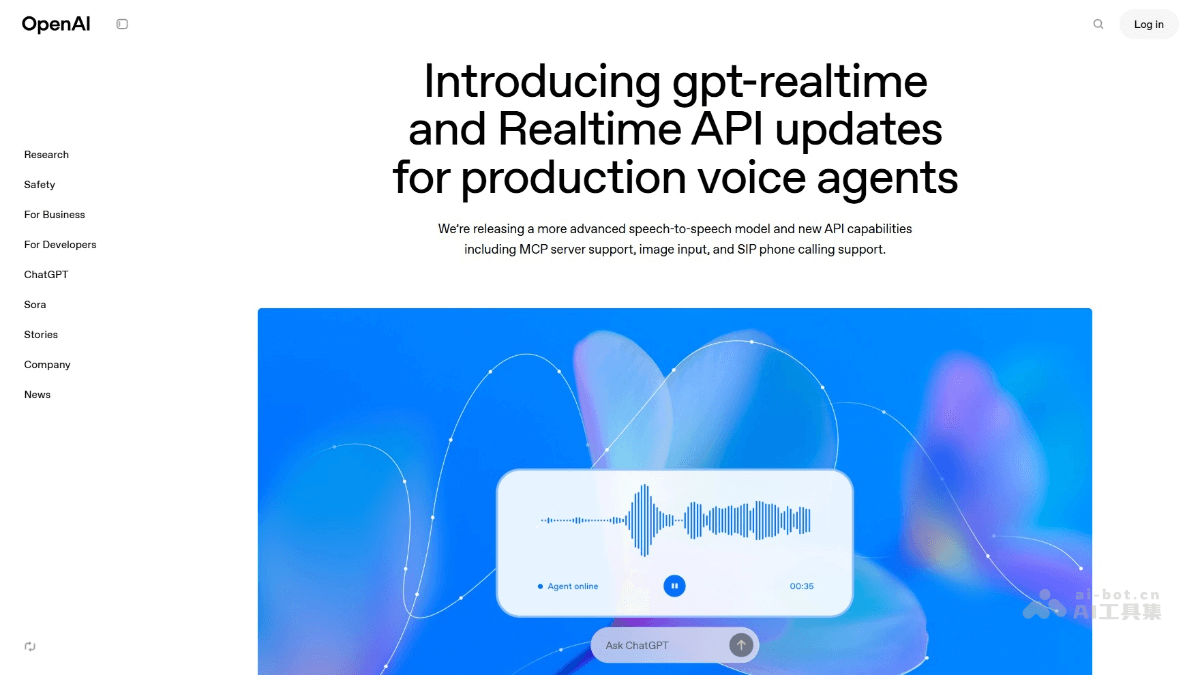
Main features of gpt-realtime
- High-quality voice generation: gpt-realtime can generate more natural, higher-quality speech, and supports multiple languages and voice styles, such as "speak quickly and professionally" or "speak compassionately with a French accent."
- Voice understanding and interaction: The model can understand native audio, accurately capture non-verbal cues (such as laughter), switch languages mid-sentence, and adjust its tone according to the scenario.
- Instruction following capability: The model performs excellently in following instructions, with instruction-following accuracy increasing from 20.6% in the old model to 30.5%.
- Function calling optimization: Comprehensive optimization was carried out across three key dimensions: calling relevant functions, timing the calls appropriately, and selecting suitable parameters to call functions. The test score soared from 49.7% in the old model to 66.5%.
- Supports image input: Through the Realtime API, developers can add images, photos, and screenshots to a session, enabling the model to hold conversations based on what the user actually sees.
- Multilingual support: In multilingual environments, the model's accuracy in detecting alphanumeric sequences is greatly improved, and its accuracy in reasoning ability tests reaches 82.8%.
Technical principles of gpt-realtime
- Single-model processing: Unlike traditional voice processing pipelines, gpt-realtime directly processes and generates audio through a single model, reducing latency, preserving subtle nuances in speech, and generating more natural and expressive responses.
- Deep learning and training: The model is trained in close collaboration with customers, focusing on real-world tasks such as customer service, personal assistants, and education, ensuring that the model can better adapt to the way developers build and deploy voice agents.
- Multi-dimensional optimization: Optimization is carried out across multiple dimensions such as voice quality, intelligence, instruction following, and function calling, improving the model architecture and training methods to enhance the model's performance in various real-world scenarios.
- Asynchronous function calling: Improved asynchronous function calling so that long-running function calls do not interrupt the session flow, and the model continues smooth conversation while waiting for results.
Project address of gpt-realtime
- Project official website:https://openai.com/index/introducing-gpt-realtime/
Application scenarios of gpt-realtime
- Customer service: Integrated into customer service centers to provide real-time solutions and improve customer service efficiency and customer satisfaction.
- Education: Helps students practice language pronunciation and expression, provides real-time feedback and correction, and improves language learning outcomes.
- Personal assistant: Integrated into smart speakers or smartphones to provide users with services such as schedule management, information queries, and device control.
- Healthcare: Doctors record medical records in real time, improving work efficiency and reducing time spent on manual input.
- Entertainment: Used to develop voice-interactive games, providing a more immersive gaming experience, where players can interact with game characters through voice.