
What is GPT-Realtime-2.1
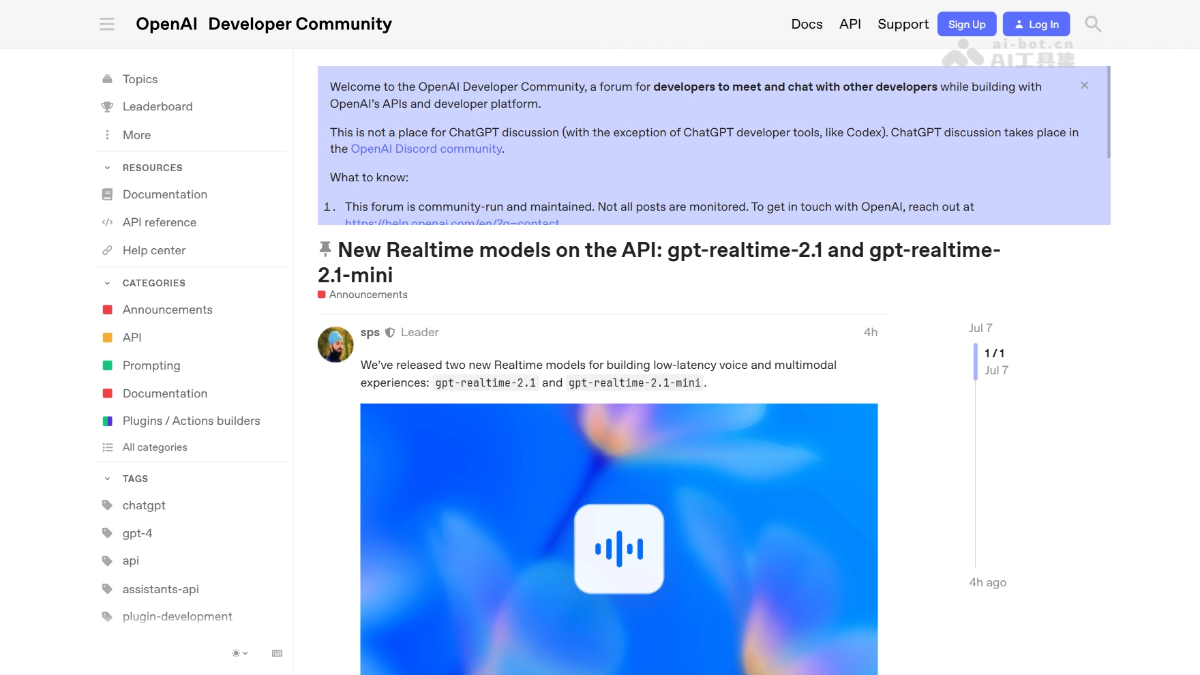
GPT-Realtime-2.1 is OpenAI's new generation real-time speech model. The 2.1 flagship version significantly improves alphanumeric recognition, silence/noise handling, and interruption response capabilities. It supports speech, text, and image inputs, and features powerful reasoning, instruction following, and tool calling capabilities, designed specifically for complex voice agent workflows.GPT-Realtime-2.1-mini Focused on high cost-effectiveness, it optimizes response speed and cost while retaining reasoning and tool calling capabilities, suitable for high-frequency, low-latency scenarios such as customer service assistants. Both achieve a 25% latency reduction through caching improvements, and developers can flexibly choose according to their needs.
Main Features of GPT-Realtime-2.1
- Multimodal Interaction: Supportsspeech, text, and imageinputs, enabling low-latency speech-to-speech conversations.
- Advanced Agent Capabilities: Features powerfulreasoning, instruction following, and tool callingcapabilities, capable of handling complex multi-step tasks.
- Enhanced Recognition and Response: Significantly improvesalphanumeric recognition(such as reading verification codes),silence/noise handling, and can handle conversationinterruptions。
- Configurable Reasoning: Developers can adjust the model'sreasoning intensity, balancing response speed and answer quality.
Technical Principles of GPT-Realtime-2.1
- Native Audio Modeling: As an end-to-end model, it directly processes audio tokens, avoiding the information loss and latency caused by speech-to-text then text-to-speech, preserving rich information such as tone and emotion.
- Unified Architecture and Caching: Based on the Transformer architecture, it uses a unified tokenization approach to process text, audio, and images. At the same time,an improved context caching mechanismtemporarily stores core data, significantly improving response speed and reducing p95 latency by at least 25%.
- Reinforcement Learning Alignment: Optimized through reinforcement learning based on human feedback, making the model's output more compliant with instructions and its behavior more controllable.
How to Use GPT-Realtime-2.1
- Prepare the Environment: Install the OpenAI Python library and set up the API key.
- Establish a Connection: Through the WebSocket or WebRTC protocol, use the model ID
gpt-realtime-2.1to create a real-time session. - Configure the Session: Set parameters such as audio format and speech-to-text model according to requirements, and register external tools for the model to call.
- Send Input: Send text, audio data chunks (PCM format), or image URL/base64 data to the session.
- Process Responses: Listen for and process streaming events returned by the model, such as text deltas, audio deltas, or tool call requests.
- Execute Tools: When a tool call request is received, execute the corresponding function and return the result to the model to continue the conversation.
Core Advantages of GPT-Realtime-2.1
- Top-Tier Real-Time Reasoning and Agent Capabilities: As a flagship model, it possesses the strongest currently availablereal-time reasoning, instruction following, and tool callingcapabilities, enabling it to autonomously complete complex multi-step tasks, making it an ideal choice for building advanced voice agents.
- Significantly reduced response latency: Through improved caching mechanisms, its p95 latency is reduced by at least 25%, ensuring a smoother and more natural real-time conversation experience.
- Enhanced audio recognition and processing: Inalphanumeric recognition(such as reading verification codes),silence/noise handling, andconversation interruption responsethere are significant improvements, making interactions more precise and intelligent.
- Unified multimodal architecture: As an end-to-end model, it natively supportsspeech, text, and imageinputs, directly processes audio tokens, fully preserves rich information such as tone and emotion, and avoids the information loss of traditional cascaded solutions.
Project address of GPT-Realtime-2.1
- Project official website:https://community.openai.com/t/new-realtime-models-on-the-api-gpt-realtime-2-1-and-gpt-realtime-2-1-mini/1385896
Comparison of GPT-Realtime-2.1 with similar competitors
| Comparison dimension | GPT-Realtime-2.1 | Google Gemini 2.0 Flash (Realtime) | Amazon Nova Pro (Realtime) |
|---|---|---|---|
| Core advantages | Powerfulreasoning and tool callingcapabilities, suitable for complex agent tasks | Multimodal understanding and deep integration with the Google ecosystem | Cost optimization, deep integration with AWS services |
| Latency | p95 latency reduced by 25% (caching optimization) | Low latency, but may increase during complex reasoning | Well optimized, suitable for large-scale deployment |
| Multimodal | Supportsspeech, text, and imageinput | Native multimodal, supports video streams | Supports text, images, and audio |
| Pricing (audio input/output) | $32 / $64 per million tokens | Usually billed by characters or audio duration | Consistent with the AWS pricing model, competitive |
| Ecosystem and integration | OpenAI API ecosystem | Google Cloud ecosystem | AWS ecosystem (SageMaker, Bedrock, etc.) |
| Applicable scenarios | Complex voice agents, automated workflows | Search, multimodal interaction, Google service integration | Enterprise-level large-scale deployment, AWS users |
Application scenarios of GPT-Realtime-2.1
- Complex voice agents: Build voice assistants that can autonomously complete multi-step tasks, such asvoice ticket booking, intelligent customer service, capable of calling multiple tools during conversations and handling interruptions.
- Automated customer service: Incustomer service hotlines, call centers, it can accurately recognize alphanumeric characters, understand user intent, and autonomously call knowledge bases or order systems to resolve issues.
- Real-time voice translation and transcription: With enhanced audio processing capabilities, inInternational conferences, real-time subtitlesand other scenarios provide low-latency, high-precision speech translation and transcription services.
- Education and training: as anAI tutorfor voice-interactive teaching, invoking the knowledge base based on student questions, and analyzing handwritten problems or diagrams through the image input function.