
What is GPT-5-Codex
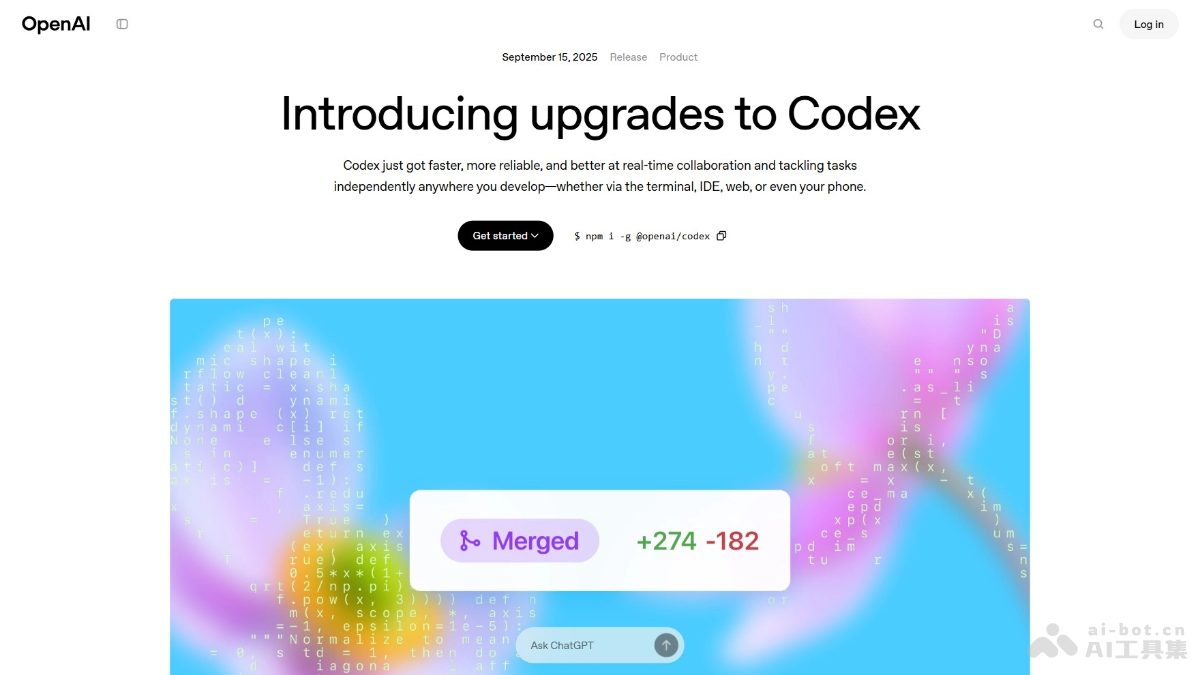
GPT-5-Codex is a model launched by OpenAI specifically optimized forprogramming, based on GPT-5 further enhanced. The model focuses on real-world software engineering tasks, such as building projects from scratch, code refactoring, debugging, testing, and code review. The model can dynamically adjust its thinking time based on task complexity, responding instantly to simple tasks and thinking deeply for complex tasks, and can independently complete complex tasks lasting up to 7 hours. The model has excellent code review capabilities, can accurately identify critical defects, and reduce ineffective comments. GPT-5-Codex supports multimodal input, can view images or screenshots in the cloud and display work results, making it a powerful programming assistant for developers.
GPT-5-Codex-Mini is OpenAI's newly launched cost-effective AI programming model, a compact version of GPT-5-Codex, with a smaller model size and lower cost, suitable for lightweight programming tasks. The model has strong programming capabilities and can handle tasks such as basic code generation and feature addition. The model is currently available in the CLI and IDE extensions, providing developers with a more flexible, low-cost option.
Main Features of GPT-5-Codex
-
Code Generation and Optimization: Quickly generate high-quality code based on natural language descriptions, support multiple programming languages, and optimize existing code to improve performance.
-
Code Review: Supports automatically discovering critical defects and potential issues in code, and provides detailed review reports to help developers quickly locate and fix them.
-
Interactive Programming: Quickly responds to simple tasks in interactive sessions, while also independently handling complex tasks such as large-scale refactoring, continuously working for more than 7 hours.
-
Multimodal Input: Supports image input for front-end design and UI tasks, and can display screenshots of work progress to provide intuitive feedback.
-
Integration and Extension: Seamlessly integrates into development environments such as VS Code, GitHub, and ChatGPT, and supports external tool calls such as web search to improve development efficiency.
Performance of GPT-5-Codex
-
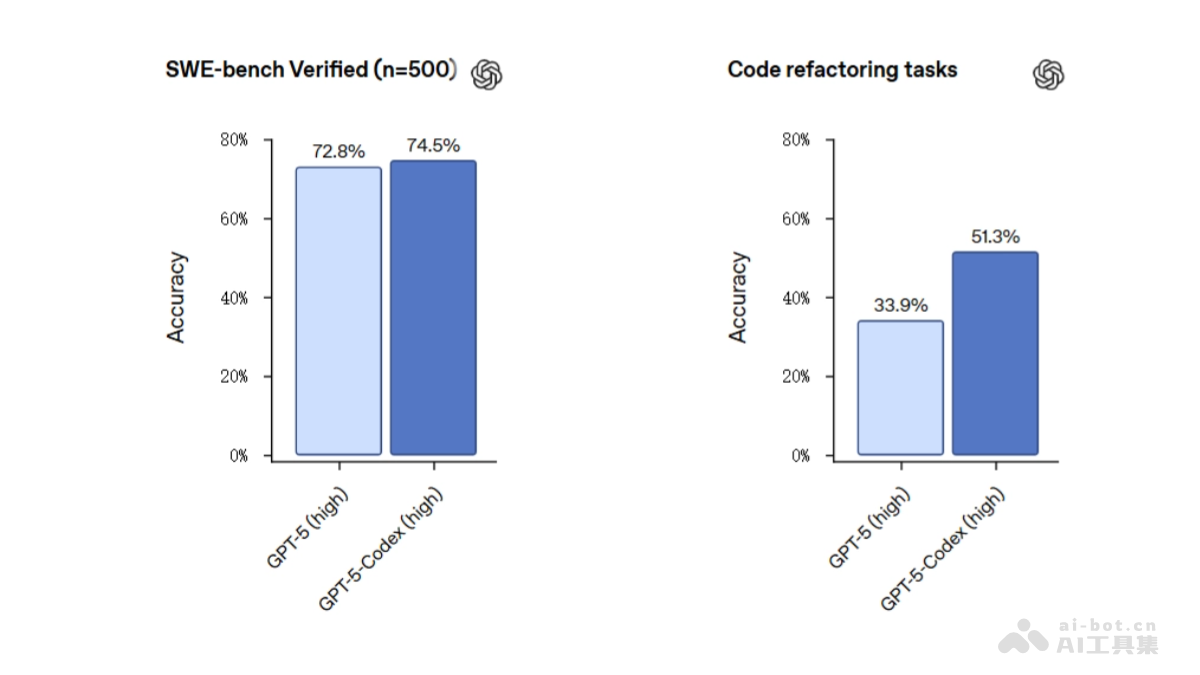
Code Generation and Optimization: In the SWE-bench Verified benchmark test, GPT-5-Codex achieved an accuracy of 74.5%, higher than GPT-5's 72.8%, and on code refactoring tasks, accuracy increased from GPT-5's 33.9% to 51.3%.
-
Dynamic Thinking Time: GPT-5-Codex can dynamically adjust computing resources based on task complexity. Token usage for simple tasks is reduced by 93.7% compared with GPT-5, while token usage for complex tasks increases by 102.2%. It can work independently for more than 7 hours to handle complex tasks.
-
Code Review Capability: GPT-5-Codex has an erroneous comment rate of only 4.4%, with high-impact comments accounting for 52.4%. The average number of comments per PR drops from 1.32 in GPT-5 to 0.93, effectively identifying critical defects and reducing ineffective comments.
-
Multimodal Processing: Supports image input for front-end design and UI tasks, and can display screenshots of work progress to provide intuitive feedback, improving the development experience.
-
Integration and Extension: Supports seamless integration into development environments such as VS Code, GitHub, and ChatGPT. Through container caching technology, the median completion time for new tasks and subsequent tasks is shortened by 90%, improving development efficiency.
Core Advantages of GPT-5-Codex
-
Optimization Direction: GPT-5-Codex is a version of GPT-5 further optimized for agentic coding in Codex, with training focused on real-world software engineering work, including complex tasks such as building complete projects from scratch, adding features and tests, debugging, performing large-scale refactoring, and conducting code reviews.
-
Dynamic thinking time: Automatically determines how much compute to invest based on task complexity. For the simplest 10% of tasks, it reduces token usage by 93.7% compared with GPT-5; for the most complex 10% of tasks, it spends twice as much time reasoning, editing, testing, and iterating, and can work independently for more than 7 hours on large, complex tasks.
-
Code review capabilities: Specifically trained for code review and finding critical defects, it navigates the codebase, reasons about dependencies, and runs code and tests to verify correctness. In evaluations, the erroneous comment rate is only 4.4% (GPT-5: 13.7%), high-impact comments account for 52.4% (GPT-5: 39.4%), and there are an average of 0.93 comments per PR (GPT-5: 1.32 comments).
-
Frontend task performance: Shows significant improvement in human preference evaluations when creating mobile websites. When working in the cloud, it supports viewing user-provided image or screenshot input, visually inspecting progress, and showing users screenshots of its work.
Shortcomings of GPT-5-Codex
-
Picky about tasks: It has certain limits on the scope and reasonableness of tasks, and will directly refuse overly complex tasks.
-
Troublesome environment setup: During setup, it may make incorrect assumptions about the user's development environment, leading to the need to manually reconfigure system files and environment settings, increasing preparation work before use.
-
Multi-agent workflow issues: Although it understands the concept of multiple agents, it does not have true sub-agents and cannot automatically keep moving forward in long-term research tasks like Claude Code.
Project address of GPT-5-Codex
- Project official website:https://openai.com/index/introducing-upgrades-to-codex/
Application scenarios of GPT-5-Codex
-
Full software development process: Building complete projects from scratch, including complex tasks such as code implementation after requirements analysis, feature addition, test writing, debugging, and large-scale code refactoring.
-
Code review stage: Automatically performs reviews before code goes live, discovers critical vulnerabilities and potential issues, and helps teams improve code quality and development efficiency.
-
Interactive programming collaboration: Works with developers in interactive sessions, quickly responding to simple tasks while also independently handling complex tasks that require long periods of thought, such as large-scale refactoring.
-
Frontend design and development: Supports image input for frontend design and UI tasks, can view design mockups or screenshots provided by users, generate corresponding code, and show screenshots of work progress.