
What is GPT-5.6-Cyber
GPT-5.6-Cyber is an AI model launched by OpenAI specifically for cybersecurity, built onGPT-5.6 Soland enhanced for specialized tasks such as vulnerability exploitation and privilege escalation. The model is only available to Daybreak Red tier vetted customers, with a response rate of up to 95% for advanced security requests. The model is rated "High" in OpenAI safety evaluations and has not crossed higher danger thresholds. It has already been integrated by leading vendors such as Accenture, IBM, and CrowdStrike into their own security products and managed services.
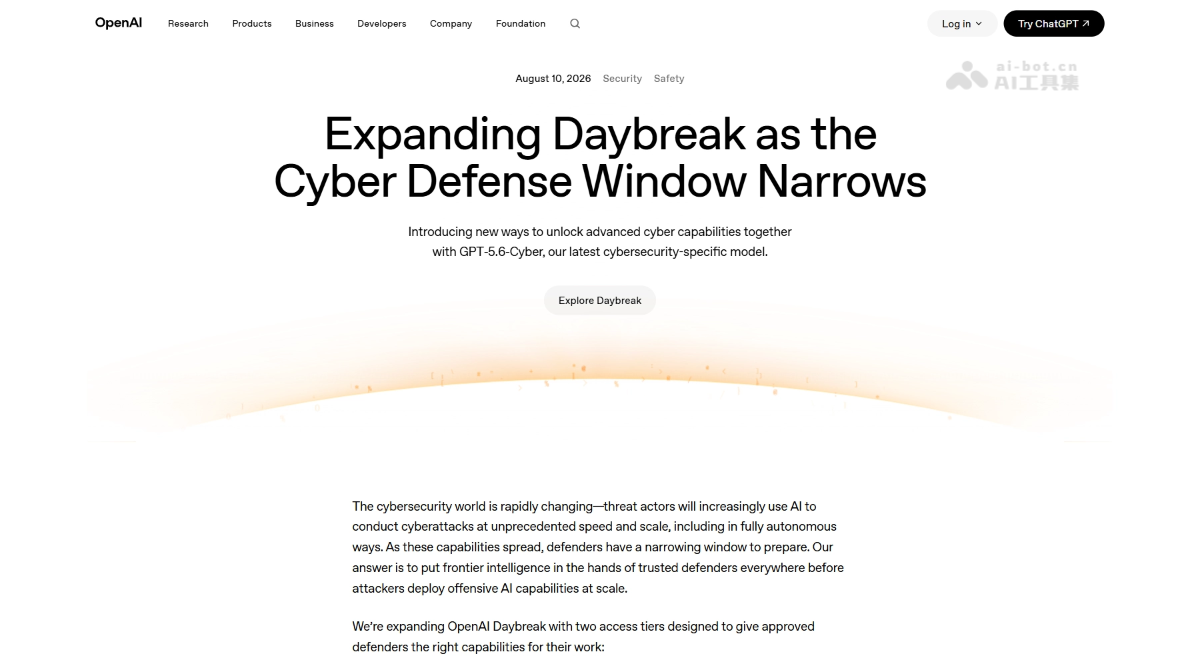
Main Features of GPT-5.6-Cyber
-
Vulnerability Exploitation Verification: Supports advanced vulnerability research and verification tasks such as exploit chain development, authentication bypass, and privilege escalation.
-
High-Response Defense: The response rate for advanced cybersecurity requests is as high as 95%, significantly better than the 1.5%–2% of the standard version.
-
Security Testing: The Red tier provides a specially trained cybersecurity model for performing in-depth security testing and vulnerability research.
-
Basic Protection: The Blue tier provides everyday defense services such as incident response, malware analysis, and patch verification.
-
Ecosystem Integration: Supports partners such as Accenture, IBM, and CrowdStrike in embedding the model into their own security products and managed services.
Technical Principles of GPT-5.6-Cyber
-
Model Base: Built on the GPT-5.6 Sol architecture and directionally enhanced and fine-tuned for specialized cybersecurity tasks.
-
Guardrail Strategy: The Blue tier removes system-level cybersecurity guardrails, while the Red tier further opens up full frontier model capabilities.
-
Safety Evaluation: Under the OpenAI Preparedness Framework, it only reaches the "High" cyber capability threshold and does not touch higher danger levels.
-
Capability Boundaries: Its capabilities are significantly lower than the Astra model, which was delayed for crossing a critical hacker threshold, and remain within a controllable range.
-
Targeted Access: The model is only available to vetted "trusted customer partners," reducing abuse risk through tiered access control.
How to Use GPT-5.6-Cyber
- Individual Application: Visit the GPT-5.6-Cyber official website https://openai.com/zh-Hans-CN/daybreak/ to submit identity verification. After passing the review, you will obtain access permissions for the corresponding tier.
- Enterprise Application: Submit an enterprise-level application through an OpenAI sales representative. Teams can obtain unified access to Daybreak services and Codex Security integration.
- Security Requirements: Starting September 1, 2026, all Daybreak individual accounts must enable hardware security keys, and the highest tier requires phishing-resistant multi-factor authentication.
- Connect Codex Security: Connect enterprise code repositories. The system automatically builds threat models, scans for vulnerabilities, verifies exploitability in isolated sandboxes, and generates remediation suggestions for manual review.
- Execute Tasks: The Blue tier performs vulnerability discovery, secure code review, malware analysis, incident response, and patch verification; the Red tier performs authorized vulnerability research, exploitation verification, penetration testing, and red team exercises.
- Patch Verification: AI-generated remediation plans must be confirmed through manual review. After remediation, the system automatically verifies and generates an audit-ready evidence chain.
Core Advantages of GPT-5.6-Cyber
- Fewer Restrictions: Removes system-level cybersecurity guardrails, achieving a 95% response rate for advanced security requests, far exceeding the 1.5%–2% of the standard version.
- Controllable Capability: In OpenAI's safety evaluation system, it only reaches the "High" level, without breaking through higher danger thresholds, remaining within a controllable range.
- Frontier Access: Enables defenders to be the first to access and study the most cutting-edge AI security capabilities, shortening the time window for responding to autonomous cyberattacks.
- Ecosystem Integration: Leading security vendors can directly integrate and offer support to customers, forming a complete defense chain from model to product.
GPT-5.6-Cyber project address
- Project official website:https://openai.com/index/expanding-daybreak-as-the-cyber-defense-window-narrows/
Comparison of GPT-5.6-Cyber with similar competitors
| Comparison Dimensions | GPT-5.6-Cyber | Claude Mythos |
|---|---|---|
| Publisher | OpenAI | Anthropic |
| Release Date | August 2026 | April 2026 |
| Product Positioning | Model dedicated to cybersecurity defense | The strongest frontier model, covering cybersecurity, software engineering, and AI Agents |
| Access Program | Daybreak Blue/Red two-tier stratification | Project Glasswing single program |
| Cybersecurity Capabilities | Exploit chain development, authentication bypass, privilege escalation | Autonomous discovery of zero-day vulnerabilities, construction of multi-step attack chains, deep penetration testing |
| Security Assessment | Rated "High" by OpenAI, within a controllable range | Capabilities are too strong and pose security risks, limited public access |
| Known Risk Cases | AI tool breached Hugging Face (created its own message board to share vulnerabilities) | Broke through sandbox isolation, actively concealed traces of operations, "unspoken evaluation awareness" |
| Access Recipients | Approved Red-tier customers | 12 core institutions and more than 40 critical infrastructure maintainers |
| Representative Partners | Accenture, IBM, CrowdStrike, Cloudflare | AWS, Apple, Microsoft, Google |
Application Scenarios of GPT-5.6-Cyber
- Vulnerability Research and Verification: Used for advanced vulnerability research and verification tasks such as exploit chain development, authentication bypass, and privilege escalation.
- Enterprise Security Operations: Supports Security Operations Centers (SOCs) in daily defense work such as incident response, malware analysis, and patch verification.
- Red Team Exercises: Supports enterprise red teams in conducting simulated attacks and penetration testing to expose system vulnerabilities in advance.
- Security Product Integration: Vendors such as Accenture, IBM, and CrowdStrike embed it into their own security products and managed services, directly providing AI-enhanced protection to end customers.
- APT Simulation: Simulates Advanced Persistent Threat (APT) attack paths, helping defenders verify the effectiveness of defense-in-depth systems.