
What is GPT-5.5-Cyber
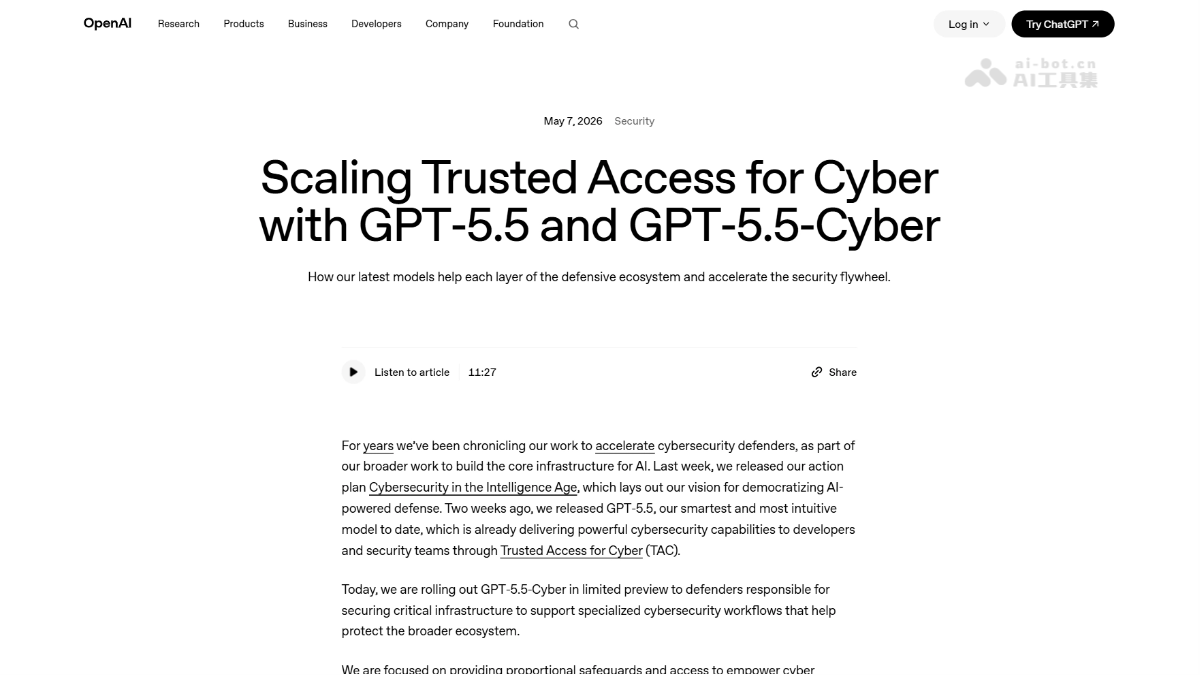
GPT-5.5-Cyber is a cybersecurity-specific model launched by OpenAI, offering a limited preview to authenticated defenders. The model is built on GPT-5.5 and lowers security restrictions through a Trusted Access for Cyber framework, supporting professional defensive workflows such as vulnerability validation, malware analysis, and red teaming, while retaining protections against malicious behavior, accelerating security protection for critical infrastructure and ecosystems.
The full-power GPT-5.5-Cyber tops the security benchmark leaderboard with a CyberGym score of 85.6%, surpassing Claude Mythos 5.
Main features of GPT-5.5-Cyber
-
Vulnerability identification and classification: Helps analyze CVE vulnerabilities, validate remediation plans, and generate security proofs of concept.
-
Malware analysis: Supports binary reverse engineering, malicious code detection, and behavioral analysis.
-
Detection engineering: Assists in writing security detection rules, SIEM/EDR alert logic, and response procedures.
-
Patch validation: Tests vulnerability remediation effectiveness in authorized environments and generates remediation documentation.
-
Red teaming and penetration testing: Executes higher-risk offensive and defensive validation in controlled environments.
-
Supply chain security: Inspects dependency changes, identifies suspicious package behavior, and prevents risky code from entering production environments.
Technical principles of GPT-5.5-Cyber
-
Based on the GPT-5.5 architecture: Inherits GPT-5.5's multi-step reasoning and tool-calling capabilities, delivering the strongest performance on cybersecurity tasks.
-
TAC trust framework: Screens trusted users through identity verification, organizational certification, and anti-phishing account security.
-
Tiered permission control: GPT-5.5 with TAC is aimed at most defenders, reducing classifier refusal rates; GPT-5.5-Cyber is aimed at a small number of high-privilege partners, supporting more permissive dual-use workflows, but its capabilities are not necessarily comprehensively superior to the former. The core difference is in permitted behavior, not the capability ceiling.
-
Continuous monitoring and feedback: Works with partners (Cisco, Intel, SentinelOne, Snyk, etc.) on misuse monitoring, scope-of-use restrictions, and iterative deployment.
How to use GPT-5.5-Cyber
-
Visit the application page: Visit the GPT-5.5-Cyber model official website https://chatgpt.com/cyber to submit a Trusted Access for Cyber (TAC) application.
-
Complete identity verification: Pass OpenAI's identity review process to prove you are a security professional or researcher engaged in legitimate defensive work.
-
Enable advanced account security: Enable advanced anti-phishing security protection for your account (such as a hardware key or passkey).
-
Start using GPT-5.5 with TAC: After approval, you can get defensive workflow support with reduced security restrictions on existing models.
-
Apply for the GPT-5.5-Cyber preview: If you need to perform higher-privilege tasks such as red teaming and PoC validation, you must additionally apply for limited preview eligibility.
Key information and usage requirements for GPT-5.5-Cyber
- Product name:GPT-5.5-Cyber
- Development team:OpenAI
- Release date: May 2026 (limited preview stage)
- Access method
-
Individual users: Go to https://chatgpt.com/cyber完成身份验证申请
-
Enterprise/Team: Submit an organization verification application through an OpenAI customer representative
-
- Security Requirements
-
Starting June 1, 2026, individual users must enable advanced account security (anti-phishing authentication such as hardware keys or Passkeys)
-
Enterprise users can demonstrate through the SSO single sign-on process that they already have anti-phishing authentication mechanisms in place
-
Core Advantages of GPT-5.5-Cyber
-
Defender-first: Specifically designed to accelerate legitimate defensive work, not to enhance attack capabilities.
-
Layered access: Provides different permissions based on task risk levels, balancing security and practicality.
-
Ecosystem collaboration: Deep integration with cybersecurity vendors to form a "discover-fix-detect-respond" security flywheel.
-
Trusted identity: Strict identity verification and anti-phishing mechanisms ensure the model ends up in the right hands.
-
Open source upstream protection: Helps open source maintainers discover and fix vulnerabilities in advance through the Codex Security plugin.
GPT-5.5-Cyber Project Address
- Project official website:https://chatgpt.com/cyber
Comparison of GPT-5.5-Cyber with Similar Competing Products
| Comparison dimension | GPT-5.5-Cyber (OpenAI) | Microsoft Security Copilot | Google Cloud Security AI Workbench |
|---|---|---|---|
| Development team | OpenAI | Microsoft | Google Cloud |
| Underlying model | GPT-5.5 | GPT-4 / custom security model | Gemini / Sec-PaLM |
| Core positioning | Layered-permission AI for verified defenders, supporting the full spectrum of defensive workflows from vulnerability analysis to red team testing | AI assistant integrated with the Microsoft security stack (Defender/Sentinel/Intune), focused on improving SOC efficiency | Integrated with Google Cloud security products (Chronicle/Mandiant), focused on cloud-native threat analysis |
| Access method | Identity verification + TAC trust framework, tiered applications for individuals/enterprises | Requires Microsoft 365 E5 / Security license, authorized by tenant | Requires a Google Cloud enterprise account, integrated into platforms such as Chronicle SOC |
| Permission layering | GPT-5.5 with TAC (routine defense) + GPT-5.5-Cyber (high-privilege red team preview) | Unified permissions, data access scope controlled through roles, no model-level permission layering | Based on IAM and project-level permissions, model behavior is relatively unified |
| Security restrictions | Strictly distinguishes defensive/offensive purposes, continuous misuse monitoring, mandatory anti-phishing authentication on 2026/6/1 | Relies on enterprise data boundaries and compliance policies, with no model-level restrictions that distinguish offensive and defensive intent | Relies on Google Cloud's privacy and data governance framework |
| Ecosystem integration | Cooperates with third-party vendors such as Cisco, Intel, SentinelOne, and Snyk | Deeply tied to the Microsoft suite (Entra, Purview, Defender suite) | Deeply tied to Google Cloud (Chronicle, VirusTotal, Mandiant) |
| Open source support | Codex Security plugin supports open source maintainers | GitHub Advanced Security integration | No significant dedicated support for open source maintainers |
| Current status | GPT-5.5 with TAC is available; GPT-5.5-Cyber is in limited preview | Fully commercially available (GA) | Fully commercially available (GA) |
Application scenarios of GPT-5.5-Cyber
- Enterprise Security Operations Center (SOC): Assist security analysts in quickly correlating alerts, writing detection rules, and investigating incident root causes, shortening the time window from discovery to response.
- Vulnerability research and coordinated disclosure: Help security researchers analyze unfamiliar code, trace vulnerability root causes, build safe proof-of-concept (PoC) tools in authorized environments, and generate remediation guidance documents.
- Red teaming and penetration testing: In controlled, authorized environments, provide attack-defense validation support for strongly verified defensive teams to test the effectiveness of defense systems.
- Malware and binary analysis: Accelerate the reverse engineering process, analyze malicious sample behavior, extract indicators of compromise (IoC), and assist in writing removal plans.
- Software supply chain security: Review dependency changes in the CI/CD process, identify suspicious package behavior, and prevent known vulnerabilities or malicious code from entering the production environment.