
What is GPT-5.2-Codex
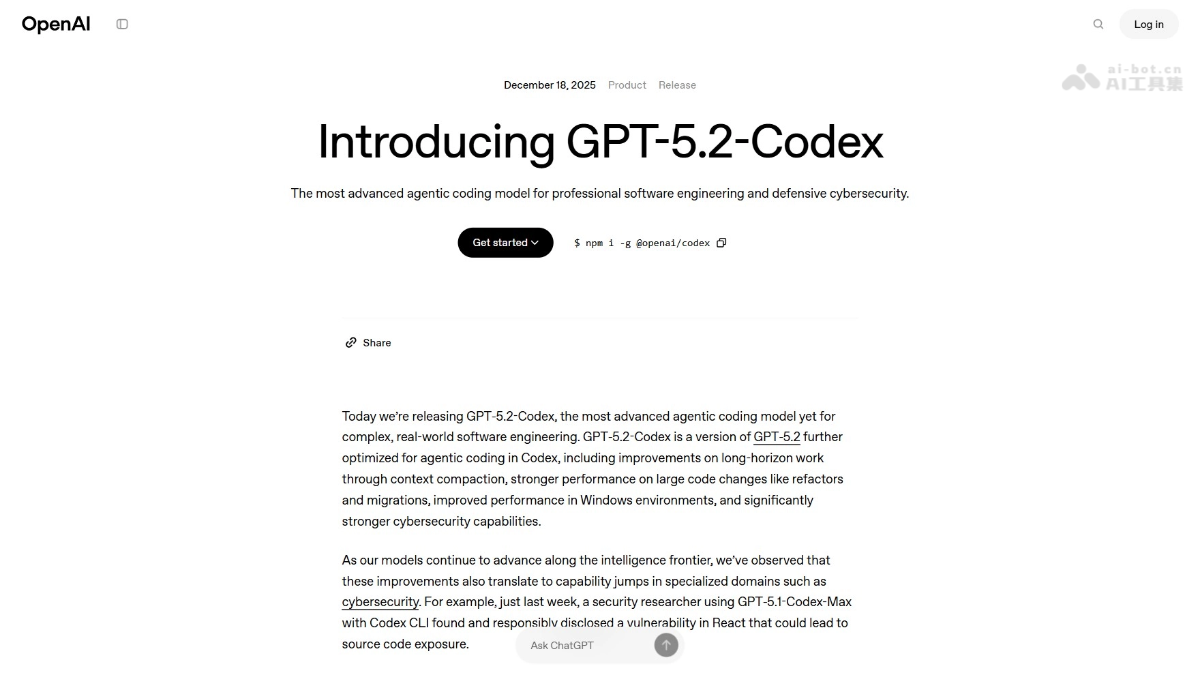
GPT-5.2-Codex is an agentic coding model introduced by OpenAI, designed for complex software engineering and defensive cybersecurity. The model is an upgraded version of GPT-5.2 , with improved instruction following, long-context understanding, and other capabilities, and it excels in large-scale change tasks such as code refactoring and migration. The model is performance-optimized for the Windows environment, with significantly enhanced cybersecurity capabilities that can help discover and fix vulnerabilities. GPT-5.2-Codex has strong visual performance and can accurately interpret screenshots, technical diagrams, and more. Currently, GPT-5.2-Codex is available to paid ChatGPT users.
Main features of GPT-5.2-Codex
-
Code generation and optimization: The model can efficiently generate high-quality code, supports multiple programming languages, and is suitable for development from simple scripts to large projects. At the same time, the model can optimize existing code to improve its performance and readability.
-
Code refactoring and migration: It performs excellently when handling large-scale code refactoring and migration tasks, can understand and execute complex code changes, and helps developers reduce workload and lower the risk of errors.
-
Code review and debugging: The model can analyze code logic, find potential errors and vulnerabilities, provide detailed review suggestions and debugging information, and help developers quickly locate and solve problems.
-
Design prototype generation: Quickly converts design mockups into functional prototypes, supports collaboration between developers and the model, and further develops prototypes into actual products.
-
Cybersecurity support: It has strong cybersecurity capabilities, can assist security researchers in discovering and analyzing vulnerabilities, and supports defensive cybersecurity work such as vulnerability scanning, attack surface analysis, and fuzz testing.
-
Multi-environment adaptability: It performs excellently in Windows and other operating system environments, and can adapt to different development environments and toolchains.
-
Long-context understanding: Through technologies such as context compression, it can handle long sessions and large codebases, maintain complete contextual information, and ensure the continuity and accuracy of complex tasks.
-
Enhanced visual performance: The model can accurately interpret visual information such as screenshots, technical diagrams, and UI interfaces, helping developers better understand and communicate technical details.
-
Tool calling and integration: It supports reliable tool calling and seamlessly integrates with various development tools and platforms, improving development efficiency.
-
Defensive security features: It provides support for defensive cybersecurity tasks, helping security teams simulate attack scenarios, analyze malware, and conduct stress testing of infrastructure.
Performance of GPT-5.2-Codex
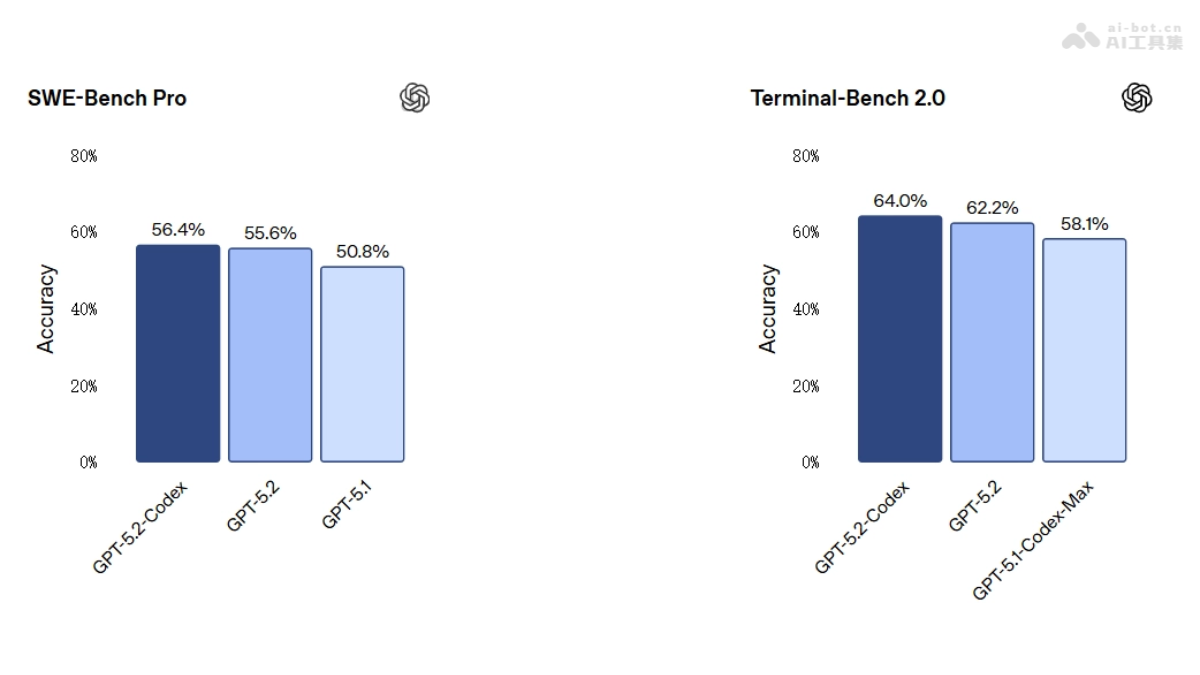
It achieves state-of-the-art performance (SOTA) on the SWE-Bench Pro and Terminal-Bench 2.0 benchmarks. The two benchmarks can evaluate the performance of agentic programs in executing various tasks in real terminal environments. This shows that GPT-5.2-Codex has strong practicality and reliability in real-world development scenarios.
GPT-5.2-Codex project address
- Project official website:https://openai.com/index/introducing-gpt-5-2-codex/
Application scenarios of GPT-5.2-Codex
- Code generation and optimization: The model can quickly generate high-quality code, supports multiple languages, reduces development workload, and improves code quality.
- Vulnerability discovery and analysis: Scans codebases to identify security vulnerabilities, provides detailed analysis reports, and helps security researchers gain an in-depth understanding of the causes of vulnerabilities.
- Security Research and Simulation: Simulates multiple attack scenarios, analyzes malware behavior, and provides data support for the formulation of security strategies.
- Design-to-Prototype Conversion: Rapidly converts design drafts into runnable code prototypes, supporting rapid frontend and backend development.
- Toolchain Integration: Seamlessly integrates with mainstream development tools and CI/CD processes to achieve automated testing and deployment.