
What is VLOGGER
VLOGGER AI is a multimodal diffusion model developed by Google's research team, specifically designed to generate realistic and coherent dynamic portrait videos from a single input image and audio sample. The main function of this model is to use an AI model to transform a static image into a dynamic video character while maintaining the realistic appearance of the person in the photo. In addition, VLOGGER can control character movements based on audio, not only facial movements and lip synchronization, but also head movement, gaze, blinking, and upper body and hand gestures, thereby pushing audio-driven video synthesis to a new level.
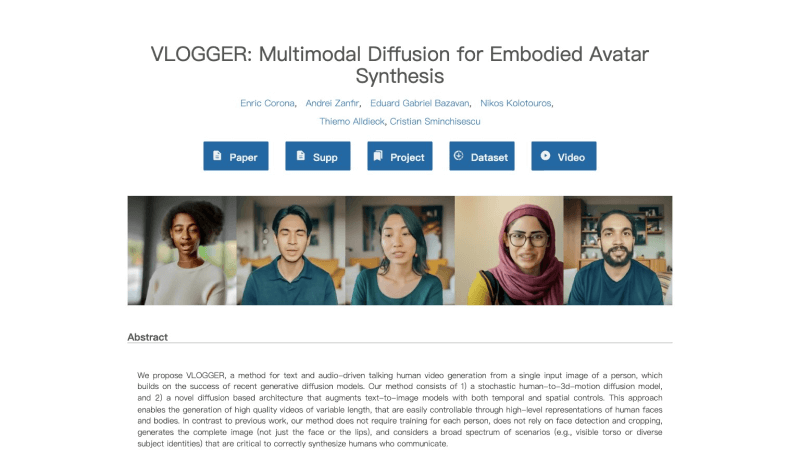
VLOGGER official website entry
- Official project homepage:https://enriccorona.github.io/vlogger/
- arXiv research paper:https://arxiv.org/abs/2403.08764v1
VLOGGER features
- Image- and audio-driven video generation: VLOGGER can generate videos of talking humans based on a single person image and corresponding audio input. Users only need to provide one image and one audio clip, and VLOGGER will generate a person in a video whose facial expressions, lip movements, and body language are synchronized with the audio.
- Diversity and realism: Videos generated by VLOGGER have a high degree of diversity, can display different movements and expressions of the original subject, while maintaining consistency of the background and the realism of the video.
- Video editing: VLOGGER can be used to edit existing videos, for example, changing the facial expressions of a person in a video so that they remain consistent with the unchanged pixels of the original video.
- Generating moving and talking people: VLOGGER can generate videos of talking faces from a single input image and driving audio, even without original video material of the person in the video.
- Video translation: VLOGGER can convert a video in one language into a video in another language, by editing the lip and facial regions to match the new audio, achieving cross-language adaptation of video content.
How VLOGGER works
VLOGGER's working principle is mainly based on a two-stage process, combining audio-driven motion generation and temporally coherent video generation.
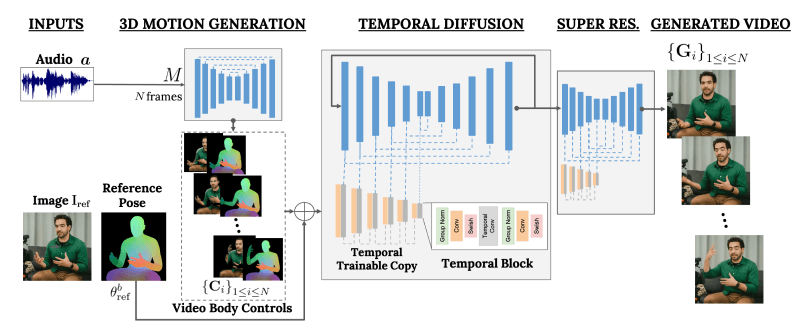
Stage 1: Audio-driven motion generation
- Audio processing: VLOGGER first receives an audio input, which can be speech or music. If the input is text, it is also converted into an audio waveform through a text-to-speech (TTS) model.
- 3D motion prediction: Next, the system uses a network based on the Transformer architecture to process the audio input. This network is trained to predict 3D facial expressions and body poses synchronized with the audio. The network uses multi-step attention layers to capture the temporal features of the audio and generate a series of 3D pose parameters.
- Generating control representations: The network outputs a series of predicted facial expressions (θe i) and body pose residuals (∆θb i). These parameters are then used to generate 2D representations that control the video generation process.
Stage 2: Temporally coherent video generation
- Video generation model: The second stage of VLOGGER is a temporal diffusion model, which receives the 3D motion controls generated in the first stage and a reference image (that is, the single input person image).
- Conditioned video generation: The video generation model is a diffusion-based image-to-image translation model that leverages predicted 2D control to generate a sequence of frames that are animated according to the input audio and 3D motion parameters.
- Super-resolution: To improve video quality, VLOGGER also includes a super-resolution diffusion model that increases the resolution of the base video from 128×128 to a higher resolution, such as 256×256 or 512×512.
- Temporal outpainting: VLOGGER uses the technique of temporal outpainting to generate videos of arbitrary length. It first generates a certain number of frames, then iteratively generates new frames based on the information from the previous frame, thereby extending the length of the video.
Dataset and Training
- VLOGGER is trained on a large-scale dataset called MENTOR (2,200 hours and 800,000 identities), which is a large-scale dataset containing a large number of identities and dynamic gestures. During training, the model learns how to generate coherent, high-quality video sequences based on 3D pose parameters and input images.