
What is Goedel-Prover
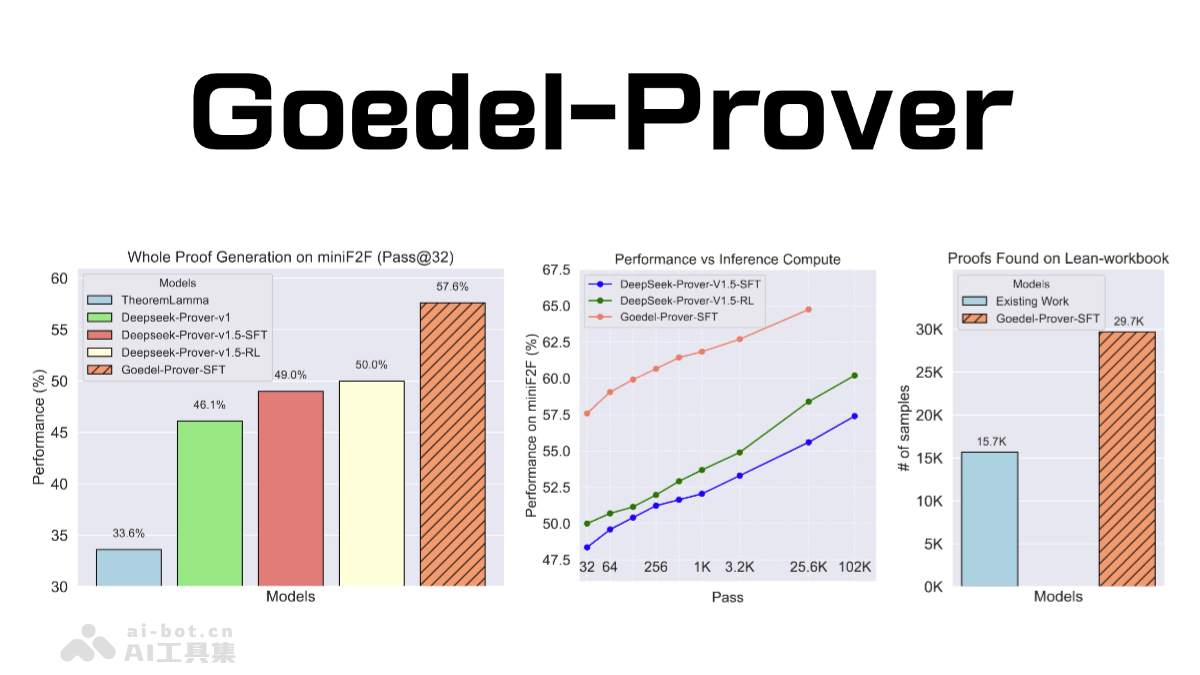
Goedel-Prover is an open-source large language model (LLM) launched by Princeton University, Tsinghua University, Tsinghua University, and other institutions, used for automated formal proof generation of mathematical problems. It generates formal proofs by translating natural language mathematical problems into formal languages (such as Lean 4), addressing the scarcity of formalized mathematical statements and proofs. Goedel-Prover is trained using an expert iteration method, based on a continuously expanding dataset of formal proofs, gradually improving its proving ability. In multiple benchmark tests, Goedel-Prover performs excellently, for example achieving a 57.6% success rate on the miniF2F benchmark, significantly outperforming previous open-source models. Goedel-Prover successfully solved 7 problems in PutnamBench and generated nearly 30,000 formal proofs for Lean Workbook, bringing a major breakthrough to the field of automated theorem proving.
Main Features of Goedel-Prover
- Formal Translation: Converts natural language mathematical problems into formal languages, ensuring the accuracy and completeness of the translation.
- Proof Generation: Automatically generates complete proofs, supporting complex mathematical reasoning.
- Performance Optimization: Continuously optimizes proving ability based on the expert iteration method, improving the proof success rate.
- Large-Scale Data Processing: Processes and generates large-scale datasets of formalized statements and proofs, improving the model's generalization ability.
Technical Principles of Goedel-Prover
- Formal Translation:
- Uses two formalizers (Formalizer A and Formalizer B) to translate natural language mathematical problems into the Lean 4 formal language. The two formalizers are trained on different datasets respectively, increasing the diversity of formalization styles.
- Evaluates the quality of formalized statements based on Compilation Correctness (CC) tests and Faithfulness and Completeness (FC) tests, ensuring they conform to Lean syntax and accurately capture the meaning of the original problem.
- Expert Iteration: In the initial stage, existing provers (such as DeepSeek-Prover-V1.5-RL) are used to generate multiple proof candidates for each formalized statement, and the correctness of the proofs is verified based on the Lean compiler. The proofs that pass verification are collected as training data, and supervised fine-tuning is performed on a base model (such as DeepSeek-Prover-V1.5-Base) to generate a new prover. The above process is repeated, with each iteration using the new prover to generate more proofs and adding them to the training data, gradually improving the model's proving ability.
- Dataset Expansion: In addition to using the public Numina dataset, Goedel-Prover formalizes a large number of privately collected mathematical problems and merges them with existing statements in Lean Workbook to form a large-scale dataset of formalized statements. During training, external datasets such as Mathlib4 are gradually added to enhance the model's adaptability to different mathematical fields.
Project Addresses of Goedel-Prover
- GitHub Repository:https://github.com/Goedel-LM/Goedel-Prover
- HuggingFace Model Library:https://huggingface.co/Goedel-LM/Goedel-Prover
- arXiv Technical Paper:https://arxiv.org/pdf/2502.07640v1
Application Scenarios of Goedel-Prover
- Mathematical Research: Helps mathematicians quickly verify proofs of complex theorems and accelerates the research process.
- Mathematics Teaching: Provides teachers with detailed proof processes and assists students in understanding mathematical concepts and logic.
- Software Verification: Verifies the logical correctness of software algorithms and improves the reliability and security of software.
- AI Algorithm Verification: Verify the theoretical foundation of AI algorithms to ensure their logical correctness and performance.
- Interdisciplinary Research: Verify theoretical connections between different disciplines to provide theoretical support for interdisciplinary research.