
What is Glyph
Glyph is an innovative framework open-sourced by Zhipu in collaboration with Tsinghua University's CoAI Lab, capable of solving the problem of excessively long contexts in large language models (LLMs) through visual-text compression. The framework renders long text as images and uses a vision-language model (VLM) to process the images, achieving 3-4x context compression. Glyph significantly reduces computational cost and VRAM usage while greatly improving inference speed. Glyph performs excellently in multimodal tasks, demonstrating strong generalization ability.
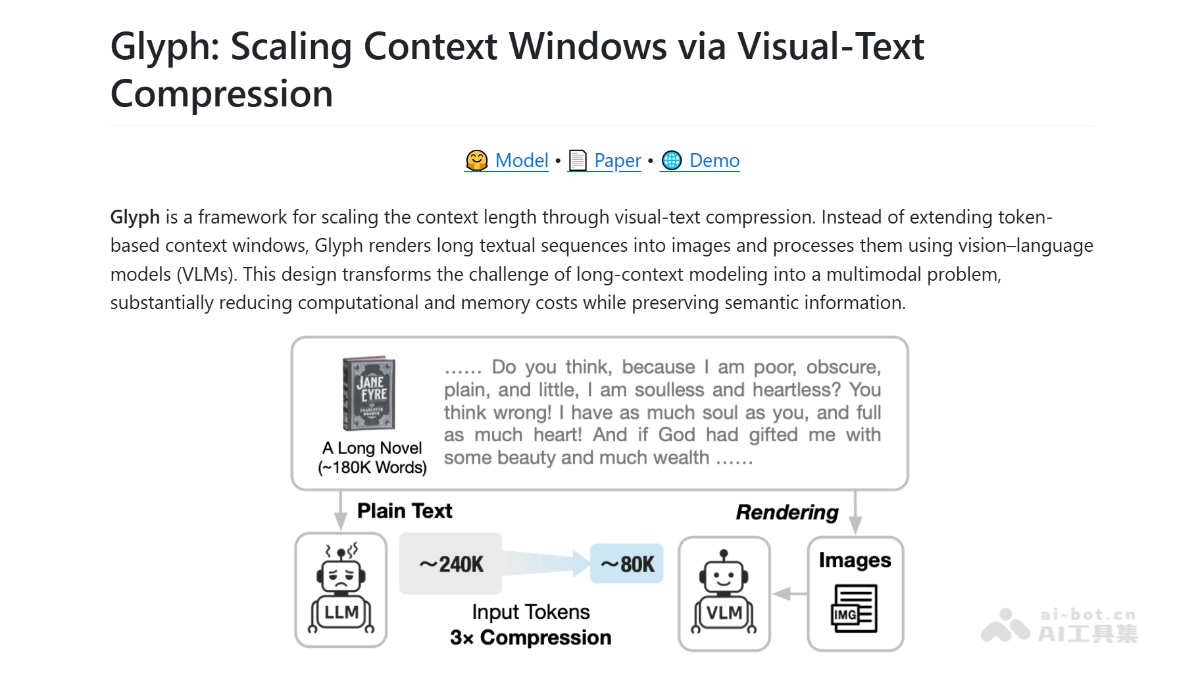
Glyph's main features
- Long context compression: Glyph can render long text (such as novels, legal documents, etc.) into compact images and process the images through a vision-language model (VLM), achieving 3-4x context compression.
- Efficient inference acceleration: Glyph performs excellently during the inference stage, with prefill speed improved by 4.8x and decoding speed improved by 4.4x, significantly reducing inference time and making it suitable for handling ultra-long text tasks.
- Reduced VRAM usage: Because visual tokens have higher information density, Glyph's VRAM usage is greatly reduced, with VRAM usage reduced by about 2/3, making it suitable for running on consumer-grade GPUs (such as 4090, 3090).
- Enhanced multimodal tasks: Glyph can handle mixed image-text content. In multimodal tasks (such as PDF document understanding), accuracy improves by 13%, demonstrating strong generalization ability.
- Low-cost modeling: Glyph does not require training an ultra-large context model; it only needs a powerful VLM and a reasonable text rendering strategy to achieve efficient long-context modeling, reducing hardware costs and training difficulty.
Glyph's technical principles
- Visual-text compression: Glyph's core idea is to render text as images and use a VLM to process the images. The information density of images is much higher than that of plain text; one visual token can carry the semantics of multiple text tokens, achieving efficient context compression.
- Three-stage training process
- Continual Pre-Training: Render massive amounts of long text into images in different styles, and train the VLM to understand the images. Tasks include OCR (restoring text), cross-modal language modeling, and generating missing paragraphs.
- LLM-driven Rendering Search: Optimize rendering parameters (such as font, DPI, line spacing, etc.) through a genetic algorithm to find the best balance between compression rate and accuracy.
- Post-training: Under the optimal rendering configuration, perform supervised fine-tuning (SFT) and reinforcement learning (RL), adding OCR auxiliary tasks to ensure the model can precisely "see clearly" the text details.
- Advantages of visual tokens: Visual tokens have higher information density, enabling shorter context windows and higher inference efficiency. Visual tokens can represent information such as text, color, and layout, which is closer to how the human brain processes information.
Glyph's project address
- GitHub repository:https://github.com/thu-coai/Glyph
- HuggingFace model library:https://huggingface.co/zai-org/Glyph
- arXiv technical paper:https://arxiv.org/pdf/2510.17800
Glyph's application scenarios
- Education field: Help teachers and students quickly analyze textbooks and online course content, extract key points and difficult points, and improve learning efficiency.
- Enterprise-level applications: Process lengthy business reports and customer support issues within enterprises, helping management quickly extract key data and conclusions and improving decision-making efficiency.
- Creative Writing: Help writers and creators quickly generate long-form stories and scripts, providing a global perspective and coherent plot development, and improving creative efficiency.
- Healthcare: Help doctors and researchers quickly extract key information and improve diagnostic and research efficiency.
- Finance: Help analysts quickly extract key data and trends and improve decision-making accuracy.