
What is GLM-4V-Flash
GLM-4V-Flash is the first free multimodal model API launched by Zhipu AI. The GLM-4V-Flash model has advanced image processing capabilities such as image description generation, image classification, visual reasoning, visual question answering (VQA), and image sentiment analysis, and supports 26 languages including Chinese, English, Japanese, Korean, and German. Being freely available lowers the threshold for developers to use large models and promotes the development of multimodal applications.
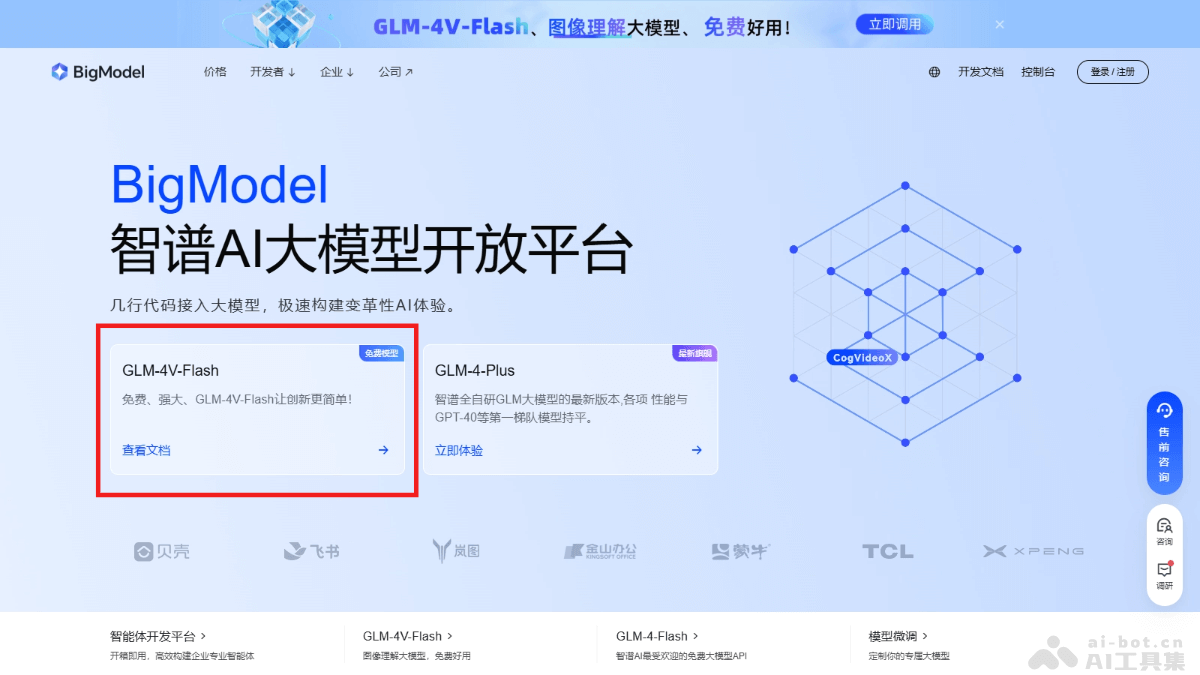
Main Features of GLM-4V-Flash
- Image Description Generation: Can automatically generate descriptive text based on image content.
- Image Classification: Classifies images and identifies the main objects or scenes in the images.
- Visual Reasoning: Analyzes image content and performs logical reasoning to understand relationships and events in the images.
- Visual Question Answering (VQA): Answers questions about image content and provides answers based on image information.
- Image Sentiment Analysis: Analyzes the emotional tone in images and identifies the emotions conveyed by the images.
- Multilingual Support: Supports 26 languages including Chinese, English, Japanese, Korean, and German, with broad application potential worldwide.
- Multimodal Data Annotation: Can extract and summarize image content and output it in a specified format, providing a convenient method for data annotation.
- Vertical Industry Solutions: Provides customized solutions for specific industries, helping enterprises quickly embrace the era of large models at low cost.
Technical Principles of GLM-4V-Flash
- Multimodal Learning: GLM-4V-Flash combines visual and language processing technologies and can understand and process images as well as related text information. The model can extract features from images and combine them with text information for deeper understanding and reasoning.
- Deep Learning: The model uses deep neural networks to process and analyze image and text data. It can automatically learn complex patterns and features in the data without manual intervention.
- Attention Mechanism: When processing images and text, the model uses an attention mechanism to identify and focus on the most important parts of the images and text, which helps improve the model's accuracy in tasks such as visual question answering and image description generation.
- Transfer Learning: GLM-4V-Flash uses a pretrained model that has already been trained on large-scale datasets and is then fine-tuned for specific tasks. This can accelerate the learning process and improve the model's performance on new tasks.
- End-to-End Training: The model adopts an end-to-end training approach, completing the entire process from input (images and text) to output (such as descriptions, classification results, etc.) within a unified framework, without the need for step-by-step processing.
- Cross-Modal Alignment: The model needs to be able to align the visual information of images with text information and establish connections between different modalities. This involves complex algorithms for identifying objects, scenes, and actions in images and matching them with corresponding text descriptions.
Project Address of GLM-4V-Flash
- Project Official Website:BigModel Official Website
Application Scenarios of GLM-4V-Flash
- Social Media Content Generation: Automatically generate social media copy related to image content, improving content appeal and engagement.
- Education and Learning: Through image recognition and understanding, assist students in learning, especially in science and engineering, helping students understand complex concepts and principles.
- Beauty Consultation: Identify skin problems and provide personalized skincare advice, assisting users in skin health management.
- Safety Inspection: Conduct safety assessments in industrial production to ensure the production environment and product quality comply with industry standards and regulatory requirements.
- Insurance Policy Information Extraction: Automatically extract key information from insurance documents, improving the efficiency and accuracy of insurance business processing.
- Work Order Quality Inspection: Through image recognition technology, detect product quality issues and improve the efficiency of product quality management.
- E-commerce Product Description Generation: Automatically generate attractive descriptions and titles for products on e-commerce platforms, enhancing product market competitiveness.
- Multimodal Data Annotation: Provide a convenient annotation method for image data, improving the efficiency and accuracy of data annotation.
- Image Classification and Recognition: In fields such as security monitoring and traffic management, use image recognition technology for target detection and classification.