
What is GigaTok
GigaTok is a visual tokenizer for autoregressiveimage generation, with 3 billion parameters. Through semantic regularization technology, the tokenizer features are aligned with the semantic features of pretrained visual encoders (such as DINOv2), effectively constraining the complexity of the latent space and resolving the contradiction between reconstruction quality and generation quality when visual tokenizers are scaled up. GigaTok adopts a one-dimensional tokenizer architecture to improve scalability, prioritizes scaling the decoder to allocate computational resources efficiently, and introduces entropy loss to stabilize the training of large-scale models.
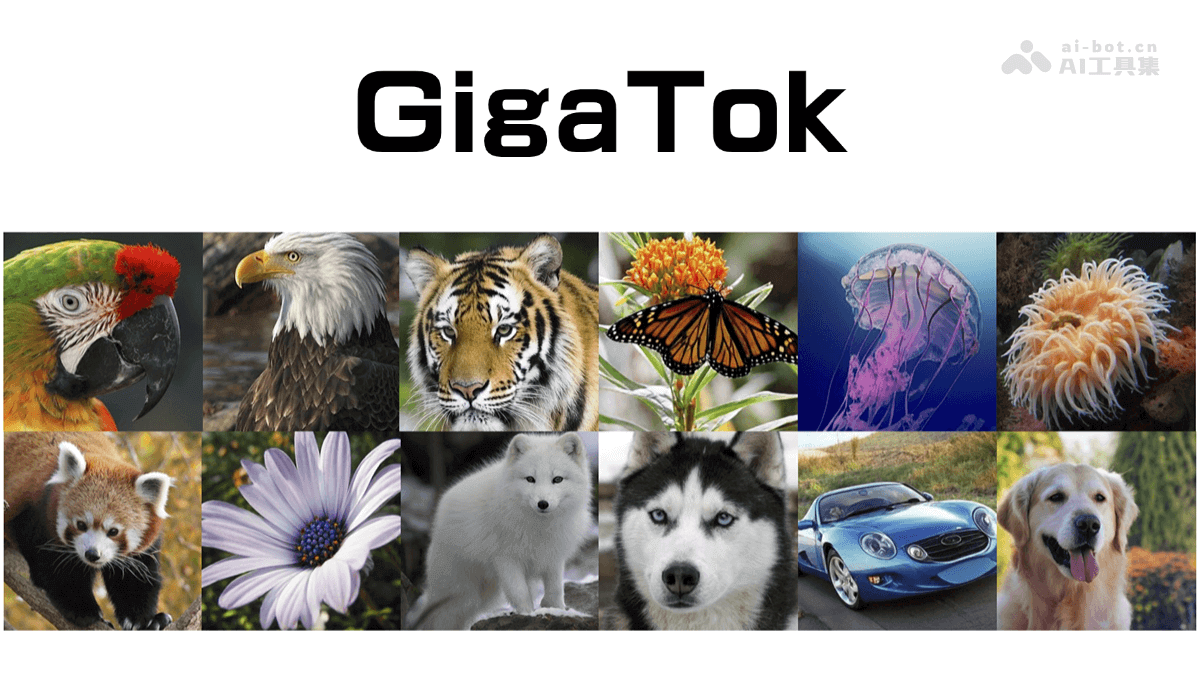
GigaTok's main features
- High-quality image reconstruction: GigaTok successfully scales the visual tokenizer to 3 billion parameters, significantly improving image reconstruction quality. Through semantic regularization technology, the tokenizer features are aligned with the semantic features of pretrained visual encoders (such as DINOv2), preventing the latent space complexity from becoming too high during scaling.
- Improved downstream generation performance: GigaTok performs excellently in downstream autoregressive generation tasks, resolving the contradiction between reconstruction quality and generation quality in traditional methods. Through semantic regularization and optimized scaling strategies, GigaTok achieves higher quality and better generalization ability in generation tasks.
- Optimized representation learning: By scaling up the visual tokenizer and combining it with semantic regularization, GigaTok significantly improves the representation learning quality of downstream autoregressive models. Experiments show that models trained with GigaTok achieve significant improvements in linear probing accuracy.
- Innovative scaling strategy: GigaTok proposes a one-dimensional tokenizer architecture, which has better scalability than traditional two-dimensional tokenizers. It prioritizes scaling the decoder and introduces entropy loss to stabilize the training of large-scale models.
GigaTok's technical principles
- Hybrid architecture design: GigaTok adopts a hybrid architecture combining CNN and Transformer, achieving efficient feature extraction and latent space encoding. The encoder part progressively downsamples the image through CNN blocks, then generates discrete latent codes through Transformer layers and a vector quantizer. The decoder reconstructs the latent codes into images through Transformer layers and a CNN decoder. It supports one-dimensional (1D) and two-dimensional (2D) tokenizers, among which the 1D tokenizer performs better in scalability.
- Semantic regularization: To solve the problem of excessively high latent space complexity when scaling the tokenizer, GigaTok introduces semantic regularization technology. By aligning the tokenizer's features with the semantically consistent features of pretrained visual encoders (such as DINOv2), it constrains the complexity of the latent space. Specifically, through a contrastive learning framework, it forces the tokenizer's intermediate features to align with the semantic space of the pretrained model, maintaining generation quality when scaling up the model size.
- Asymmetric scaling strategy: When scaling the encoder and decoder, GigaTok prioritizes scaling the decoder. This allocates computational resources more efficiently while avoiding the latent space becoming uncontrollable due to an overly complex encoder.
- Entropy loss: GigaTok introduces entropy loss to stabilize the training of large-scale tokenizers. Entropy loss ensures that the model remains stable during training by encouraging higher codebook usage, avoiding training collapse caused by increased complexity.
GigaTok's project address
- Project website:https://silentview.github.io/GigaTok/
- Github repository:https://github.com/SilentView/GigaTok
- arXiv technical paper:https://arxiv.org/pdf/2504.08736
GigaTok's application scenarios
- Image Generation and Synthesis: GigaTok performs excellently in autoregressive image generation and can generate high-quality images. It can be used in fields such as artistic creation, game development, and virtual reality to help users quickly generate image content that meets their needs.
- Image Editing and Enhancement: GigaTok can be used for image editing tasks, such as seamlessly blending foreground objects into background images.
- Data Augmentation and Pretraining: Through efficient image tokenization and reconstruction capabilities, GigaTok can provide high-quality pretraining data for machine learning models.
- Multimodal Learning: GigaTok's semantic regularization technique enables it to be combined with text generation models to achieve text-to-image generation. Its multimodal capabilities can be applied in fields such as intelligent creation and virtual assistants.
- Medical Image Processing: GigaTok's high-fidelity image reconstruction capability can be applied to medical image generation and processing, for example, generating high-quality medical images for diagnosis or research.