
What is Get3W
Get3W is an AI model aggregation platform for developers and enterprises, offering one-stop access to 700+ models from more than 20 vendors including Google, OpenAI, ByteDance, Alibaba, Kling, Midjourney, Runway, MiniMax, and Black Forest Labs through a unified API, with capabilities spanning video, image, audio, 3D, panoramic, and conversational generation. Developers only need to integrate once and can freely switch models under the same set of interface specifications, without having to adapt to each vendor's API repeatedly. The platform provides REST API, Python/JavaScript SDK, asynchronous tasks, and Webhook callbacks, adopts a pay-as-you-go billing model, and can save up to about 50% in costs compared with connecting directly to official services.
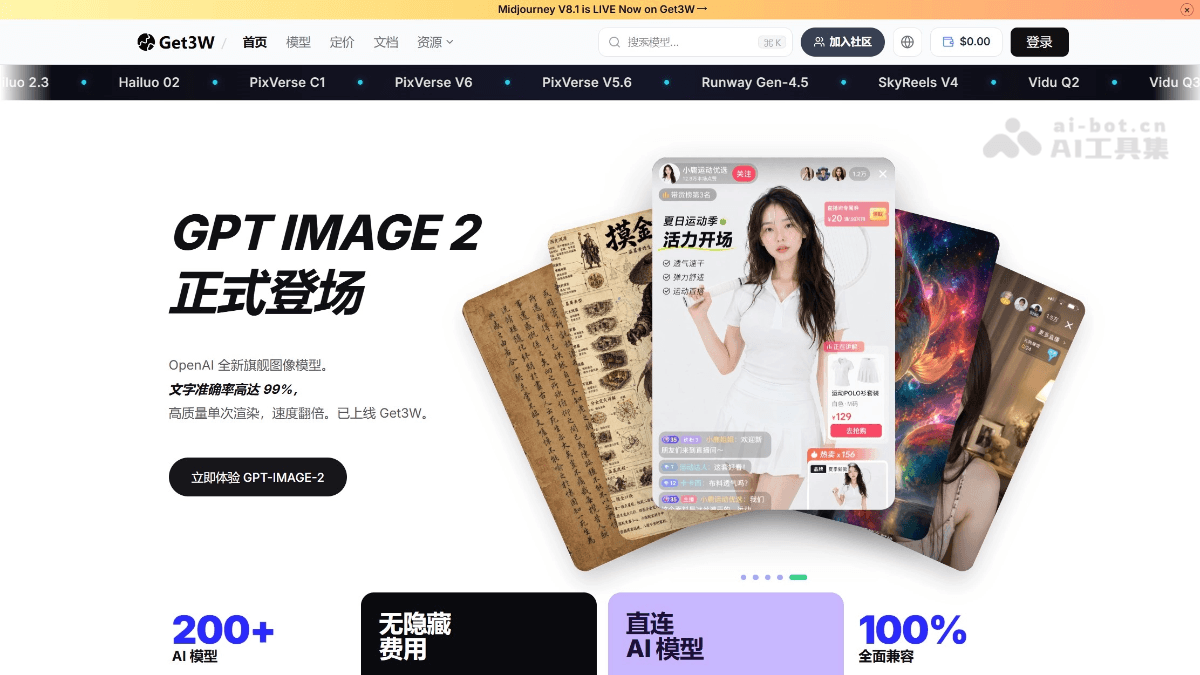
Get3W's Main Features
-
Unified API Access: One API Key calls 700+ models, covering six major modalities: video, image, audio, 3D, panoramic, and conversation; switching models does not require changing the integration method.
-
Video Generation: Supports text-to-video, reference-to-video, first-frame-to-video, first-and-last-frame-to-video, video-to-video, and digital human generation.
-
Image Generation: Supports text-to-image and image-to-image, aggregating mainstream image models such as FLUX, Midjourney, and GPT Image.
-
Audio Generation: Provides speech-to-text (STT), text-to-speech (TTS), and text-to-music capabilities.
-
3D and Panoramic Generation: Supports text-to-3D, image-to-3D, text-to-panorama, and image-to-panorama, meeting the asset needs of games and interactive entertainment.
-
Developer-Friendly: Provides REST API, Python / JavaScript SDK, asynchronous task queue, and Webhook callbacks, and supports polling for results.
-
Web-Based Trial: You can first test model results in the Playground web interface, then solidify it into API calls after confirmation.
-
Multi-Vendor Aggregation: Integrates 20+ model service providers such as Google, OpenAI, ByteDance, Alibaba, Kling, and MiniMax.
How to Use Get3W
-
Visit and Register: Visit Get3W's official website https://get3w.com/zh, register an account; new accounts are usually given a $1 trial credit
-
Step 2: Log in to the console, create and save an API Key
-
Step 3: Try the target model in the Web Playground to confirm the generation results
-
Step 4: Consult the API documentation and submit generation tasks according to the specifications (create tasks with POST requests)
-
Step 5: Obtain generation results by polling task status or configuring Webhook callbacks
-
Step 6: Integrate the Python / JavaScript SDK into a formal project, and top up as needed to increase account level and concurrency capacity
Get3W's Core Advantages
-
Integrate Once, All Models Available: Eliminates the repetitive work of registering with each vendor, authentication, and adapting documentation, greatly shortening the integration cycle.
-
Cost Advantage: Pay-as-you-go with no mandatory subscription, saving up to about 50% compared with direct official channels.
-
Flexible Billing and Credits: New accounts get a $1 trial credit, the minimum top-up is $5, and credits never expire.
-
Tiered Account Levels: Bronze → Silver ($100) → Gold ($1,000) → Ultra ($10,000); concurrency and rate limits increase with cumulative top-ups.
-
Multi-model price comparison and switching: Freely compare prices and switch among multiple model providers, enabling primary/backup failover and reducing single-vendor risk.
-
Unified asynchronous architecture: All models uniformly follow the "submit task → poll/Webhook for results" pattern, making it easy to build stable content production pipelines.
Get3W use cases
-
AI application / SaaS product development: Embed generation capabilities such as text-to-image, text-to-video, and digital humans as product features into applications, and launch quickly through a unified API without integrating with each model vendor one by one.
-
Batch production of marketing materials: Large-scale automated generation of e-commerce posters, product images, advertising short videos, and social media graphics, reducing design outsourcing and shooting costs.
-
Short video content pipeline: Self-media and MCN agencies can batch-produce talking-head videos, digital human videos, and AI derivative content, using asynchronous tasks and Webhooks to build a fully automated content pipeline.
-
Digital human livestreaming and customer service: Use digital human generation + TTS capabilities to create virtual anchors, AI customer service agents, and corporate promotional presenters.
-
Games and interactive entertainment: Quickly generate character illustrations, scene concept art, text-to-3D assets, panoramic environment images, and game voiceovers, accelerating the production of art and audio assets.
-
E-commerce product details and outfit-change displays: Image-to-image and image-to-video capabilities are used for multi-angle product displays, virtual try-on, and scenario-based product image generation.
Get3W FAQ
A: It uses a pay-as-you-go model, so you pay for what you use, with no mandatory subscription or package. Fees are calculated based on dimensions such as model, output type, resolution, and duration.
A: Yes. New accounts usually receive $1 in trial credits, which can be used to test the results of various models.
A: No. The minimum top-up amount is $5, and topped-up credits are valid permanently.
A: Tiers increase with cumulative top-ups: Bronze (default) → Silver ($100) → Gold ($1,000) → Ultra ($10,000). The higher the tier, the higher the API concurrency and request rate limits.
A: Very little. All models share one REST API specification, and with the official Python / JavaScript SDKs, a generation call can usually be completed with just a few lines of code.