
What is GENIE
GENIE is launched by Luma AIA text-to-3D content tool, capable of transforming simple text descriptions into vivid three-dimensional scenes and objects. Users only need to input a text description, and GENIE can generate a 3D model based on the description, supporting the export of the generated 3D model to mainstream 3D file formats such as OBJ, FBX, etc., making it convenient to use in different software and platforms. GENIE provides tools and interfaces for interactive scene creation, and API support for video-to-3D model conversion. It is suitable for 3D artists, designers, game developers, educators, and AR/VR content creators, greatly expanding the boundaries of digital creation.
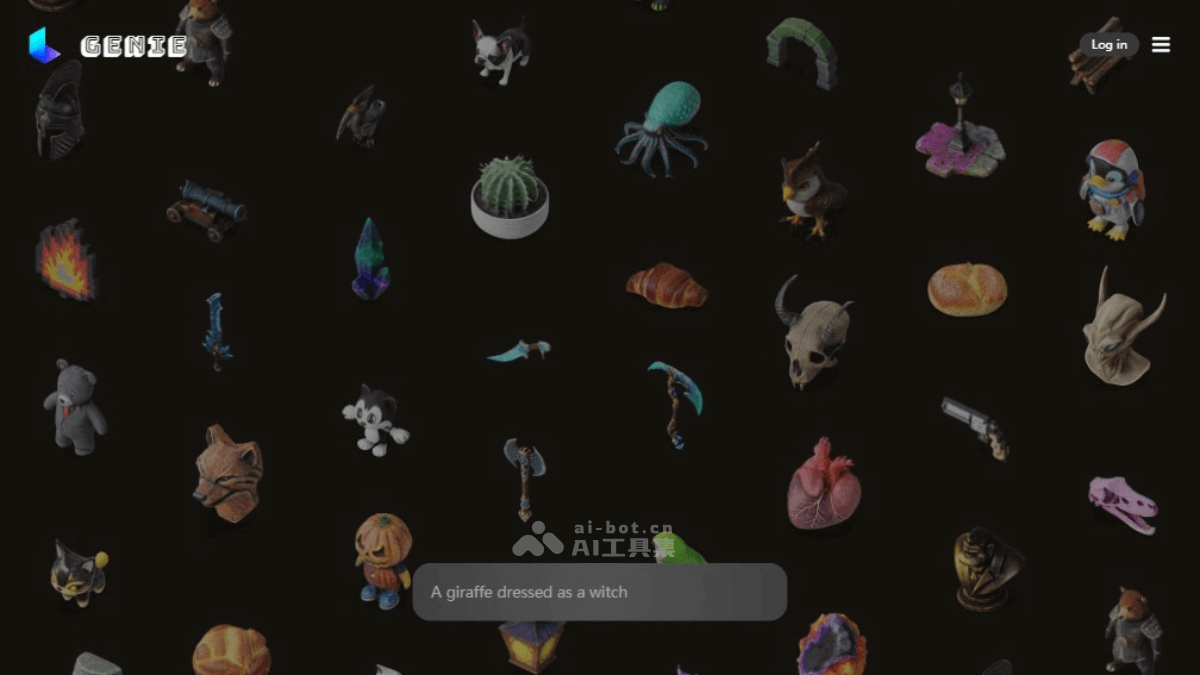
GENIE's main features
- Text-to-3D model conversion: Users input a text description, and GENIE can generate the corresponding 3D model.
- 3D scene creation: GENIE can create complete 3D scenes based on text descriptions.
- Model editing and customization: Users can edit the generated 3D models and customize materials and styles.
- Multi-format export: The generated 3D models can be exported in multiple formats, such as OBJ, FBX, etc., to adapt to different application scenarios.
- Video-to-3D model: GENIE provides an API that can convert video content into 3D models.
- Rapid generation: GENIE can quickly generate multiple 3D model options matching the description.
- Augmented reality preview: Users can preview the generated 3D models in augmented reality.
GENIE's product official website
- Product official website:hlumalabs.ai/genie
GENIE's application scenarios
- 3D art creation and design: GENIE can quickly transform ideas into three-dimensional scenes and objects, saving time on model creation for 3D artists and designers.
- Game development: Game designers can use GENIE to quickly create environments and characters in games, accelerating the game development process while maintaining a high level of creativity and quality.
- Education and training: Educators can use GENIE to create interactive teaching materials, making the learning process more vivid and engaging.
- Foundational world modeling: In the field of machine learning, it can be used to predict dynamic scenes, guide autonomous vehicles, or train aspiring doctors in medical simulations.