
What is GenEvolve
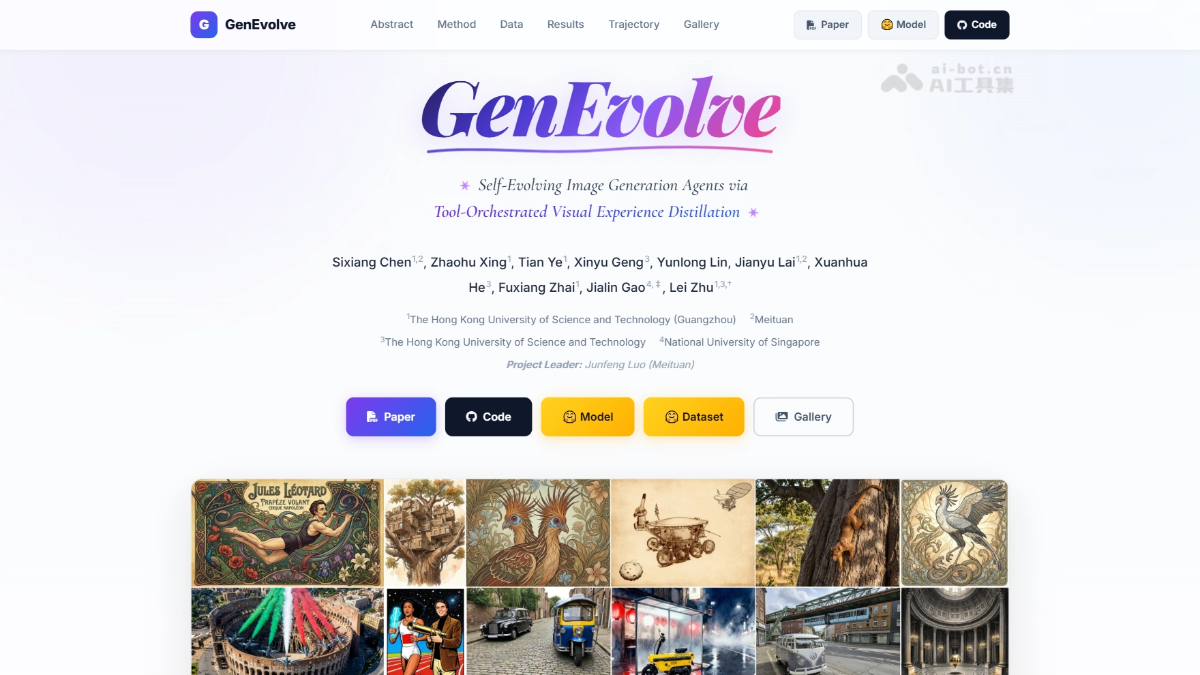
GenEvolve is a self-evolving image generation Agent jointly launched by The Hong Kong University of Science and Technology (Guangzhou), Meituan, and the National University of Singapore. GenEvolve formalizes open-ended image generation as tool-orchestrated visual trajectories. The Agent searches textual evidence, retrieves visual references, and invokes generation knowledge, ultimately synthesizing a prompt-reference program, which is handed to any reference-conditioned generator for rendering.
Main Features of GenEvolve
-
Text search (search): Collects external factual evidence to supplement world knowledge such as real buildings, public figures, and product structures.
-
Image search (image_search): Retrieves visual reference images to obtain visual references such as landmarks, people, and materials.
-
Generation knowledge query (query_knowledge): Activates internal generation skills to handle complex requirements such as text rendering, spatial layout, and material consistency.
-
Prompt-Reference Program synthesis: Integrates tool results into an executable generation program, supporting rendering by any reference-conditioned generator.
Technical Principles of GenEvolve
- Training is divided into two stages:
-
SFT cold start: Performs supervised fine-tuning on Qwen3-VL-8B-Instruct on high-quality Teacher trajectories to learn basic tool calling and program writing.
-
Self-evolution (Rollout): Samples multiple trajectories for the same request, renders them into images, and scores them jointly by a visual scorer and a textual scorer, using GRPO to optimize trajectory-level rewards.
-
- Visual Experience Distillation: Compares the best and worst trajectories under the same request, summarizes the differences into a structured Decision Guide, and distills the teacher branch's preferences into the student model through token-level reverse KL, enabling the model to learn the decision-making habits of "how to search, select references, and organize constraints for similar requests".

Follow WeChat and reply "open source" to join theAI Open Source Project Communication Group
How to use GenEvolve
-
Clone the repository: Download the GenEvolve code from GitHub to the local environment.
-
Install dependencies: Run
pip install -r requirements.txtto install the required Python packages. -
Download the model: Download from HuggingFace
MeiGen-AI/GenEvolvethe Qwen3-VL-8B Agent policy weights. -
Configure search tools: Set the search engine API key and enable
searchandimage_searchtool calls. -
Load generation knowledge: Place the eight skill Markdown files into the specified directory for the
query_knowledgetool to read. -
Choose a generator: Select a backend among Qwen-Image-Edit or Nano Banana Pro and configure the key.
-
Initialize the Agent: Instantiate
GenEvolveAgent, passing in the model path, generator name, and tool list. -
Input a request: Call the
agent.run()method, passing in a natural language image generation description. -
Execute the trajectory: The Agent automatically searches textual evidence, retrieves visual references, invokes generated knowledge, and synthesizes a prompt-reference program.
-
Render image: Pass the program output by the Agent to the configured generator backend to obtain the final generated image.
GenEvolve's Core Advantages
-
Generator Transferability: The same Agent policy can be paired with the open-source Qwen-Image-Edit or the strong generator Nano Banana Pro, and the policy is not tied to a specific generator.
-
Self-Evolution Loop: GRPO + visual experience self-distillation forms a loop of "stronger policy → better trajectories → richer experience → future improvement."
-
Fine-Grained Credit Assignment: Compared with the scalar reward of pure RL, SDL provides token-level guidance, clarifying whether a good trajectory is good in tool planning, reference selection, or constraint formulation.
-
Cross-Benchmark Generalization: On the WISE knowledge-intensive benchmark, without in-domain fine-tuning, the 8B open-source policy surpasses GPT-4o.
GenEvolve's Project Address
- Project Website:https://ephemeral182.github.io/GenEvolve/
- GitHub Repository:https://github.com/MeiGen-AI/GenEvolve
- HuggingFace Model Library:https://huggingface.co/MeiGen-AI/GenEvolve
Comparison of GenEvolve with Similar Competitors
| Comparison Dimension | GenEvolve | Gen-Searcher |
|---|---|---|
| Core Mechanism | Tool-orchestrated visual trajectory → prompt-reference program → cross-generator rendering | Search augmentation → direct generation |
| Agent Architecture | Three-tool loop: search + image_search + query_knowledge | primarily search tool invocation |
| Training Method | SFT cold start + GRPO trajectory optimization + visual experience self-distillation (SDL) | No publicly disclosed explicit multi-stage training mechanism |
| Self-Evolution | ✅ Supported: forms a loop of "stronger policy → better trajectories → richer experience" through GRPO and SDL | ❌ Not supported: no continuous optimization mechanism |
| Generator Transferability | ✅ Core design: the same Agent output can adapt to Qwen-Image-Edit or Nano Banana Pro | ❌ Tied to a specific generator backend |
| Degree of Open Source | Full-stack open source: model weights, runtime, tools, datasets, evaluation benchmarks | Limited degree of open source |
| KScore | 0.3663 | 0.3493 |
GenEvolve's Application Scenarios
- Knowledge-Intensive Image Generation: Scenarios requiring external world knowledge, such as real landmarks (the Eiffel Tower, the Forbidden City), portraits of public figures, structures of specific products, and reconstruction of historical events. The Agent supplements facts through search tools to avoid the generator's "hallucination" of incorrect details.
- Quality-Constrained Image Generation: Commercial design, advertising posters, and educational illustrations with hard requirements for text rendering, precise counting, spatial layout, attribute binding, anatomical accuracy, material realism, and aesthetic style.
- Reference-Consistency Image Generation: Serialized content production and IP derivative creation that require the output to maintain identity consistency with a reference image (character design), special materials (metal/silk texture), or unified style (a specific painter's style).
- Clarification and Programmatization of Ambiguous Requirements: Transform vague user descriptions into executable generation programs, clarifying what to search, what to reference, and what to constrain, lowering the threshold of prompt engineering.