
What is Genesis
Genesis is an open-source generative physics engine jointly launched by research institutions such as Carnegie Mellon University, the University of Maryland, Stanford University, and the Massachusetts Institute of Technology, capable of simulating all things in the world. Genesis can use simple language descriptions to rapidly generate precise physics simulations, including object motion, character actions, and robot strategies. The engine's features lie in its high physical accuracy, fast simulation speed (about 430,000 times faster than the real world), and user-friendly Python-based design. Genesis can simulate various materials and physical phenomena, providing a lightweight, ultra-fast robot simulation platform, as well as a powerful and fast photorealistic rendering system. Genesis can convert users' natural language descriptions into data patterns for use in a generative data engine. Genesis is designed for general-purpose robots, embodied AI, and physical AI applications, heralding significant advances in the fields of physics simulation and robotics.
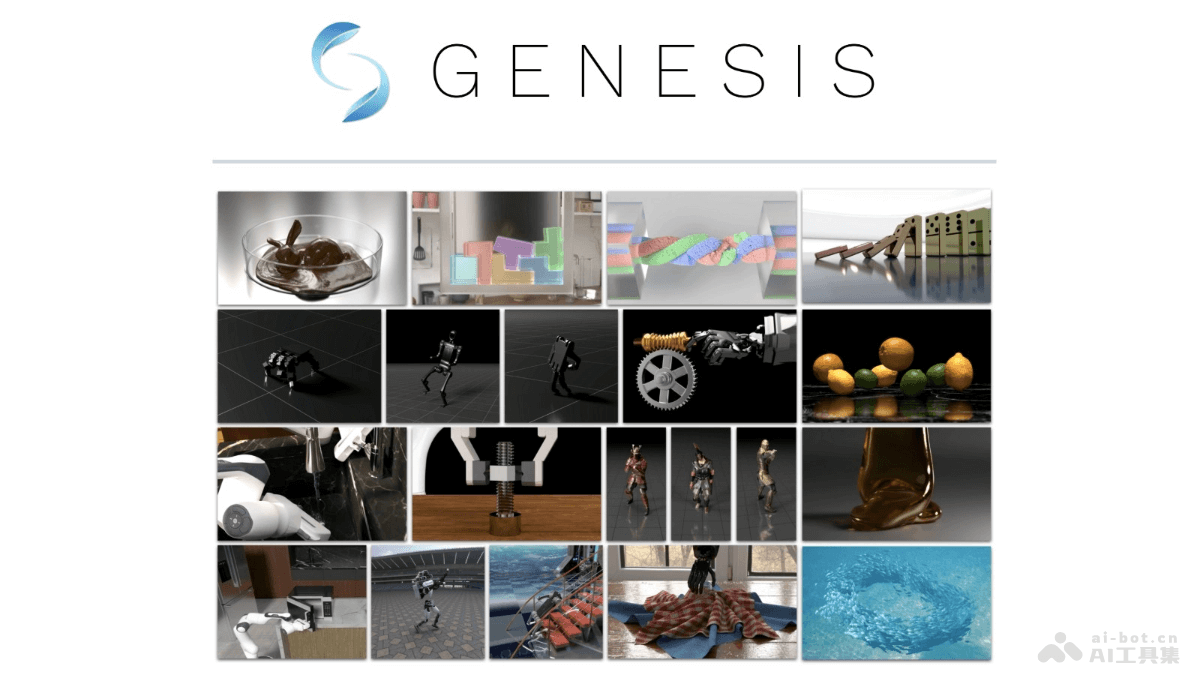
Genesis's main features
- Physics simulation: Simulates various materials and physical phenomena, including object motion, collisions, fluid dynamics, etc.
- Robot simulation: Provides a lightweight, ultra-fast robot simulation platform, supporting multiple robot types, such as robotic arms, legged robots, drones, soft robots, etc.
- Photorealistic rendering: Has a powerful and fast photorealistic rendering system, capable of generating high-quality visual output.
- Generative data engine: Converts users' natural language descriptions into data patterns for use in generating simulated scenes.
- Interactive 3D scenes: Supports fully interactive 3D scene generation, including home interior scenes, game environments, etc.
- Open-world object generation: Can generate articulated objects in open worlds, providing high-quality mesh assets.
- Soft robot simulation: Achieves realistic simulation for soft robots, such as worms, soft grippers, etc.
- Facial animation and speech synchronization: Generates facial movements and expressions, synchronized with speech, to achieve realistic facial animation.
Genesis's technical principles
- General-purpose physics engine: Built from scratch, integrating various physics solvers, such as rigid body, MPM (Material Point Method), SPH (Smoothed Particle Hydrodynamics), FEM (Finite Element Method), PBD (Position-Based Dynamics), etc., to achieve precise physics simulation.
- Generative Agent framework: Runs on top of the core physics engine, used for automated data generation, including videos, camera movements, character actions, robot strategies, etc.
- Differentiable simulation: Supports differentiable simulation, allowing the simulation process to be combined with machine learning algorithms for training and optimization.
- Multimodal integration: Integrates physics simulation with multimodal technologies such as visual rendering, motion capture, and speech synthesis to achieve a comprehensive simulation experience.
- Cross-platform compatibility: Designed to run on different operating systems and computing backends (such as CPU, Nvidia GPU, AMD GPU, Apple Metal).
Genesis's project address
- Project official website:genesis-embodied-ai.github.io
- GitHub repository:https://github.com/Genesis-Embodied-AI/Genesis
Genesis's application scenarios
- Robot simulation training: Simulates complex environments to train robots to perform tasks in the real world.
- Game Physics Engines: In game development, to create realistic physics effects and character movements.
- Film Special Effects Production: Simulate realistic physical destruction and dynamic effects, used in film post-production.
- Scientific Research Simulation: In physics and engineering research, simulate experiments and test theories.
- Virtual Teaching Platforms: In the field of education, create virtual laboratories to assist physics and science teaching.