
What is Generative UI
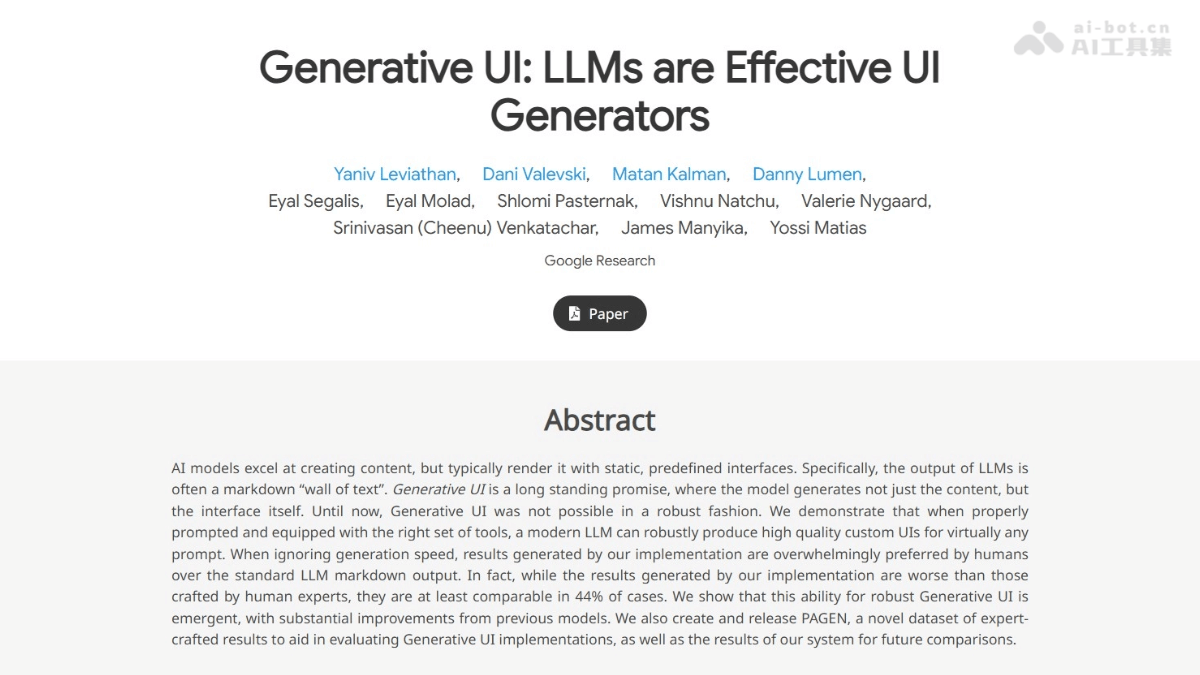
Generative UI is an innovative AI technology launched by Google that enables AI to instantly generate complete, interactive user interfaces based on users' natural language prompts. The interface can be a webpage, tool, game, or educational application, fully customized according to user needs. Generative UI achieves high-quality dynamic interactive experiences by accessing external tools (such as image generation, search engines), following system instructions, and post-processing corrections. Generative UI technology marks a shift in human-computer interaction from "text dialogue" to "dynamic interface co-creation," bringing new possibilities to education, entertainment, data analysis, and other fields.
Generative UI has been experimentally deployed in Google's Gemini App and the AI Mode of Google Search. In the Gemini App, through the "dynamic view" feature, customized interactive interfaces are generated for users, supporting educational tools, interactive exhibitions, and many other applications; in the AI Mode of Google Search, search results are transformed into interactive dynamic interfaces, such as physics simulations or data visualizations, enhancing users' understanding and operation experience of complex information.
Main features of Generative UI
-
Instant generation of interactive interfaces: Supports generating complete user interfaces based on user needs, not just text output.
-
Highly customizable: Generates personalized interfaces according to different user needs (such as education, entertainment, data analysis, etc.).
-
Dynamic interactive experience: Supports real-time interaction between users and the generated interface, such as operating simulations, adjusting parameters, etc.
-
Integration of external tools: Enhances the richness and practicality of the interface by accessing tools such as image generation, search engines, and code execution.
-
Post-processing optimization: Corrects and optimizes the generated interface to ensure the code is runnable, the style is consistent, and it is safe and reliable.
Technical principles of Generative UI
- Tool Access: AI is given the ability to access a series of external tools, including:
- Image generation system(such as Imagen): used to generate visual elements in the interface.
- Search engine: obtains the latest external information to enrich content.
- Code execution module: runs the generated code to ensure the interface functions properly.
- Graphics rendering and simulation environment: used to create dynamic and interactive visual effects.
- System-Level Instructions: To ensure the generated interface meets requirements, AI receives a set of detailed system instructions, including:
- Interface type: specifies whether the generated interface is a webpage, tool, dashboard, or another form.
- Code format: ensures the generated code can run correctly.
- Design style: defines the visual style of the interface to maintain consistency.
- Error specifications: avoids common errors to ensure the stability and usability of the interface.
These instructions act like a design specification, guiding AI to generate high-quality interfaces.
- Post-Processing: Before the interface output by AI is presented to users, it undergoes correction and safety checks by multiple layers of algorithms, including:
- Code checking: Ensuring that the generated code runs properly.
- Error correction: Correcting common logical or formatting errors.
- Visual style consistency: Maintaining a consistent visual style for the interface, such as a unified color scheme or layout.
- Security check: Ensuring that the output content is safe and reliable, avoiding potential risks.
Generative UI project address
- Project official website:https://generativeui.github.io/
- arXiv technical paper:https://generativeui.github.io/static/pdfs/paper.pdf
Application scenarios of Generative UI
-
Education: Presenting complex knowledge in a dynamic and interactive way, such as generating biological animations, mathematical simulations, or virtual history exhibitions, to help students understand learning content more intuitively.
-
Entertainment and gaming: Generating interactive fiction, educational games, and virtual character interaction applications, providing personalized entertainment experiences and enhancing user engagement.
-
Data analysis and professional assistance: Generating data dashboards, simulated experimental environments, and decision support tools for scientific research and business users, improving the efficiency of data analysis and decision-making.
-
Practical tasks: Generating home decoration suggestions, event planning tools, and personalized learning plans to help users complete daily tasks efficiently.
-
Social media and content creation: Providing users with personalized social media interfaces and content creation assistance tools, improving content quality and user experience.