
What is Generative Omnimatte
Generative Omnimatte is a video editing technology launched by Google DeepMind and other institutions. It can intelligently decompose a video into multiple RGBA layers with transparent backgrounds, each corresponding to an object and its related effects (such as shadows, reflections, etc.). It requires no green screen or depth information, can achieve precise separation of objects from the background, and can handle occluded parts. The core of Generative Omnimatte is a video diffusion model called "Casper," which can accurately erase objects and their shadows from videos while keeping the background intact. Users can easily achieve various creative effects, such as teleportation, changing motion speed, and even making time flow backward.
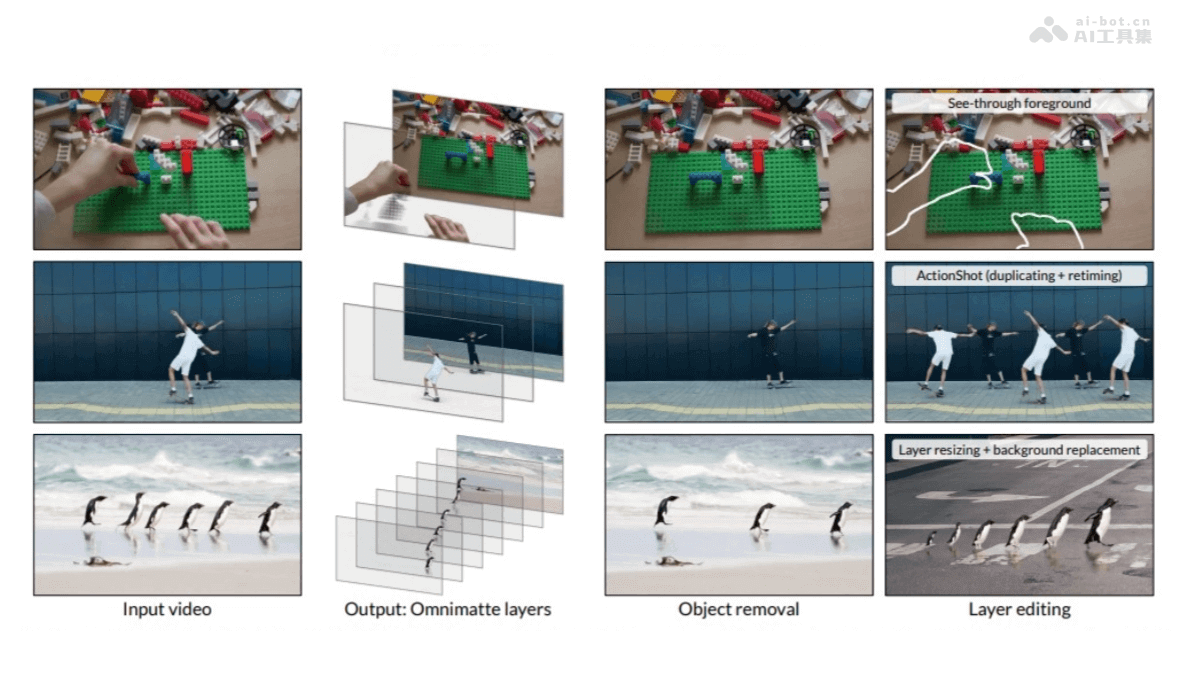
Main features of Generative Omnimatte
- Video layering: Decomposes a video into multiple RGBA layers, each containing a fully visible object and its related effects, such as shadows and reflections.
- Video editing: Supports users in performing a wide range of video editing operations, including removal of objects and effects, background replacement, and more.
- Dynamic background processing: Handles dynamic backgrounds and avoids entanglement between background elements and foreground object layers.
- Multi-object scenes: Effectively handles scenes containing multiple objects, including isolation of similar objects and association of effects.
- User-specified Trimask: Supports users in using a specified Trimask to finely control the regions to retain and remove during the video editing process.
Technical principles of Generative Omnimatte
- Object effect removal model Casper: Given an input video and a binary object mask, the Casper model is used to generate a clean background plate and a series of single-object (solo) videos, applying different Trimask conditions.
- Trimask conditions: Trimask specifies regions to retain (white), remove (black), and possibly contain uncertain object effects (gray). This helps accurately handle multi-object scenes.
- Test-time optimization: In the second stage, test-time optimization is used to reconstruct Omnimatte layers from solo video and background video pairs.
- Training data: The model is trained with multiple datasets (Omnimatte, Tripod, Kubric, and Object-Paste), providing examples of causal relationships in real videos and enhancing the model's ability to handle multi-object scenes.
- Self-attention analysis: Based on analyzing the self-attention patterns of the Lumiere model, it studies the intrinsic understanding of object-effect associations in text-to-video (T2V) models and trains an effective object effect removal model.
Project address of Generative Omnimatte
- Project official website:https://gen-omnimatte.github.io/
- arXiv technical paper:https://arxiv.org/pdf/2411.16683
Application scenarios of Generative Omnimatte
- Film and video production: In film production, remove unwanted background elements or replace the background to achieve seamless compositing of special effect scenes.
- Video editing and post-production: Video editors separate objects and backgrounds in videos for color correction, adding special effects, or other creative editing.
- Advertising production: In advertising, replace product backgrounds or remove distracting elements from shoots to highlight the product.
- Virtual reality and augmented reality: In VR and AR applications, combine real-world video content with virtual elements to provide a more immersive experience.
- Game Development: In game production, creating complex game environments that seamlessly blend real-world elements with virtual game worlds.