
What is Gemma 4 12B
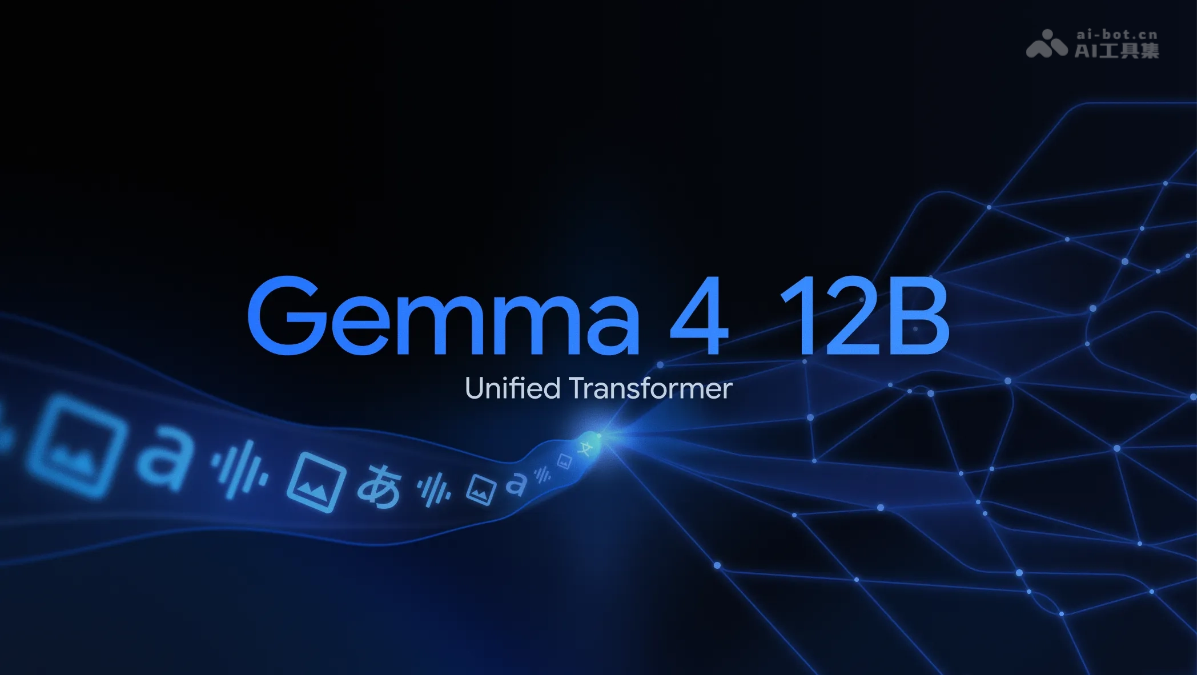
Gemma 4 12B is Google's open-source multimodal large model, featuring the industry's first encoder-free unified architecture, where visual and audio data are fed directly into the LLM backbone, completely eliminating independent encoders. With 12B parameters, it runs locally on a 16GB VRAM laptop, yet its performance surpasses the previous generation's 27B model: AIME mathematical reasoning soars from 20.8% to 77.5%. It supports text, image, audio, and video understanding as well as agentic reasoning, and for the first time introduces a native macOS desktop application, enabling fully local multimodal AI interaction on consumer-grade devices.
Main Features of Gemma 4 12B
-
Encoder-Free Unified Architecture: Completely eliminates independent visual and audio encoders, with multimodal data fed directly into the LLM backbone, and all modalities sharing the same Transformer weights.
-
Native Audio Input: The first mid-sized model in the Gemma family to support native audio understanding; previously this feature was limited to small edge models such as E2B/E4B.
-
Locally Friendly Deployment: The 12B parameters after 8-bit quantization are about 12GB, and it can run locally on a laptop with 16GB VRAM or unified memory, supporting MacBook Air M2 and RTX 4060 Laptop.
-
Leapfrog Performance Improvement: AIME mathematical reasoning soars from 20.8% on Gemma 3 27B to 77.5%, LiveCodeBench improves from 29.1% to 72%, GPQA Diamond reaches 78.8%, and DocVQA at 94.9% surpasses its own 26B model.
-
Native macOS Desktop Application: For the first time introduces Google AI Edge Gallery and Edge Eloquent desktop versions, supporting offline operation on Apple Silicon and voice editing interaction.
-
Multimodal Agentic Capabilities: Supports video understanding (1FPS frame extraction + audio analysis), automatic speech recognition, speaker diarization, code generation, and agentic reasoning.
Technical Principles of Gemma 4 12B
- Encoder-Free Architecture: Traditional multimodal models rely on frozen independent visual encoders (hundreds of millions of parameters) and audio encoders as "middlemen", translating pixels and waveforms into tokens before feeding them into the LLM, resulting in increased latency, memory fragmentation, and the inability to jointly fine-tune with the language model. Gemma 4 12B completely overturns this paradigm by adopting the same pure decoder Transformer as Gemma 4 31B Dense, achieving end-to-end unified processing.
- Visual Processing: Replaces the traditional 550M-parameter, 27-layer vision Transformer with a lightweight 35M-parameter embedding module. Raw images are split into 48×48 pixel patches and directly projected to the LLM hidden dimension through a single matrix multiplication; meanwhile, factorized coordinate lookup (X/Y matrices) directly appends spatial position information to the input tokens, allowing the language model to learn to see on its own.
- Audio Processing: Completely removes the independent 300M-parameter, 12-layer Conformer audio encoder. Raw 16kHz audio waveforms are sliced into 40ms frames and directly enter the LLM input space through linear projection, and the model learns to listen on its own.
- Unified Fine-Tuning Advantage: Since visual, audio, and text inputs share exactly the same weight space, downstream LoRA or full-parameter fine-tuning does not need to coordinate multiple frozen encoders, and the entire multimodal token loop can be naturally updated in a single forward pass via Hugging Face or Unsloth, greatly simplifying the fine-tuning process.
How to Use Gemma 4 12B
-
Download the Model: Download the pretrained and instruction-tuned weights of Gemma 4 12B from Hugging Face or Kaggle.
-
Choose the Runtime Environment: Load the model in LM Studio, Ollama, the Google AI Edge Gallery desktop app, or the LiteRT-LM CLI.
-
Start a local service: Use
litert-lm servecommand to start an OpenAI-compatible local API server. -
Connect agent tools: Point IDE plugins or agent frameworks such as Continue, Aider, and OpenClaw to the local API endpoint.
-
Build multimodal applications: Through visual embedding and audio projection capabilities, develop local AI applications that support image, speech, and video input.
-
Fine-tuning and customization: Use Hugging Face Transformers or Unsloth for LoRA/full-parameter fine-tuning to adapt to domain-specific tasks.
-
Deploy to production: Scale to cloud production environments through Google Cloud's Model Garden, Cloud Run, or GKE.
Core advantages of Gemma 4 12B
-
Minimal and efficient architecture: By removing the separate encoder with hundreds of millions of parameters, the model structure is more compact, memory usage is lower, the inference path is shorter, and latency is genuinely reduced.
-
Parameter efficiency revolution: With 12B parameters, it surpasses its own 27B predecessor and 26B MoE model on multiple benchmarks, proving that an encoder-free architecture achieves a better balance between efficiency and performance.
-
True multimodal unification: Vision, audio, and text are processed within the same weight space, and fine-tuning requires no complex coordination of encoder freezing and adapters; a single fine-tuning run covers all modalities.
-
Complete local AI loop: From model weights to desktop applications to API servers, Google provides an end-to-end local AI toolchain, enabling multimodal agents to run without cloud dependencies.
-
Agent ecosystem ready: Native support for agent frameworks such as OpenCode, together with the official Gemma Skills skill library, can be used directly to build automated programming and multimodal workflows.
Project address for Gemma 4 12B
- Project official website:https://blog.google/innovation-and-ai/technology/developers-tools/introducing-gemma-4-12B/
- HuggingFace model repository:https://huggingface.co/google/gemma-4-12B
Comparison of Gemma 4 12B with similar competitors
| Comparison dimension | Gemma 4 12B | Llama 3.2 11B Vision |
|---|---|---|
| Architecture design | Encoder-free unified architecture, with vision/audio projected directly to the LLM backbone | Traditional multi-encoder architecture, with an independent vision encoder (CLIP-style) + projection layer connected to the LLM |
| Modality support | Text, images, audio, video (native audio input) | Text, images (no native audio input support) |
| Parameter scale | 12B Dense | 11B Dense |
| Local deployment threshold | 8-bit quantization is about 12GB, runnable with 16GB unified memory/VRAM | 8-bit quantization is about 11GB, runnable with 16GB unified memory/VRAM |
| Inference latency | Eliminates the encoder bottleneck, with lower end-to-end latency and faster first-token response | Must first be processed by the vision encoder, and the multi-stage pipeline increases latency |
| Fine-tuning method | Unified weights: a single LoRA/full-parameter fine-tuning covers all modalities | The vision encoder is usually frozen, and the projection layer and LLM need to be fine-tuned separately, making the process more complex |
| Performance benchmark | AIME 77.5%,LiveCodeBench 72%,DocVQA 94.9% | AIME/LiveCodeBench data not disclosed, MMMU around 50% level |
| Native desktop application | Official macOS desktop app (Edge Gallery/Eloquent) + LiteRT-LM CLI | No official desktop app; relies on third-party tools such as Ollama and LM Studio |
| Open-source license | Apache 2.0 (commercially usable, no restrictions) | Llama 3.2 Community License (commercial use requires monthly active users << 700 million, with additional terms) |
| Audio capabilities | Native audio understanding, supports ASR, speaker diarization, and joint audio + video analysis | No audio input capability; requires additional integration of independent models such as Whisper |
| Agent ecosystem | Official Gemma Skills library + native OpenCode support | Community-driven toolchain, no official agent skills library |
| Quantization ecosystem | Full-platform support for Unsloth GGUF, MLX, vLLM, and SGLang | Supports Ollama, llama.cpp, and vLLM, but the MLX ecosystem is weaker |
| Context length | 128K | 128K |
Application scenarios for Gemma 4 12B
-
Privacy-sensitive applications: medical consultations, internal document analysis, and customer service call processing, with data not needing to be uploaded to the cloud.
-
Multimodal Agent: local automated workflows combining images, voice, and text, such as retail inventory inspection and on-site equipment diagnosis.
-
Developer assistance: a local code assistant; the 128K context can analyze large codebases and supports function calling and structured output.
-
Real-time translation and OCR: game UI translation, screenshot text extraction, and multilingual document processing.
-
Edge and offline environments: fieldwork, travel scenarios, and security-isolated networks without network dependency.