
What is Gemini Robotics
Gemini Robotics is a robotics project launched by Google DeepMind based on Gemini 2.0 , bringing the capabilities of large multimodal models into the physical world. The project includes two main models: Gemini Robotics-ER and Gemini Robotics. Gemini Robotics-ER is an enhanced vision-language model (VLM) with strong embodied reasoning capabilities, supporting tasks such as understanding 3D space, object detection, pointing, trajectories, and grasp prediction. Gemini Robotics is a vision-language-action (VLA) model that supports direct control of robots to complete complex manipulation tasks, demonstrating robustness to changes in object types and positions and executing open-vocabulary instructions. Based on further fine-tuning, Gemini Robotics can solve long-horizon, high-dexterity tasks (such as origami or playing cards) and quickly adapt to new tasks and robot embodiments.
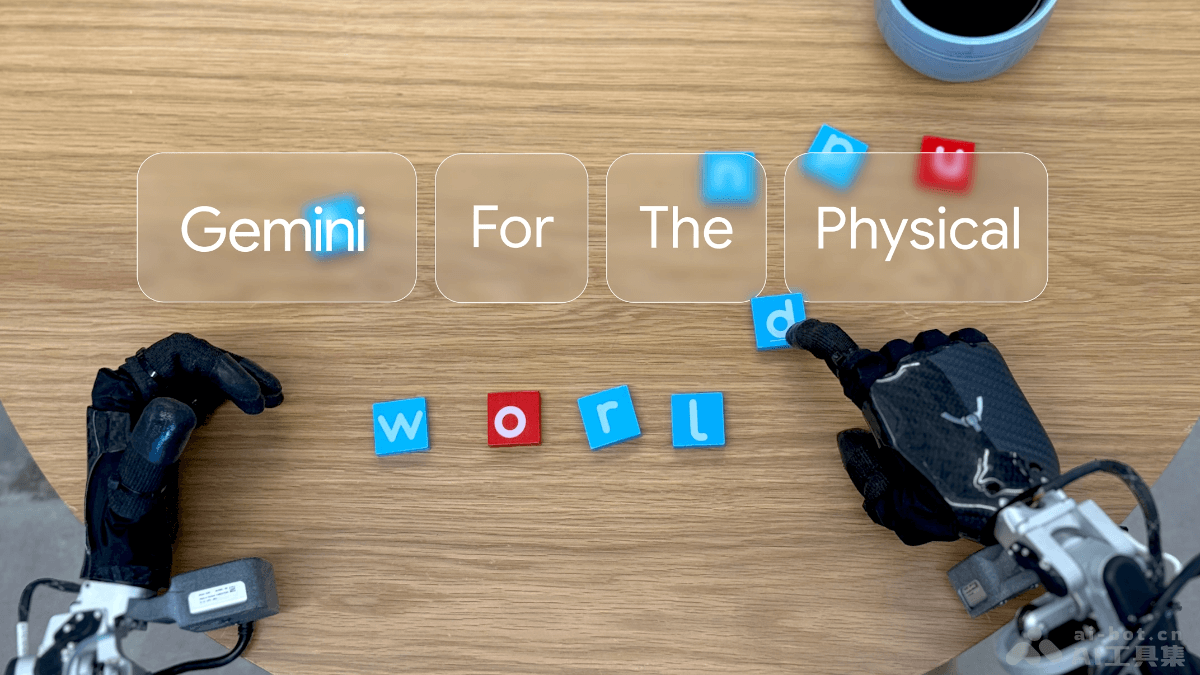
Main Features of Gemini Robotics
- Intelligent dialogue and question answering for executing complex tasks:
- High-dexterity tasks: such as origami, playing cards, using tools, etc.
- Long-horizon tasks: such as packing a lunch box, making a sandwich, and other multi-step tasks.
- Fine manipulation: such as using tweezers to pick up small objects, tightening bottle caps, etc.
- Powerful visual and language understanding capabilities:
- Visual understanding: recognizing and locating objects in scenes, supporting multi-view understanding, 3D spatial reasoning, and object detection.
- Language understanding: understanding natural language instructions and executing open-vocabulary tasks.
- Environmental adaptation and generalization capabilities:
- Visual generalization: robust to changes in background, lighting, and distracting objects in scenes.
- Action generalization: adapting to changes in object positions and manipulation of different object instances.
- Instruction generalization: understanding different expressions of instructions (such as different languages, instructions with spelling errors).
Technical Principles of Gemini Robotics
- Gemini 2.0 foundation model: built on Gemini 2.0. Gemini 2.0 provides Gemini Robotics with powerful visual and language understanding capabilities.
- Embodied reasoning: Gemini Robotics-ER is an extended version of Gemini Robotics, focusing on embodied reasoning capabilities. It supports understanding 3D space, object relationships, and motion trajectories in the physical world.
- Vision-language-action (VLA) model:
- Visual input: acquiring scene images through cameras to recognize objects and the environment.
- Language instructions: understanding natural language instructions and converting them into specific robot actions.
- Action output: generating robot action instructions to achieve execution of complex tasks.
- Data-driven training:
- Robot action data: learning how to perform various tasks based on operation data from real robots.
- Non-robot data: such as web images, text, videos, etc., providing rich background knowledge and generalization capabilities.
- Architecture design:
- Cloud VLA backbone network: responsible for handling complex visual and language reasoning tasks.
- Local action decoder: Runs locally on the robot, responsible for generating action commands in real time, ensuring low latency and high responsiveness.
Gemini Robotics project address
- Project official website:https://deepmind.google/discover/blog/gemini-robotics
- Technical paper:https://storage.googleapis.com/deepmind-media/gemini-robotics
Gemini Robotics application scenarios
- Industrial manufacturing: Used in complex assembly, quality inspection, and repair to improve production efficiency and precision.
- Logistics and warehousing: Enables automation of cargo sorting, packaging, and loading/unloading, improving logistics efficiency.
- Home services: Assists with household chores such as organizing, cleaning, and caring for the elderly or disabled.
- Healthcare: Assists with rehabilitation training and surgical operations, supporting medical processes.
- Education and research: Serves as an educational tool and research assistant, supporting teaching and experimental operations.