
What is Gemini Robotics On-Device
Gemini Robotics On-Device is the first vision-language-action (VLA) model from Google DeepMind that can run locally on robots. The model has powerful offline operation capabilities and can follow natural language instructions to complete delicate tasks, such as opening bags and folding clothes. The model supports deployment on a variety of robot embodiments, has low response latency, and is suitable for latency-sensitive applications. Gemini Robotics On-Device has the ability to quickly adapt to new tasks; it only needs 50 to 100 demonstration samples to learn new actions, demonstrating strong generalization performance. Google has launched the Gemini Robotics SDK to help developers evaluate and deploy the model, reducing development costs and risks.
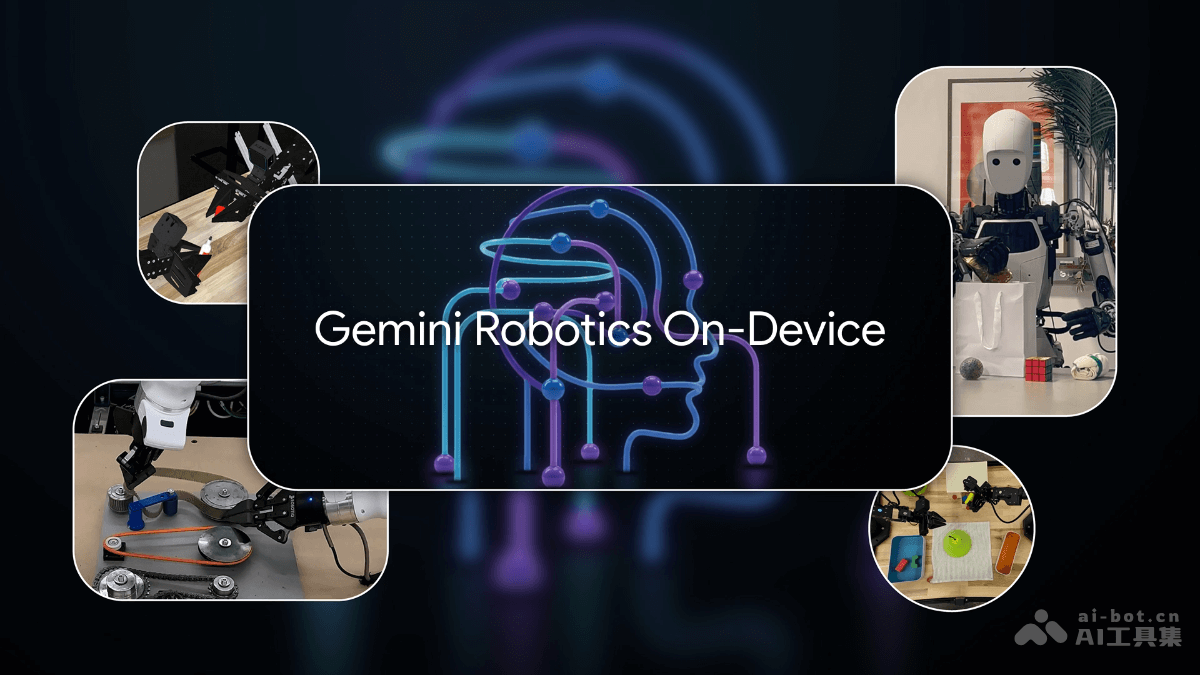
Main features of Gemini Robotics On-Device
- Local offline operation: Gemini Robotics On-Device can run entirely locally on the robot without relying on cloud computing, solving the problems of network latency and unstable connections. It enables robots to stably execute tasks in environments without a network connection or with a weak network signal.
- Follow natural language instructions: The model can understand human natural language instructions. The model can handle complex multi-step instructions, enabling robots to truly operate according to human intent.
- Complete delicate manipulation tasks: It supports a variety of robot embodiments, from humanoid robots to industrial dual-arm robots, and can complete various tasks requiring delicate manipulation, such as opening bags, folding clothes, zipping a lunchbox, drawing cards, pouring salad dressing, and industrial-grade belt assembly.
- Quickly adapt to new tasks: For the first time, Google has opened the fine-tuning capability of a VLA model. Developers only need 50 to 100 demonstration samples to enable the model to adapt to entirely new tasks. Even for the most complex tasks, fewer than 100 samples can achieve a fairly high success rate.
- Cross-platform deployment: The model can be transferred to completely different robot platforms, such as the dual-arm Franka FR3 robot and Apptronik's Apollo humanoid robot, demonstrating strong generalization ability.
Technical principles of Gemini Robotics On-Device
- Multimodal reasoning capability: Gemini Robotics On-Device is based on the multimodal reasoning capability of Gemini 2.0 and can simultaneously process multiple modalities of information such as vision, language, and action. It perceives the environment based on visual input, understands language instructions to determine task goals, and generates corresponding actions to complete the task.
- Optimized model architecture: To achieve local operation, the model has been optimized to reduce computational resource requirements while maintaining strong performance. The model can achieve low-latency inference on robot devices, ensuring real-time execution of tasks.
- Fine-tuning capability: As Google's first fine-tunable VLA model, developers can fine-tune the model based on a small number of demonstration samples, enabling the model to adapt to new tasks and environments. The fine-tuning capability allows the model to quickly learn new skills and improves the adaptability and flexibility of robots.
- Safety mechanisms: The model is based on an overall safety scheme that emphasizes both semantic safety and physical safety. It uses the Live API to capture semantic and content safety issues, preventing robots from performing potentially dangerous or inappropriate behaviors. It interfaces with underlying safety-critical controllers to ensure that the robot's actions meet physical safety requirements, safeguarding the robot's safety when executing tasks.
Project address of Gemini Robotics On-Device
- Project official website:https://deepmind.google/discover/blog/gemini-robotics-on-device-brings-ai-to-local-robotic-devices/
Application scenarios of Gemini Robotics On-Device
- Industrial manufacturing: On industrial production lines, performing complex assembly tasks, such as automobile parts assembly and fine installation of electronic devices, to improve production efficiency and quality.
- Logistics and Warehousing: Assisting in moving goods, managing inventory, identifying cargo information and sorting and stacking according to instructions, optimizing logistics processes, and reducing manual errors.
- Medical Care: Assisting medical staff in tasks such as passing surgical instruments and guiding rehabilitation training, providing patients with precise care, and reducing the workload of medical staff.
- Home Services: Helping complete household chores, such as cleaning, organizing items, and caring for the elderly and children, enhancing convenience and comfort in life.
- Retail Services: In places such as shopping malls and supermarkets, providing customers with services such as product information inquiries, shopping guidance, and cargo handling, enhancing the shopping experience.