
What is Gemini Deep Research
Gemini Deep Research is a deep research agent launched by Google, built on Gemini 3 Pro and optimized for long-horizon content collection and synthesis tasks. Through multi-step reinforcement learning, the agent can autonomously navigate complex information environments with high precision, reducing hallucinations and improving report quality. Gemini Deep Research can iteratively plan research paths, repeatedly search and analyze data, and generate in-depth research reports. Gemini Deep Research has achieved excellent results on multiple benchmarks. In the future, it will be applied to products such as Google Search and Google Finance, and opened to developers through the Interactions API, helping build the next generation of automated research tools.
Main features of Gemini Deep Research
- Complex information retrieval and analysis: Through multi-step reinforcement learning, it autonomously plans research paths, including forming queries, reading results, identifying knowledge gaps to search again, and can obtain precise data in complex information environments.
- High-quality report generation: Based on the Gemini 3 Pro model, it reduces hallucinations, improves report quality, and generates structured, detailed research reports with citation support.
- Unified information synthesis: Integrates uploaded files (such as PDF, CSV) and public web data, handles large context volumes, and supports comprehensive analysis of multiple data sources.
- Controllable report structure: Users can define report structure, headings, table formats, etc. through prompts, achieving highly customizable output.
- Fine-grained citations and data verification: Provides fine-grained sources for every fact in the report, making it convenient for users to trace and verify the original provenance of data.
- Low-cost and efficient research: While maintaining high quality, it significantly reduces the cost of generating in-depth research reports and improves research efficiency.
- Supports structured output: Supports JSON format output, making it convenient for downstream applications to parse and further process research results.
Performance of Gemini Deep Research
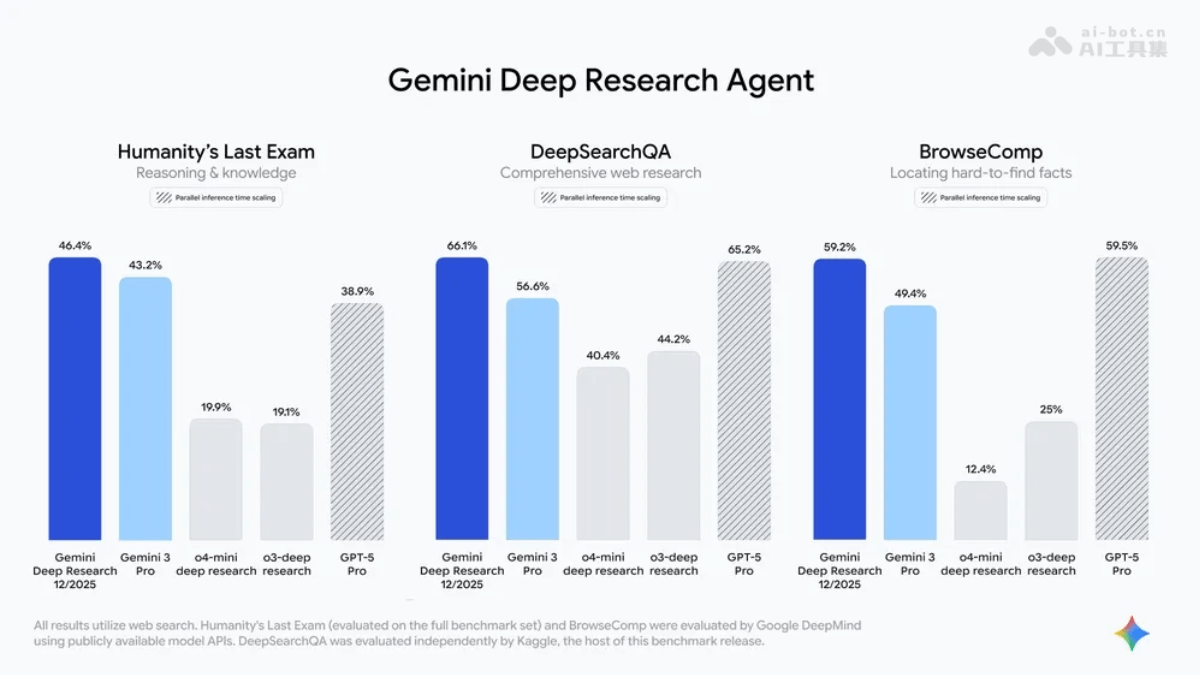
- In Humanity’s Last Exam (HLE) , the score reached 46.4%, performing better than other similar models.
- In the DeepSearchQA benchmark test, the score was 66.1%, demonstrating strong multi-step research capabilities.
- In the BrowseComp test, the score was 59.2%, comparable to GPT-5 Pro, with lower cost.
How to use Gemini Deep Research
- Register an account: At Google AI Studio , register an account and create a project to obtain a Gemini API Key.
- Build the request:
- Prepare a task description (such as "generate a report about AI in the medical field").
- Provide input file links (such as PDF, CSV).
- Build a JSON request containing the task description, file links, and output format.
- Send the request: Use Python or another programming language to send the request via HTTP POST to the Interactions API endpoint, adding the API Key in the request header.
- Process the response: Parse the JSON data returned by the API and extract the generated report or analysis results.
- Integrate into the application: Embed the capabilities of Gemini Deep Research into the application, design the user interface, and allow users to conveniently input tasks and obtain results.
Gemini Deep Research project official website
- Project address:https://blog.google/technology/developers/deep-research-agent-gemini-api/
Application Scenarios of Gemini Deep Research
-
Financial Services: Automate due diligence and market analysis, helping investment teams quickly complete early-stage research and improve decision-making efficiency.
-
Biotechnology: Accelerate drug development and toxicity prediction, improving research depth and granularity through in-depth literature analysis.
-
Market Research: Generate industry trend and competitive intelligence reports, supporting enterprises in formulating market strategies and product planning.
-
Academic Research: Quickly generate literature reviews and interdisciplinary research reports, assisting with academic paper writing and research projects.
-
News Creation: Provide journalists with background research and data support, generating in-depth reports and thematic analyses.