
What is Gamma-World
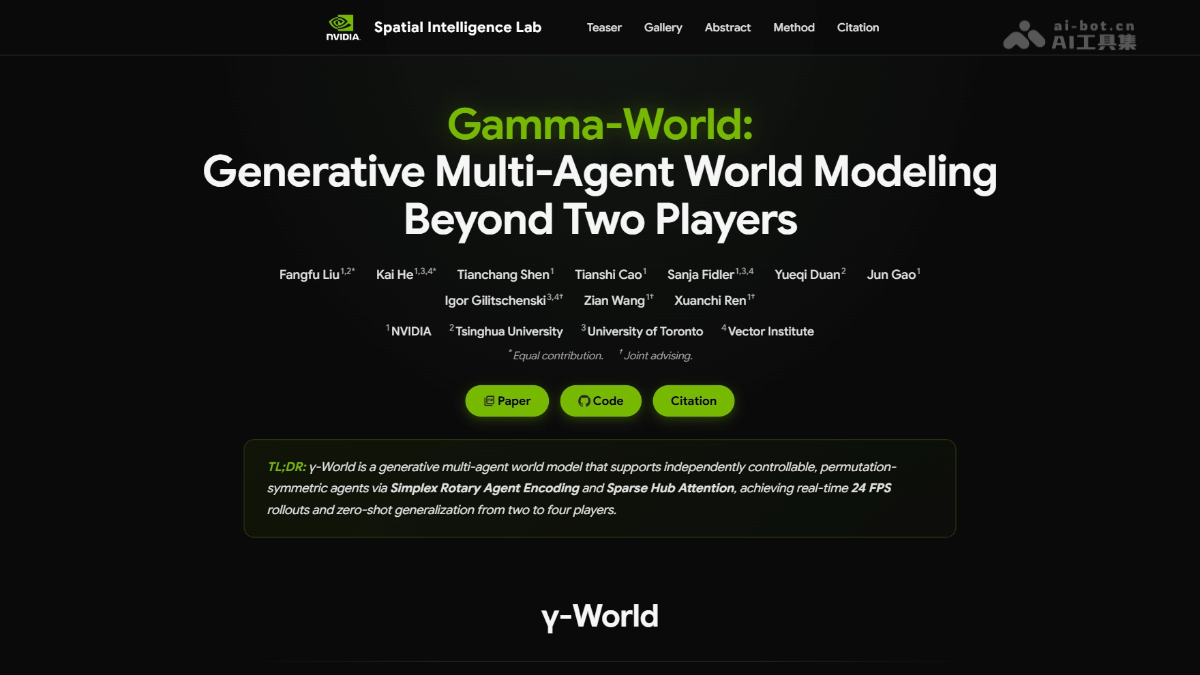
Gamma-World is a multi-agent world model launched by NVIDIA, capable of solving the problem of multiple agents interacting equally and remaining globally consistent within the same simulated world. The model innovatively adoptssimplex rotation encodingto ensure agent identity symmetry, combined withsparse hub attentionto reduce communication complexity from quadratic to linear, enabling real-time, scalable multi-view video generation. The model can zero-shot generalize from two-person interaction to multi-person collaboration, making it an important breakthrough in building interactive virtual worlds.
Main features of Gamma-World
- Equal and inclusive multi-agent interaction: Supports any number of agents in the same dynamic worldacting independently and interacting equally, without the need to preset master-slave relationships or fixed identities.
- Synchronized multi-view video generation: Can simultaneously generatemultiple views that are consistent and physically plausibleofvideo frame sequences, accurately simulating spatial occlusion and causal interactions between agents.
- Zero-shot generalization to unseen numbers: Ontwo-person interaction data training, can directly generate without fine-tuningfour or even more agentsin collaborative scenes.
- Real-time interactive-level inference: Through engineering optimization, achieves24 FPSreal-time generation speed, with key quality metric (FVD) reduced by an average ofover 40%。
Technical principles of Gamma-World
- Simplex rotation agent encoding: Uses regular simplex vertices in high-dimensional space to map each agent. Since the geometric distance between any two vertices is equal, each agent obtains a unique but completely equivalent "identity." The encoding scheme requires no learnable parameters, ensuring from principle the equal status and permutation symmetry of all agents。
- Sparse hub attention mechanism: Introduces a set of learnable shared "hub tokens" as the information relay station for all agents. Each agent only needs to interact with the hub token, forming a agent→hub→agenttwo-hop communication path.The spoke-hub topologyis the key to reducing computational complexity, transforming fully connected dense interactions across agents into sparse, controllable linear interactions。
How to use Gamma-World
- Get the code: Visit the Gamma-World project homepage and clone its GitHub repository.
- Configure the environment: Install Python and PyTorch dependencies according to requirements.txt, and prepare a GPU with more than 24GB of VRAM.
- Download weights: Obtain the pretrained model files from the official link, such as
gamma_world_2agent.pth。 - Run generation: Execute the example script, specify the number of agents and prompts, and output a multi-view interactive video.
- Train on your own: Prepare a multi-agent dataset and start the training script according to the three-stage strategy.
Core advantages of Gamma-World
- Breakthrough generalization capabilityTrained on two-agent data, it can zero-shot generate coordinated interaction scenes for four or even more agents.
- Linear computational complexity: Through sparse hub attention, multi-agent communication is reduced from quadratic to linear, and the computation for an 8-agent scenario is only 1/16 that of traditional solutions.
- Real-time interaction performance: Achieves an inference speed of 24 FPS, while generation quality (FVD) is reduced by more than 40% on average compared with the baseline.
- General-purpose architecture design: A simplex encoding without learnable parameters ensures equal symmetry among agents and can seamlessly adapt to different domains such as games and robotics.
Gamma-World project address
- Project website:https://research.nvidia.com/labs/sil/projects/gamma-world/
- GitHub repository:https://github.com/nv-tlabs/Gamma-World
- arXiv technical paper:https://arxiv.org/pdf/2605.28816
Gamma-World application scenarios
- Multiplayer game development: As a generation engine for open-world games, it generates complex interactions between NPCs and players in real time, supporting dynamic plots and multi-perspective cutscenes.
- Robot collaborative training: Simulates dual-arm or multi-robot collaboration in virtual environments, generating infinitely diverse, physically consistent training data and reducing the cost of real-world experiments.
- Autonomous driving simulation: Simultaneously simulates the interactive behavior of multiple intelligent vehicles and pedestrians, generating multi-perspective traffic scenes for algorithm testing and safety evaluation.
- Film and virtual production: Automatically generates synchronized performance footage of multiple characters in the same scene based on script prompts, assisting previsualization or creative expansion.
- Embodied intelligence research: Provides a high-fidelity "digital sandbox" for multi-agent tasks such as home services and warehouse logistics, supporting policy learning and zero-shot generalization testing.