
What is Funloom
Funloom is an AI-native game content co-creation platform founded by Gen Z entrepreneur Wu Tong. It allows users to generate a complete game including visuals, music, maps, and intelligent NPC interactions within five minutes through simple character settings and worldview input, without any programming, art, or game engine background.
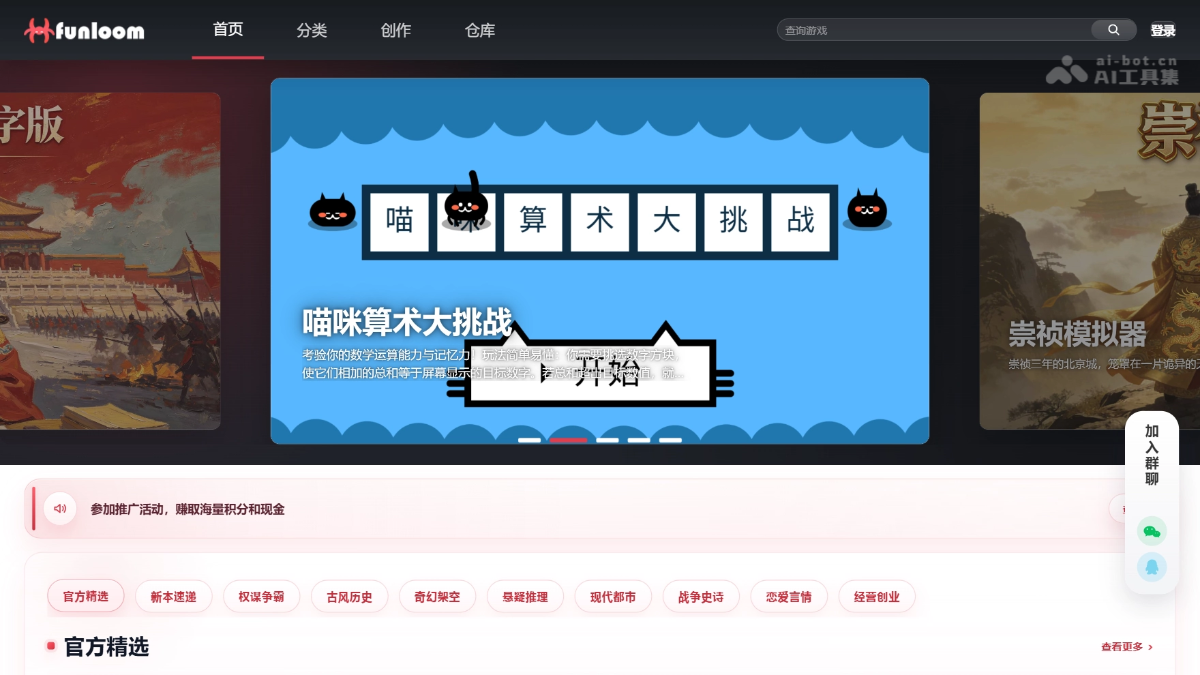
Funloom's main features
-
AI-native game generation: Encodes narrative design expertise into the AI's underlying instructions, automatically generating long-form adventure plots and dramatic story content.
-
Ultra-long-term worldview consistency: The underlying architecture ensures that NPC dialogue history and logic units always remain consistent, preventing NPCs from "losing memory" or map landmarks from being misplaced.
-
Visual GUI components: Provides components such as map search, inventory management, and attribute panels, staying close to the usage habits of traditional RPG users.
-
Dual-mode interaction: Supports free text input to express ideas, and also allows clicking preset options to smoothly advance the game.
-
AI Coding extension: Triggers new interactive components and interfaces through a few natural language requirements, continuously expanding game functionality.
How to use Funloom
-
Visit the platform: Visit the Funloom AI official website https://funloom.kurangames.com/funloom/。
-
Input settings: Tell the AI what theme you want and who the protagonist is, and provide simple character settings and worldview.
-
Automatic generation: The AI automatically completes the generation of the plot, visuals, music, maps, and intelligent NPCs.
-
Start playing: Advance the game through text input or preset options and experience the complete interactive content.
-
Secondary creation: Create secondary works based on existing games and generate derivative versions.
Funloom's core advantages
-
Zero-threshold creation: No programming, art, or game engine knowledge is required; anyone can make games.
-
AI-native definition: Without AI, the game would not exist, which is different from the traditional model of games plus AI patches.
-
Activation of long-tail themes: Greatly reduces the development cost of niche and non-mainstream themes, activating content that the traditional game industry is unwilling to cover.
-
Team DNA: The founder has both game engineering and content creation backgrounds. The team includes Alibaba's AI algorithm lead, a former Baidu gaming industry general manager, and several Gen Z master's and doctoral students from BUPT.
Comparison of Funloom with similar competitors
| Dimension | Funloom AI | AI Dungeon |
|---|---|---|
| Product positioning | AI-native game content co-creation platform | AI-native text interactive adventure game platform |
| Creation threshold | Zero code; a complete game can be generated through natural language input | Natural language input drives the plot, but there are no visual game-building tools |
| Degree of AI nativeness | Core gameplay, worldview, and NPCs all rely on AI generation | The core plot is entirely AI-generated, with no preset script |
| Worldview consistency | Ultra-long-term consistency guarantee, with coherent NPC memory | Long-term consistency is weaker; NPCs easily "lose memory," and the plot easily drifts |
| GUI components | Complete RPG components such as map search, inventory management, and attribute panels | Plain text interaction, no visual GUI |
| Graphics/Music | Automatically generates graphics, music, and maps | Plain text, no automatically generated graphics or music |
| Derivative creation | Supports derivative creation and adaptations based on existing games | Supports community story sharing, but has no structured derivative creation tools |
| Target users | General players + game creators | Mainly text adventure game players |
Funloom's application scenarios
-
Personal entertainment: General players can experience creative games on long-tail themes such as "Green Pepper Simulator" and "Chongzhen Simulator" without any technical background.
-
UGC content creation: Users quickly generate complete games through natural language input and share them, forming a small-circle KOL social network.
-
Cultural expression: Provides low-cost creation tools for niche cultural groups, enabling personalized cultural expression that the traditional game industry is unwilling to cover.
-
Educational simulation: Used for immersive interactive experiences on academic, historical, and other topics, assisting learning and understanding in a gamified way.