
What is FunctionGemma
FunctionGemma is a lightweight AI model open-sourced by Google, focused on function calling optimization, with 270 million parameters. The model is based on the Gemma 3 architecture and is designed to run on edge devices such as phones and browsers. It can convert natural language into executable API actions, enabling efficient interaction between agents and tools. The model has strong multi-step reasoning and task execution capabilities, supports offline operation, and is widely used in scenarios such as mobile voice assistants and home automation control, meeting users' need for AI that can "get things done" and driving AI's shift from conversational interfaces to proactive agents.
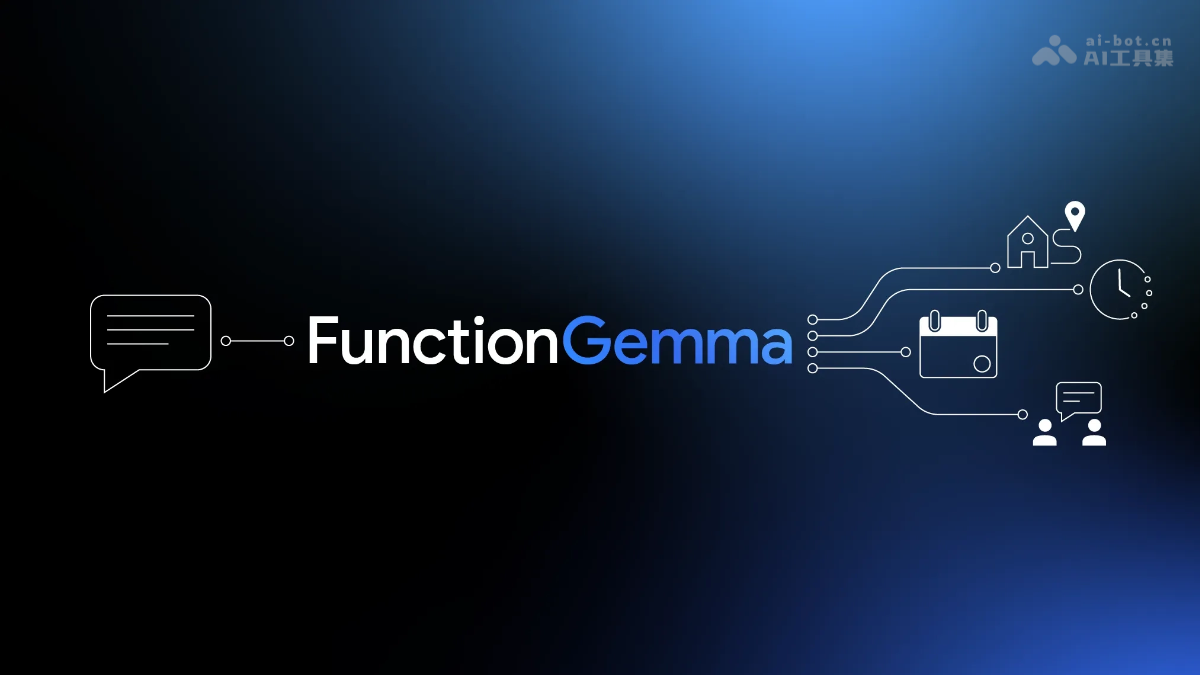
Main Features of FunctionGemma
-
Conversion from Natural Language to Function Calls: Converts users' natural language instructions into structured function calls, for example, converting "wake me up at 7 tomorrow morning" into an API function call for setting an alarm.
-
Multi-Step Task Execution: Supports decomposition and execution of complex multi-step tasks. For example, in the instruction "plant sunflowers all across the top row, then water them," the model breaks it down into multiple function calls, executing the planting and watering operations in sequence.
-
Localized Operation and Privacy Protection: Designed for edge devices (such as phones and IoT devices), it supports local operation without an internet connection, ensuring user data privacy and low-latency responses.
-
Multilingual Support: Supports input in multiple languages, can process instructions in different languages, and convert them into corresponding function calls.
-
Customized Training: Provides fine-tuning tools, allowing developers to customize training of the model according to specific application scenarios, further improving its performance and reliability on specific tasks.
-
Agent Interaction: Acts as an independent agent to execute local tasks, and can also serve as an "intelligent router," distributing complex tasks to larger models in the cloud or on other devices, enabling efficient system collaboration.
Technical Principles of FunctionGemma
-
Optimization Based on the Gemma 3 Architecture: FunctionGemma is a lightweight model optimized on the basis of the Gemma 3 architecture. It inherits Gemma 3's efficient decoder structure and undergoes specialized fine-tuning and optimization for function calling tasks.
-
Model Adaptation and Fine-Tuning: Uses "model adaptation" technology to map the weights of the extensively pretrained Gemma 3 model into a new task-specific structure. Through fine-tuning on specific datasets (such as common tasks on mobile devices), the model can learn precise function calling patterns and performs outstandingly on edge tasks.
-
Structured Output Capability: The model is trained to generate structured data (such as JSON format). The data can be used directly to call external APIs or execute system commands, achieving seamless integration between natural language and software interfaces.
-
Edge Optimization: To run efficiently on resource-constrained edge devices, FunctionGemma is optimized in multiple aspects, including model quantization (such as Int8 or Int4 quantization) to reduce memory usage and power consumption, and vocabulary optimization for efficient processing of JSON and multilingual input.
FunctionGemma Project Address
- Project Official Website:https://blog.google/technology/developers/functiongemma/
- HuggingFace Model Repository:https://huggingface.co/collections/google/functiongemma
Application Scenarios of FunctionGemma
-
Mobile Voice Assistant: Integrated into mobile phone systems to enable voice command execution for local tasks such as setting reminders, controlling the flashlight, and managing schedules, improving interaction efficiency.
-
Smart Home Control: As a smart home hub, control devices such as lights and temperature via voice commands, or execute scenario-based operations such as "sleep mode."
-
Game Interaction: Used for voice-controlled games, such as decomposing complex commands like "plant sunflowers and water them" into game function calls, enhancing game interactivity.
-
Mobile Office Applications: In mobile office scenarios, complete tasks such as sending emails and editing documents via voice commands, improving work efficiency.
-
Health and Fitness Applications: Integrated into health devices or fitness applications to record health data, guide fitness movements, and provide personalized health management.