
What is FreeScale
FreeScale is a fine-tuning-free inference framework launched by Nanyang Technological University, Alibaba Group, and Fudan University, enhancing the ability of pre-trained diffusion models to generate high-resolution images and videos. Based on processing and fusing information from different scales, FreeScale effectively solves the problem of repetitive patterns caused by increased high-frequency information when models generate content beyond their training resolution. FreeScale achieves 8K resolution image generation for the first time, not only improving the quality and fidelity of generated content but also reducing inference time, significantly surpassing existing methods.
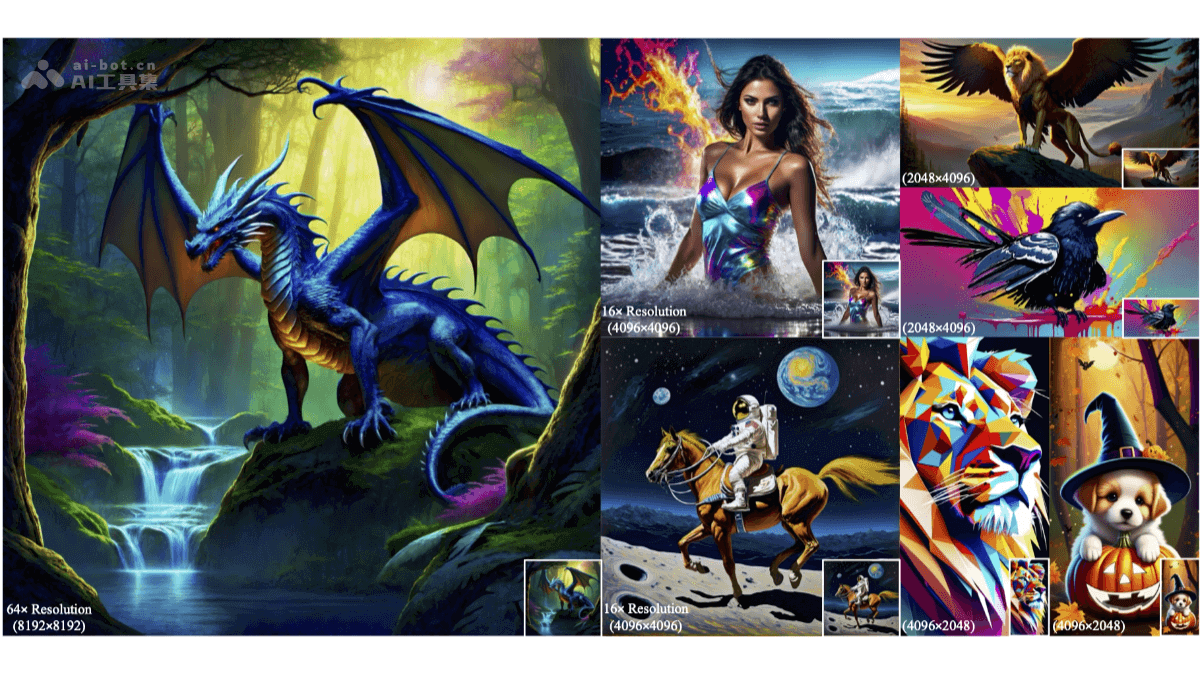
Main Features of FreeScale
- High-Resolution Visual Generation: FreeScale can generate high-quality images and videos up to 8K resolution, expanding the capabilities of visual diffusion models in high-resolution generation.
- No Fine-Tuning Required: Unlike traditional methods that require fine-tuning, FreeScale does not require additional adjustments or training of pre-trained models to achieve high-resolution output.
- Handling High-Frequency Information: Based on extracting and fusing information from different scales, FreeScale effectively manages high-frequency information, reducing repetitive patterns and artifacts in generated content.
- Multi-Scale Information Fusion: By combining information from different receptive field scales, FreeScale optimizes the generation of local and global details, improving the overall quality of visual content.
- Flexible Control of Detail Level: Users can adjust the level of detail in different regions as needed, achieving finer control over visual effects.
Technical Principles of FreeScale
- Custom Cascaded Upsampling: Starting from pure Gaussian noise, gradually denoise to generate images at training resolution, and obtain higher-resolution images through upsampling.
- Constrained Dilated Convolution: To expand the receptive field of convolution and reduce local repetition issues, FreeScale uses dilated convolution in specific network layers.
- Scale Fusion: During the denoising process, adjust the self-attention layer to have both global and local attention structures, fusing high-frequency details from global attention and low-frequency semantics from local attention based on Gaussian blur.
- Frequency Component Extraction and Fusion: By extracting the required frequency components and fusing them, optimize high-resolution generation quality and reduce repetitive pattern issues caused by high-frequency information.
- Detail Level Control: Adjust the level of generated details based on scaling the cosine decay factor to control the level of newly generated details, achieving differentiated processing of details in different semantic regions.
FreeScale Project Address
- Project Website:haonanqiu.com/projects/FreeScale
- GitHub Repository:https://github.com/ali-vilab/FreeScale
- arXiv Technical Paper:https://arxiv.org/pdf/2412.09626
Application Scenarios of FreeScale
- High-Quality Image Generation: In art creation and digital entertainment, generate high-resolution artworks, game textures, and textures for 3D models.
- Video Content Production: In film and video production, generate high-resolution video content, improve video quality, and reduce post-production costs and time.
- Virtual Reality (VR) and Augmented Reality (AR): In VR and AR applications, generate high-resolution virtual environments and objects, enhancing user experience.
- Advertising and Marketing: Create attractive advertising images and videos to enhance the visual impact and appeal of advertisements.
- Social Media Content: Social media users generate high-resolution images and videos for personal branding or content sharing.