
What is Fractal Generative Models
Fractal Generative Models is a newimage generationmethod launched by the MIT Computer Science and Artificial Intelligence Laboratory and the Google DeepMind team. Fractal Generative Models is based on the idea of fractals, abstracting generative models into reusable "atomic modules," and building self-similar fractal architectures based on recursive calls to modules, achieving pixel-by-pixel generation of high-resolution images. The model uses a divide-and-conquer strategy, combined with Transformer modules, to progressively refine from image patches to the pixel level, ultimately achieving efficient generation. Compared with traditional methods, the computational efficiency of fractal generative models is improved by 4000 times, and they perform excellently in image quality and generation speed. Fractal Generative Models has the potential to handle high-dimensional non-sequential data and can be applied to fields such as molecular structures and proteins.
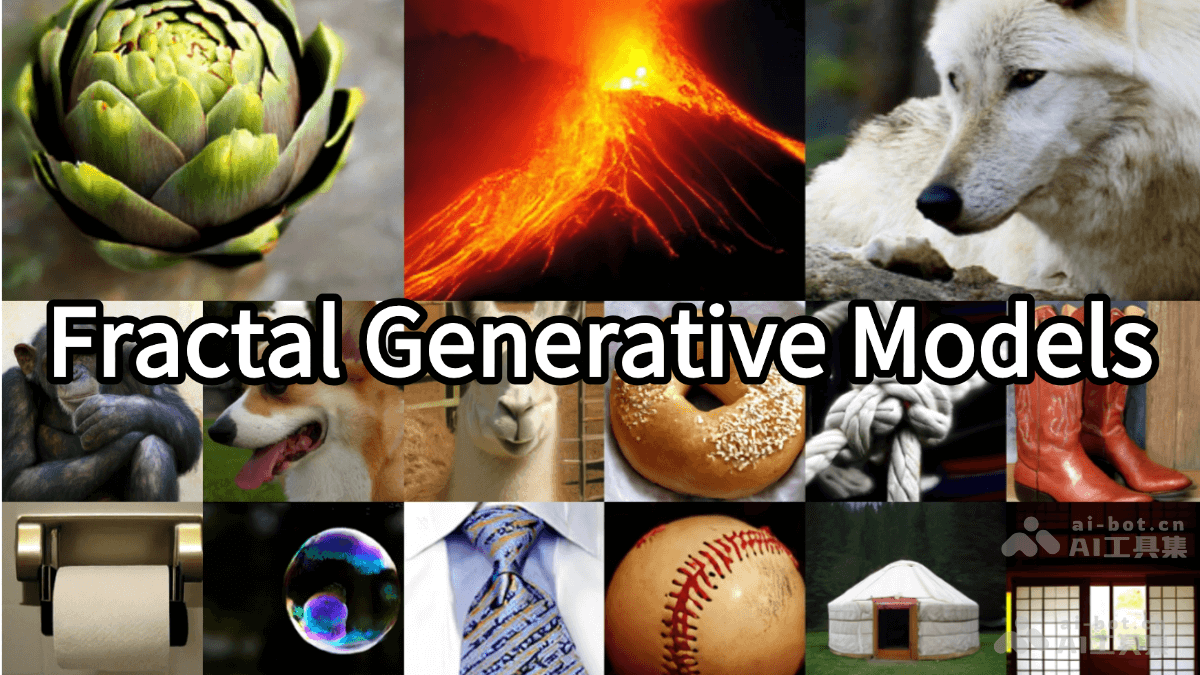
Main Features of Fractal Generative Models
- Pixel-by-pixel generation of high-resolution images: Generate high-quality high-resolution images pixel by pixel, solving the computational bottleneck of traditional generative models in high-resolution image generation.
- Significantly improved computational efficiency: Compared with traditional methods, the computational efficiency of fractal generative models is improved by 4000 times, making pixel-by-pixel generation of high-resolution images possible.
- Modeling high-dimensional non-sequential data: It can be used not only for image generation, but can also be extended to the modeling of other high-dimensional non-sequential data, such as molecular structures and proteins.
- Masked reconstruction and semantic prediction: Accurately predict masked pixels and capture high-level semantic information from class labels, enabling image editing and semantic control.
- Autoregressive generation capability: The model progressively refines the generation process, gradually optimizing the generated results from image patches to the pixel level.
Technical Principles of Fractal Generative Models
- Fractal architecture: The model abstracts the generation process into reusable "atomic modules," and builds a self-similar fractal architecture based on recursive calls to modules. The architecture is similar to Russian nesting dolls, where each layer of modules generates higher-resolution output.
- Divide-and-conquer strategy: Decompose complex high-dimensional generation tasks into multiple recursive levels, where the generator at each level generates multiple outputs from a single input, achieving exponential growth in generated output.
- Transformer modules: At each fractal level, the autoregressive model receives the output of the previous generator, connects it with the corresponding image patches, and generates a set of outputs for the next generator based on multiple Transformer modules, progressively refining the generation process.
- Autoregressive modeling: The model performs pixel-by-pixel modeling of image pixels based on an autoregressive method, and generates high-quality images based on learning the dependencies between pixels.
- Masked reconstruction technology: Combined with the masked reconstruction capability of the masked autoencoder (MAE), the model can predict masked pixels, further improving the flexibility and robustness of generation.
Project Address of Fractal Generative Models
- GitHub repository:https://github.com/LTH14/fractalgen
- arXiv technical paper:https://arxiv.org/pdf/2502.17437v1
Application Scenarios of Fractal Generative Models
- High-resolution image generation: Used in fields such as film and television, games, and digital art to generate high-quality images.
- Medical image simulation: Generate medical images to assist disease research and diagnosis.
- Molecular and protein modeling: used in the field of biochemistry to generate molecular and protein structures.
- Virtual environment creation: generates virtual scenes and textures, applied to VR and AR.
- Data augmentation: generates synthetic data to improve the training effectiveness of machine learning models.