
What is Fourier N1
Fourier N1 is the first open-source humanoid robot released by Fourier, a general robotics company. It is 1.3 meters tall, weighs 38 kilograms, has 23 degrees of freedom, and uses a composite structure of aluminum alloy and engineering plastics, combining strength and flexibility. Equipped with the FSA 2.0 integrated actuator and a self-developed control system, it can reach a maximum stable running speed of 3.5 meters per second and has the ability to perform highly difficult movements such as standing on one foot and pushing off the ground to get up. The plug-in battery design on the back enables over 2 hours of battery life, meeting the needs of high-frequency testing and convenient deployment.
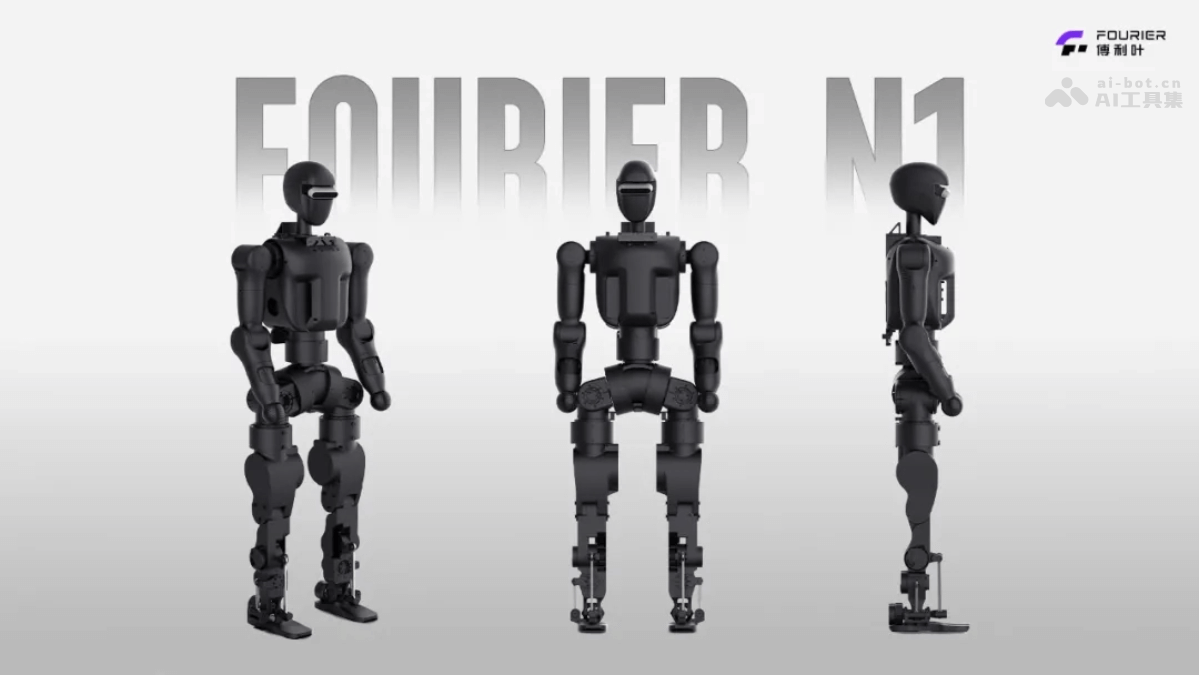
Main functions of Fourier N1
- Motion control function: With 23 degrees of freedom throughout the body, it can simulate various human movements and can achieve 15°–20° slope traversal, climbing stairs 20 centimeters high, standing on one foot, and pushing off the ground to get up, demonstrating excellent body reliability and motion robustness in unstructured scenarios.
- Multimodal interaction function: It has multimodal interaction capabilities and can well understand and respond to multiple input methods such as voice, vision, and touch, greatly improving the naturalness and fluency of human-robot interaction.
- Open-source sharing function: It simultaneously opens a complete body resource package covering the bill of materials, design drawings, assembly guide, and basic operation software. In the future, inference code and training frameworks for this platform will also be gradually opened, providing global developers with a more complete validation and development environment.
Technical principles of Fourier N1
- High degrees of freedom design: Fourier N1 has 23 degrees of freedom throughout the body, can simulate complex human movements, and demonstrates a high degree of flexibility and adaptability during motion.
- Self-developed power system: Equipped with Fourier's self-developed FSA 2.0 integrated actuator and combined with a self-developed control system, it improves motion stability and impact resistance and achieves higher-precision pose control. The measured maximum stable running speed can reach 3.5 meters per second, demonstrating excellent dynamic response capability.
- Motion algorithm validation: During the R&D stage, Fourier N1 underwent long-cycle, high-intensity motion algorithm validation. The core control system reached the expected technical standards in key performance areas such as response speed, precision control, and anti-interference capability. In the engineering validation phase, N1 has completed more than 1,000 hours of outdoor complex terrain testing, with a single continuous operation time exceeding 72 hours, comprehensively validating the stability, durability, and environmental adaptability of its structural design. At the same time, N1 can stably achieve 15°–20° slope traversal, climbing stairs 20 centimeters high, standing on one foot, and pushing off the ground to get up, demonstrating excellent body reliability and motion robustness in unstructured scenarios.
Project address of Fourier N1
- Project official website:https://fourier-grx-n1.github.io/
Application scenarios of Fourier N1
- Teaching tool: Fourier N1 is an ideal teaching tool. Through hands-on operation, students can intuitively understand scientific knowledge such as mechanical structures, circuits, and programming.
- Patient assistance: Fourier N1 may be used for patient assistance, for example, helping patients with rehabilitation training and assisting patients with limited mobility in completing some daily activities.
- Material handling and inspection: With its excellent motion capability and flexibility, N1 can undertake work such as material handling, packaging, and inspection.
- Housework assistant: Household users can, through custom development, let Fourier N1 undertake tasks such as cleaning and daily assistance.
- Complex terrain operations: In disaster rescue, Fourier N1, with its excellent terrain adaptability, can enter dangerous areas to carry out search and rescue work.