
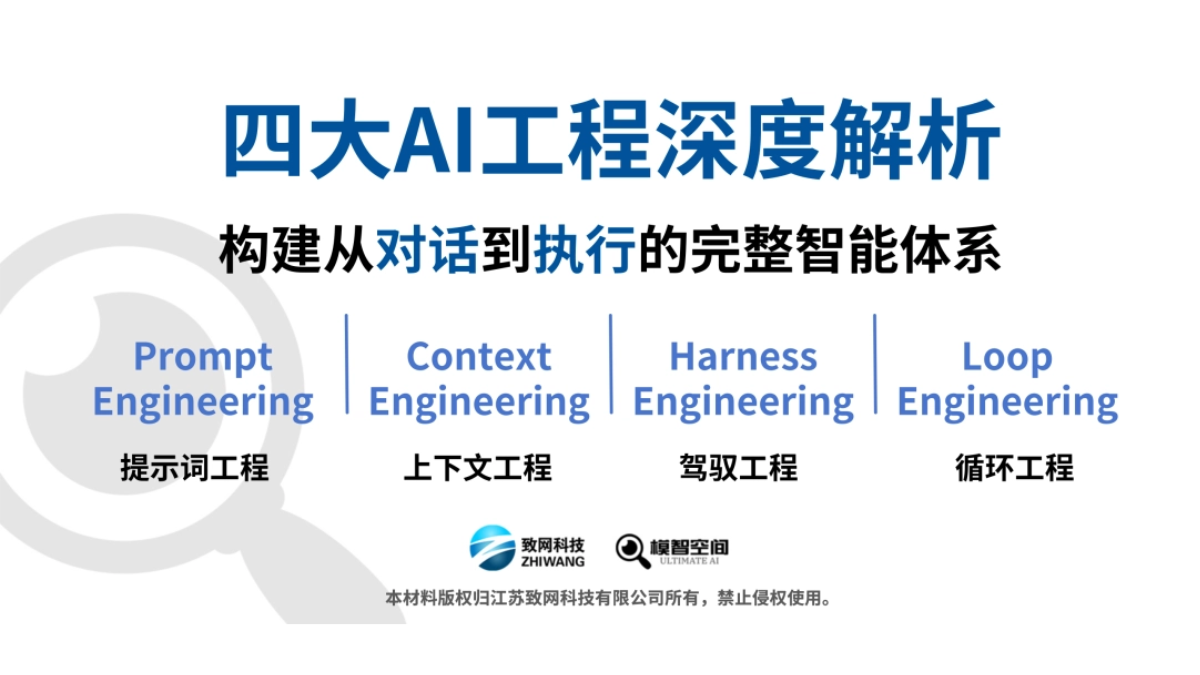
"Detailed Explanation of the Four Major AI Engineering Areas: Prompt / Context / Harness / Loop" is a 55-page in-depth report released by Zhiwang Technology Mozhi Space. It systematically proposes the four major AI engineering systems of Prompt, Context, Harness, and Loop, covering the complete chain from intent expression, information supply, and secure execution to autonomous looping. The report proposes that AI engineering is evolving from single-turn Q&A to closed-loop execution. The four layers of capability are synergistic and additive rather than substitutive, and none can be missing. It also explains in detail engineering implementation methods such as structured Prompt templates, RAG retrieval augmentation, Agent sandbox security, automated work loops, and Skills accumulation.

Scan the QR code to follow the official account and reply with the keyword:20260619, to receive the PDF report for free
From basic interaction to autonomous looping—the evolution of AI engineering
-
The focus of AI engineering has shifted from generating accurate answers to closed-loop execution.
-
In the early stage, it was a single-turn Q&A mode; now it requires an execution chain composed of understanding, retrieval, action, verification, and feedback.
-
Proposes a four-layer evolution architecture: Prompt Engineering (expression), Context Engineering (information), Harness Engineering (execution), and Loop Engineering (closed loop).
-
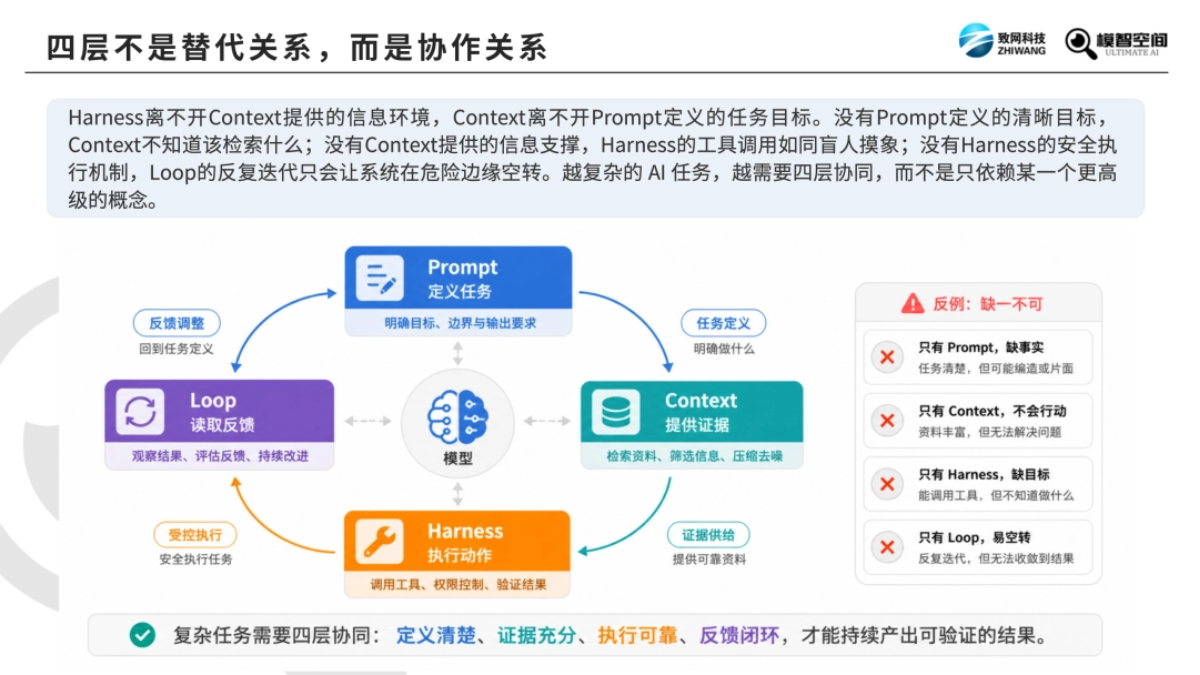
The four layers are not a substitutive relationship, but a collaborative叠加: Prompt defines the task, Context provides evidence, Harness executes securely, and Loop reads feedback.
-
Counterexample warning: With only Prompt, facts are lacking; with only Context, it cannot act; with only Harness, the goal is missing; with only Loop, it easily spins idle.
Prompt Engineering—the precise expression of intent
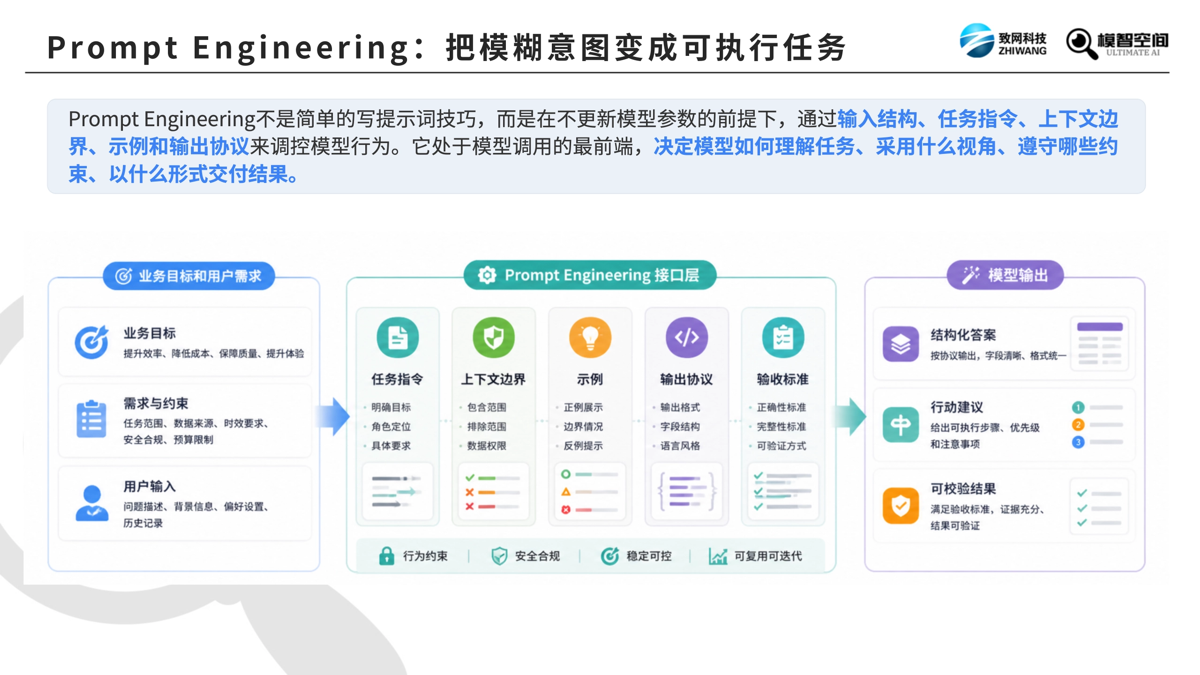
- Core objective: Turn vague intent into executable tasks, and regulate model behavior through input structure, task instructions, context boundaries, examples, and output protocols.
- Five core elements: identity (limiting perspective), task (clarifying the goal), context (providing background), constraints (defining boundaries), and output (specifying format).
- Prompting technique 1—Few-Shot: Use a small number of examples to concretize implicit business standards, output formats, and edge cases, suitable for tasks whose rules are difficult to write out completely.
- Prompting technique 2—CoT and Self-Consistency: CoT lets complex tasks be decomposed and derived step by step; Self-Consistency reduces single-run bias through multi-path reasoning voting.
- Control conditions and output structure: The same task can output different structures according to role (architect/customer service/product manager), audience (technical team/general users/management), and scenario (incident review/customer notification/decision briefing).
- Engineering implementation: Establish a template library, example library, version management, and failure sample library to make Prompts versionable, evaluable, and rollback-capable.
Context Engineering—the window of knowledge and memory
- Core objective: Enable the model to see the right materials at the right time, and generate context packages through retrieval, filtering, ranking, compression, permission filtering, and citation binding.
- Context window management: Organize raw documents, historical conversations, and tool returns by priority into six major blocks: system instructions, current task, key evidence, recent conversations, tool results, and work status.
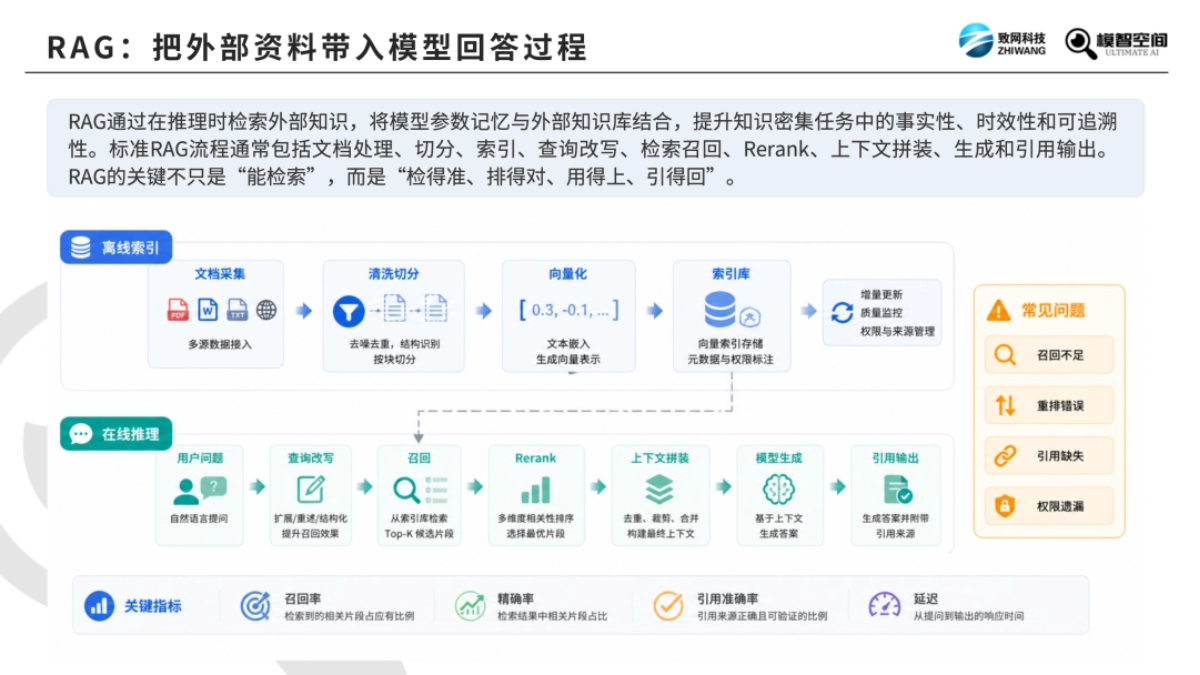
- RAG system: Offline indexing completes document collection, cleaning and segmentation, vectorization, and index library construction; online inference completes answer production through query rewriting, recall, Rerank, context assembly, model generation, and citation output.
- Agentic RAG Evolution: upgraded from single retrieval to the model actively determining whether to rewrite the query, split sub-questions, or continuously retrieve.
- Context Assembler: prioritizes, deduplicates, detects conflicts in, permission-filters, and formats input materials, then outputs a usable context package.
- Long Document Processing: through deduplication and trimming, summary compression, evidence localization, and key fragment extraction, combined with summary writing and evidence retrieval, it supports long-cycle tasks.
- Multimodal Processing: uniformly processes text, images, tables, code, logs, and webpage screenshots; after region localization, table structuring, code semantics, log aggregation, and screenshot recognition, it generates a unified context package.
Harness Engineering—the System's Safety Guardrails
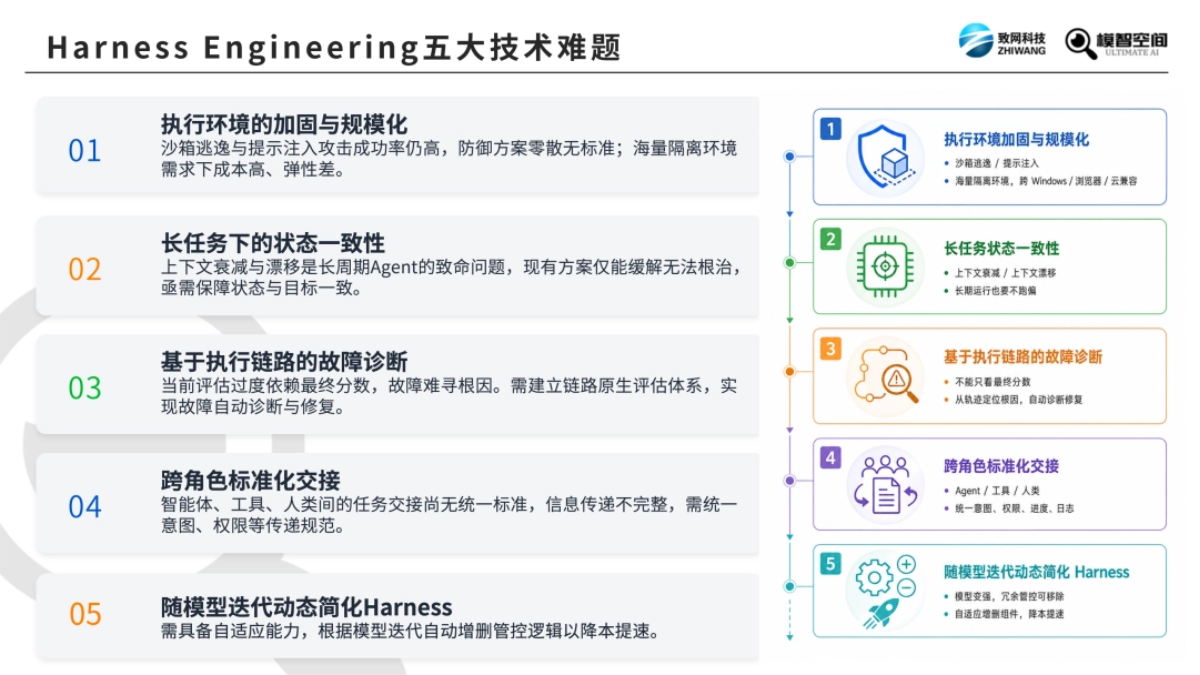
- Background: in 2025, Agent capabilities exploded, but reliability was insufficient, with problems such as infinite loops, forgetting things, ignoring rules, and low-level errors.
- System Analogy: the model is like a CPU providing compute power, context is like memory storing information, the Harness is like an operating system responsible for scheduling, and the Agent is like an application completing tasks.
- ETCLOVG Framework: Execution environment (E), Tool interface (T), Context and memory (C), Lifecycle and orchestration (L), Observability (O), Verification and evaluation (V), Governance and security (G).
- Execution Environment: through sandboxing, it achieves security isolation (code/command/network restrictions), reproducibility (one-click reset, consistent initial state), and improved autonomy (reducing manual authorization).
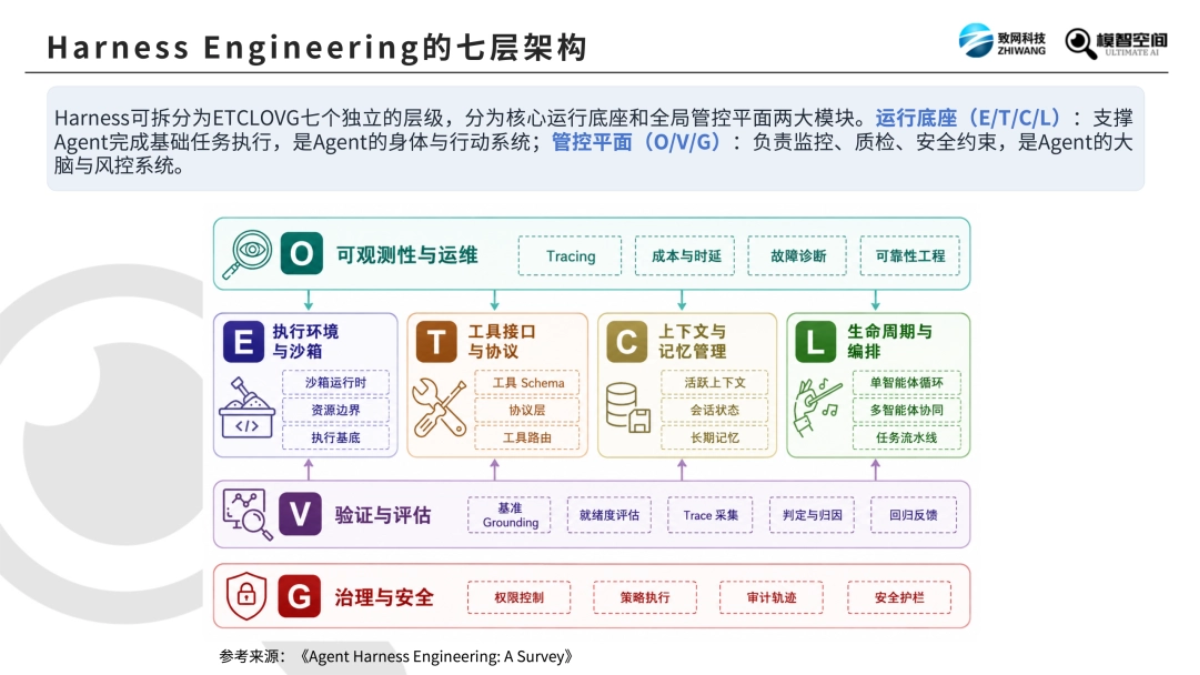
- Tool Interface: through the standardized MCP (Model Context Protocol) and A2A (Agent-to-Agent) protocols, it solves the problem that models cannot directly operate software interfaces, APIs, and command lines.
- Memory Management: builds a three-layer system of short-term context (working memory), medium-term session memory (session-level cache), and long-term persistent memory (vector/graph database).
- Lifecycle Orchestration: single-agent loop (ReAct: think-act-observe-reflect), multi-agent orchestration (planner-executor-reviewer division of labor), and full-process pipeline (GitHub Issue→development→testing→PR).
- Observability: trace tracking (model/tool/context changes), cost and performance monitoring (Token consumption, inference latency), and fault operations (looped calls, environment anomalies, inference failures).
- Verification and Evaluation: upgraded from looking only at the final score to full-process quality inspection, covering task definition, pre-run validation, trace collection, multi-dimensional judging (results/tool reasonableness/efficiency/compliance), and regression iteration.
- Governance and Security: permission control (fine-grained authorization for files/network/tools), execution hooks (pre- and post-checkpoints, interception of violations), component hardening (prevention of sandbox escape and prompt injection), and auditing and compliance.
- Trilemma: quality, speed, and cost trade off against one another and must be balanced according to the scenario.
Loop Engineering—Loop Design and Autonomous Execution
- Core Shift: from people continuously manually driving the agent to people designing loops, and the loops automatically driving the agent.
- Outer Loop and Inner Loop: the outer loop determines whether to start the next round, and the inner loop is responsible for how to do things within this round.
- Six Major Components:
- Automations: Scheduled triggering, scanning status, summarizing failures.
- Worktrees: Isolate parallel tasks to avoid multi-agent file overwrites and code conflicts.
- Skills: Through SKILL.md, precipitate project knowledge (specifications, processes, pitfalls), configure once and reuse continuously.
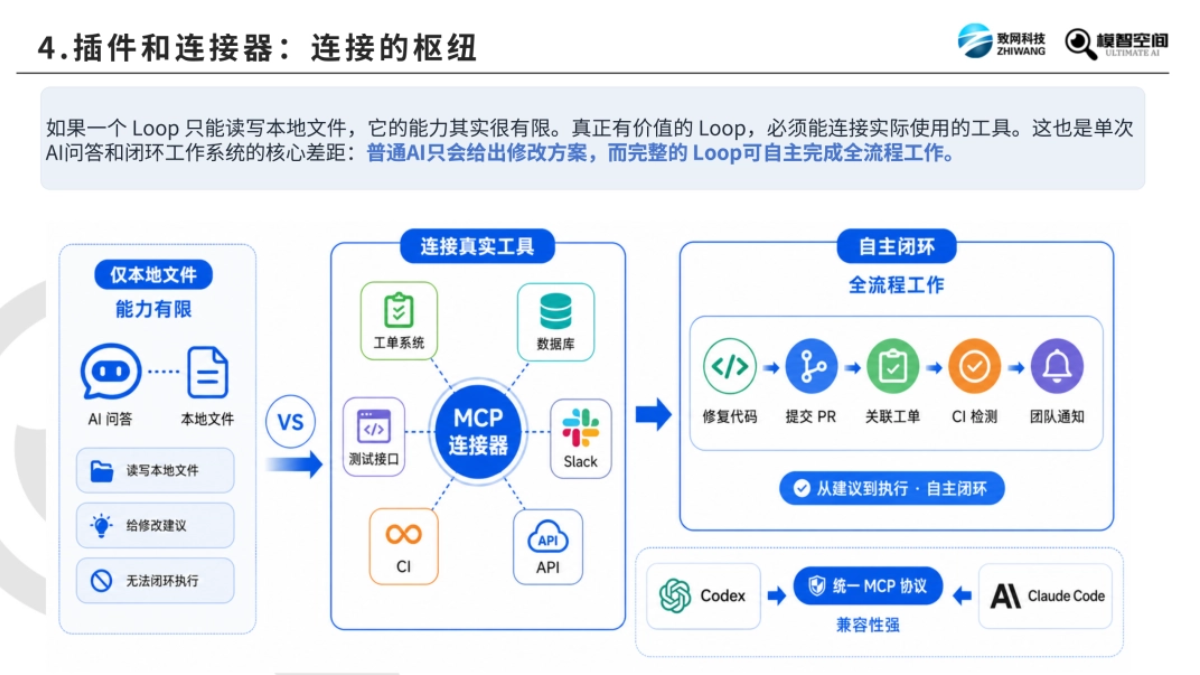
- Plugins & Connectors: Connect to real environments such as ticketing systems, databases, Slack, CI, APIs, etc., through MCP.
- Sub-Agents: Role separation (exploration, development, review, verification), resolving self-review blind spots and achieving cross-validation.
- Memory: External persistent memory (Markdown/task board/status files), resolving forgetting after restarts and achieving seamless continuation across loops.
- Automated tasks: Compared with single AI execution, Loop supports repetition by frequency (/loop) or until conditions are met (/goal), combined with an independent verification model to ensure trustworthy results.
- Practice mapping: Codex's built-in Worktree supports multi-threaded parallelism; Claude Code supports independent working directories, sub-agent isolation, and automatic cleanup after tasks.
Summary and future outlook
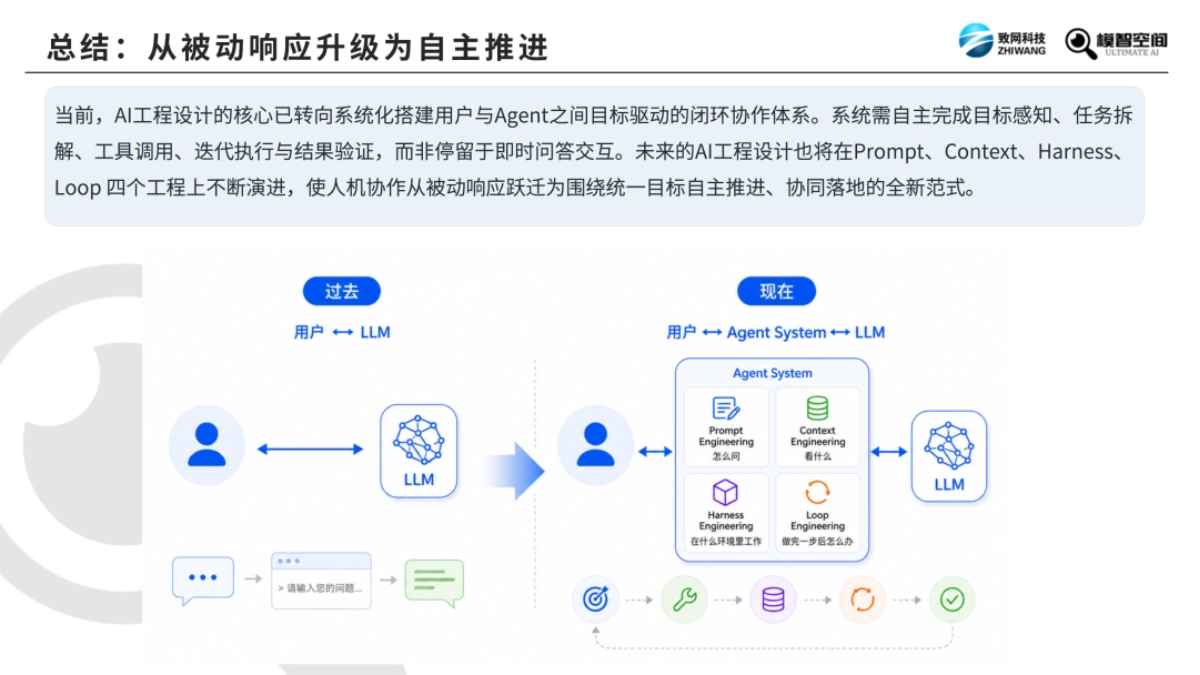
- One-sentence summary of the four major engineering practices: Prompt solves how to ask, Context solves what the AI sees, Harness solves what environment the AI works in, and Loop solves what the AI does after completing one step.
- Three-stage evolution: Stage 1 instruction-driven (Prompt Engineering, simple/single-turn/static) → Stage 2 information-driven (Context+Harness, multi-turn dialogue/tool invocation, still requiring human intervention) → Stage 3 system-driven (Loop Engineering, long-cycle/multi-step/autonomous iteration).
- Essence: From writing instructions for the model, to providing information and environment for the model, to building a system that runs itself.
Scan the QR code to follow the official account, and reply with the code word:20260619, to receive the PDF report for free