
What Is FluxSR
FluxSR is a novel single-step diffusion model, launched by Shanghai Jiao Tong University, Harvard University, South China University of Technology, and Huawei Noah's Ark Lab, specifically for real-world image super-resolution (Real-ISR) tasks. FluxSR is based on the FLUX.1-dev text-to-image (T2I) diffusion model and distills a multi-step flow matching model into a single-step super-resolution model through Flow Trajectory Distillation (FTD) technology. The core advantage of FluxSR lies in its ability to efficiently generate high-quality super-resolution images while maintaining the high realism of the T2I model. FluxSR uses TV-LPIPS perceptual loss and Attention Diversification Loss (ADL) to optimize high-frequency image details and reduce artifacts. FluxSR demonstrates outstanding performance on multiple datasets, especially in no-reference image quality assessment metrics, significantly reducing computational cost and providing a new solution for efficient, high-quality image super-resolution.
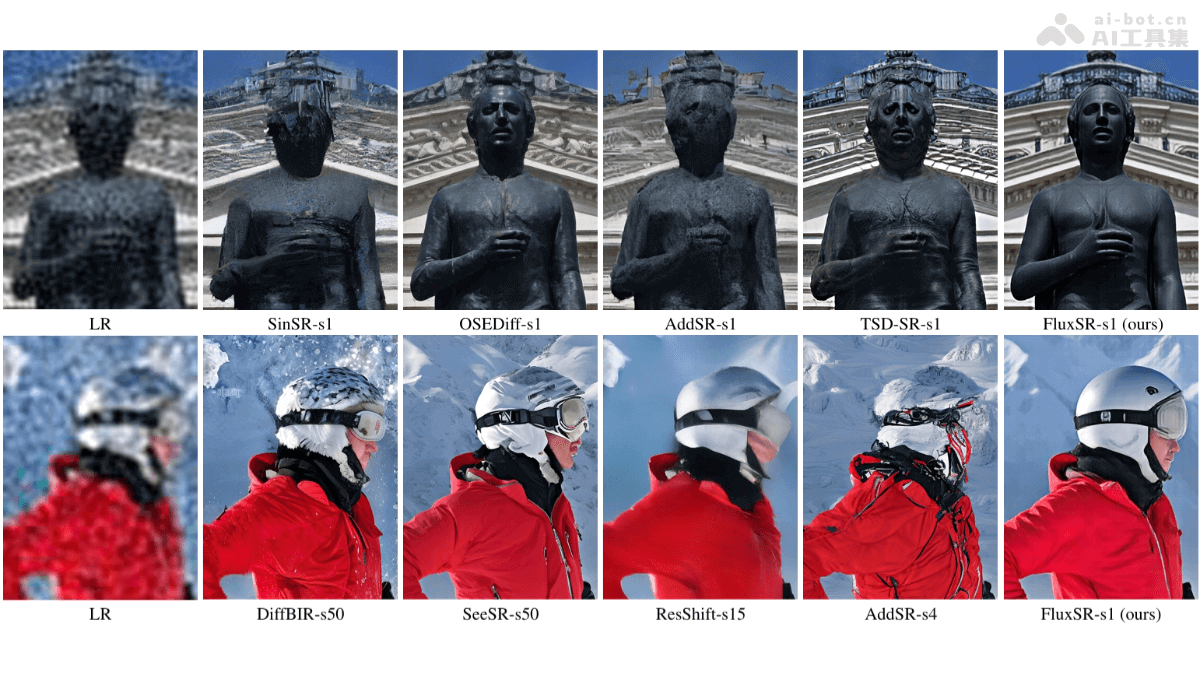
Main Features of FluxSR
- Efficient Single-Step Super-Resolution Reconstruction: Efficiently restores low-resolution images to high-resolution images in a single-step diffusion process, significantly reducing computational cost and inference latency, suitable for rapid image processing needs.
- High-Realism Image Generation: Extracts high-realism details from a pretrained text-to-image (T2I) model and applies them to super-resolution tasks, generating images with rich details and high realism.
- High-Frequency Detail Recovery and Artifact Suppression: Effectively recovers high-frequency details in images and reduces high-frequency artifacts and repetitive patterns.
Technical Principles of FluxSR
- Flow Trajectory Distillation(Flow Trajectory Distillation, FTD):
- Generation of Noise-to-Image Flow: Uses a pretrained T2I model to generate noise-to-image flow.
- Derivation of Low-Resolution to High-Resolution Flow: Derives the LR-to-HR flow trajectory based on mathematical relationships, avoiding distribution shift caused by directly optimizing the SR flow.
- Training Strategy for Single-Step Diffusion Models: Based on a training strategy friendly to large models, offline generation of noise-to-image flow data pairs avoids reliance on additional teacher models during training. It significantly reduces memory consumption and training costs, making single-step model training more efficient.
- Perceptual Loss and Regularization:
- TV-LPIPS Perceptual Loss: Combines Total Variation (TV) and LPIPS (Learned Perceptual Image Patch Similarity) losses, emphasizes the recovery of high-frequency components, and reduces artifacts in generated images.
- Attention Diversification Loss (ADL): Based on reducing the similarity of different tokens in the transformer, enhances attention diversity and eliminates high-frequency artifacts.
- Efficient Inference: In the inference stage, it relies only on a single flow model, avoiding the high computational overhead of multi-step diffusion models. Based on FTD technology, it generates high-quality super-resolution images in a single step while maintaining realism comparable to multi-step models.
Project Address of FluxSR
- GitHub Repository:https://github.com/JianzeLi-114/FluxSR
- arXiv Technical Paper:https://arxiv.org/pdf/2502.01993
Application Scenarios of FluxSR
- Old Photo Restoration: Restores low-resolution, blurry, or damaged old photos to high-resolution, clear images.
- Film and Television Production: In post-production for film and television, upgrades low-resolution footage to high resolution to meet HD or 4K production needs.
- Medical Imaging Enhancement: Enhance the resolution of low-resolution medical images (such as X-rays, CT, MRI) to help doctors diagnose diseases more accurately.
- Smartphone photography: Enhance the clarity of low-resolution photos taken by mobile phones, especially in low-light or fast-motion scenes.
- Quality inspection: In industrial production, enhance the resolution of image inspection systems on production lines to help detect product defects more accurately.