
What Is FluxMusic
FluxMusic is an open-sourcemusic generation model, based on diffusion models and Transformer architecture, that converts text descriptions into music. The model can handle complex text instructions and generate music with specific emotions, styles, and instruments. FluxMusic provides models of different scales, from small to giant, to adapt to different hardware requirements. It adopts rectified flow technology to improve the naturalness and quality of music, and all related code and model weights can be obtained on GitHub.
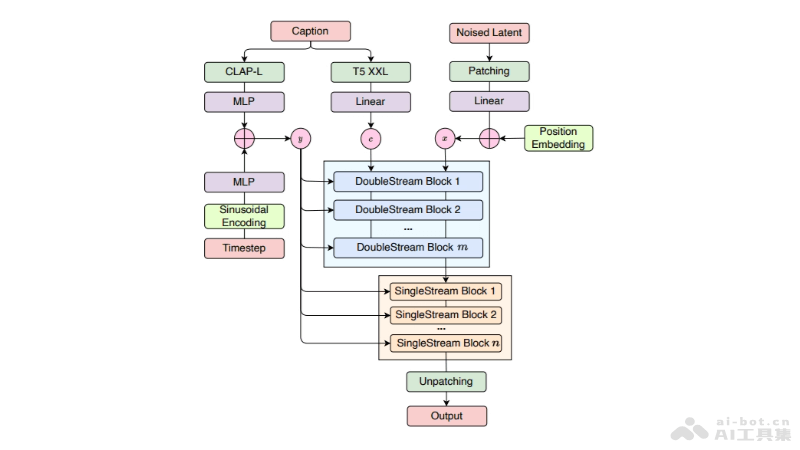
FluxMusic's Main Features
- Text-to-Music Generation: Directly converts text descriptions into music, allowing users to create music through textual descriptions.
- Semantic Understanding: Uses a pre-trained text encoder to capture semantic information in the text, ensuring that the generated music matches the emotion and style of the text description.
- Multimodal Fusion: Combines text and music modalities, using deep learning technology to understand the relationship between text and music, achieving more precise music generation.
- Efficient Training Strategy: Adopts a rectified flow training method to improve the efficiency of model training and the quality of generated music.
- Scalability: The model architecture design has good scalability, adapting to music generation tasks of different scales and requirements by adjusting parameters and configurations.
FluxMusic's Technical Principles
- Diffusion Models: By simulating the process in which data gradually transitions from an ordered state to random noise, and then reversing this process to generate new data samples. In music generation, diffusion models gradually recover the music signal from noise.
- Rectified Flow Transformers: Optimizes the generation process by defining a linear trajectory between data and noise. It improves theoretical properties and generation performance, making the generated music more realistic and natural.
- Dual-stream Attention Mechanism: The dual-stream attention mechanism processes the joint sequence of text and music, enabling bidirectional flow of information. It allows the model to simultaneously consider text content and music features.
- Stacked Single-stream Blocks: After the text stream is discarded, the model uses stacked single music stream blocks to focus on music sequence modeling and noise prediction, further improving the accuracy of music generation.
- Pre-trained Text Encoders: FluxMusic is based on pre-trained models such as T5 XXL and CLAP-L to extract text features, enhancing the model's ability to understand text descriptions.
FluxMusic's Project Address
- GitHub Repository:https://github.com/feizc/FluxMusic
- HuggingFace Model Library:https://huggingface.co/feizhengcong/FluxMusic
- arXiv Technical Paper:https://arxiv.org/pdf/2409.00587
FluxMusic's Application Scenarios
- Music Creation Assistance: Musicians and composers use FluxMusic to gain creative inspiration, quickly generate music drafts, and accelerate the music creation process.
- Film and Television Soundtracks: In the production of movies, TV series, advertisements, and video games, FluxMusic automatically generates soundtracks based on the script or scene descriptions, improving the efficiency of music production.
- Game Music Generation: In video games, FluxMusic generates background music in real time based on game situations and player behavior, enhancing the gaming experience.
- Music Education: In the field of music education, FluxMusic serves as a teaching tool, helping students understand the music creation process and learn music theory and composition techniques through practice.
- Personalized Music Experience: Ordinary users generate personalized music by inputting their emotional state, scene descriptions, or stories, creating a unique auditory experience.