
What is FLUX-Text
FLUX-Text is a novel multilingual scene text editing framework launched by Alibaba, based on a Diffusion Model and a lightweight glyph embedding module. The framework improves the accuracy and fidelity of text generation in complex scenes by injecting glyph condition information, and performs excellently when handling non-Latin characters such as Chinese. With only 100,000 training samples (97% fewer than other methods), it achieves a balance among high fidelity, style consistency, and data efficiency in text editing tasks, setting a new benchmark for high-quality multilingual text generation.
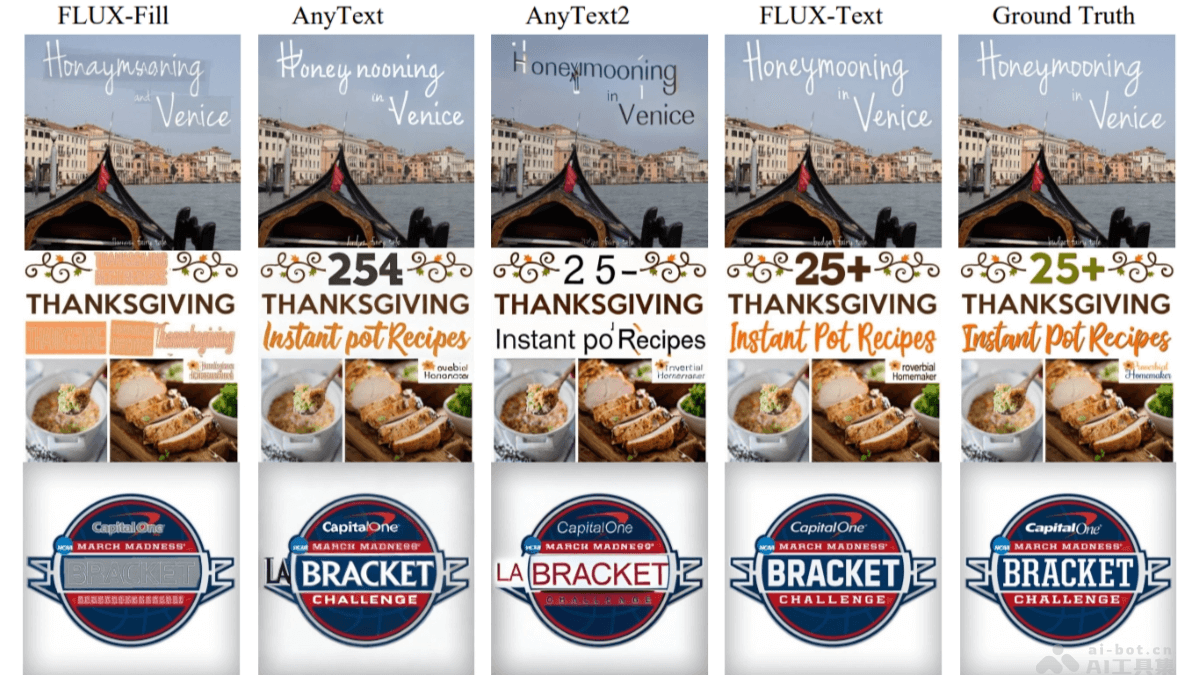
Main Features of FLUX-Text
- Multilingual Text Editing: Supports text generation and editing in multiple languages (such as English, Chinese, etc.), and can handle complex character structures and diverse language styles.
- High-Fidelity Text Generation: The generated text is highly integrated with the background visually, maintaining the clarity and readability of the text and avoiding blurry or erroneous characters.
- Flexible Text Layout: Supports editing of multi-line text, generating a text layout that fits the scene according to the input text prompt.
Technical Principles of FLUX-Text
- Diffusion Model: FLUX-Text uses a Diffusion Model for image generation and editing. The Diffusion Model generates images by gradually removing noise, and can generate high-quality image content with details. Based on the FLUX-Fill architecture, FLUX-Text introduces text conditions during the diffusion process, enabling the model to generate corresponding text content according to text prompts.
- Lightweight Glyph Embedding Module: To better handle complex glyphs (such as Chinese characters), FLUX-Text designs a lightweight glyph embedding module that injects glyph information directly into the Diffusion Model. It directly uses the VAE encoder to extract glyph features, which are combined with text features to reduce the model's training burden and improve generation accuracy.
- Text Embedding Module: FLUX-Text uses two methods, OCR injection and Glyph-ByT5 injection, to enhance the semantic information of text. OCR injection inputs the text image into an OCR model to extract features, and combines the features with the output of the text encoder. Glyph-ByT5 injection uses the Glyph-ByT5 encoder to extract fine-grained semantic information, further improving the quality of text generation.
- Region-Aware Loss: Traditional perceptual loss is calculated on the global image, which ignores the details of the text region. FLUX-Text introduces region-aware loss, which calculates the loss only in the text region, making the model focus more on the quality of text generation. Combined with position information as a mask, region-aware loss can better optimize the generation effect of the text region.
- Two-Stage Training Strategy: In the first stage, the model is trained with a lower loss weight to ensure overall stable convergence. In the second stage, the loss weight is increased, and the model focuses more on optimizing the text region, improving the quality and consistency of text generation.
FLUX-Text Project Address
- arXiv Technical Paper:https://arxiv.org/pdf/2505.03329
Application Scenarios of FLUX-Text
- Advertising and Poster Design: Quickly generate high-quality text that blends with the background, improving the design effect.
- Film and Video Production: Dynamically generate subtitles, ensuring natural integration with the video background.
- Game Development: Supports multilingual text generation, enhancing game immersion.
- Social Media Content Creation: Generate text that matches the style to enhance content appeal.
- Education and Publishing: Generate clear and readable text annotations to improve the quality of textbooks and charts.