
What is FLUX 3
FLUX 3 is a multimodal foundation model from Black Forest Labs that, for the first time, jointly learns images, video, and audio under a unified architecture. The model is based on Self-Flow technology, aligning generation and understanding within the same framework, and can generate videos up to 20 seconds long with native audio in a single pass, supporting text-to-video, image-to-video, video-to-video, and keyframe-to-video. Through physical constraints between modalities, the model learns world representations and performs excellently on tasks such as robotic manipulation.
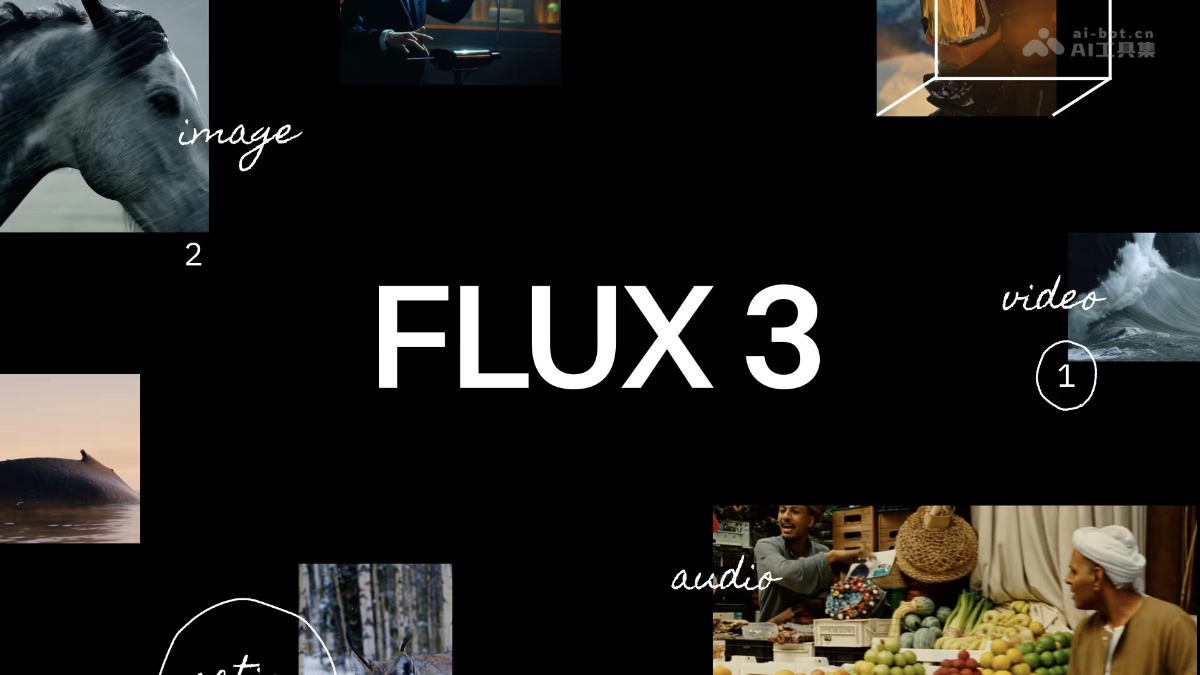
Key Features of FLUX 3
- Multimodal Video Generation: Generates diverse videos up to 20 seconds long with native audio in a single pass, supporting text-to-video, image-to-video (animation continuation/visual reference), video-to-video, keyframe-to-video, and multilingual dialogue.
- Unified Modality Understanding and Generation: Based on the Self-Flow architecture, it aligns generation and understanding within the same underlying framework, supports joint generation of images, video + audio, and enables creation from pure text or reference image/video inputs.
- Intelligent Clip Chaining: Supports intelligently chaining multiple independent clips into longer multi-shot sequences, covering a wide range of visual styles from handheld camera footage to animation and cinematic quality.
- Scalable Action Prediction: The architecture reserves expansion slots for Action encoders/decoders, natively supporting physical AI and robotic control tasks.
Technical Principles of FLUX 3
- Self-Flow Architecture: Builds on Flow Matching by introducing a self-alignment mechanism, unifying multimodal generation and understanding within the same framework and achieving dual improvements in generation quality and world understanding.
- Multimodal Transformer: Text, images, video, and audio are processed by independent encoders and then fed into a unified Transformer; after the information from each modality interacts and fuses, it is output by the corresponding decoder.
- Joint Training Paradigm: Simultaneously scales compute and data resources, jointly trains on video, images, and audio, and uses physical constraints between modalities to learn a more accurate world model.
- Cross-Modal Mutual Constraint Learning: Sound must match impact, motion must obey mass, and the future must follow the past; through joint multimodal constraints, it builds a unified representation of the physical world.
How to Use FLUX 3
- Obtain Access: Visit the Black Forest Labs official website (https://bfl.ai/)申请 Early Access early experience eligibility.
- Choose a Usage Method: Experience it instantly through the browser Playground, or integrate and call it via API and third-party platforms (Replicate, fal.ai, Together AI).
- Enter a Creation Prompt: Enter a text prompt in the Playground or API, or upload a reference image/video as creation input.
- Configure Generation Parameters: Select the target modality (image/video/audio), set style, aspect ratio, output duration, and other parameters.
- Get the Generated Results: The model automatically completes multimodal generation; download or integrate the output content such as images and videos with audio.
Core Advantages of FLUX 3
- Dual Improvements in Generation and Understanding: The Self-Flow architecture unifies generation and understanding, achieving a 47% success rate on robotic manipulation tasks and a learning speed twice that of traditional Flow Matching.
- Leading User Preference: In a blind test of 720p video with audio, the preference rate is 77% for Runway Gen-4.5 and 93% for Luma Ray 3.2.
- Native joint audio-video generation: Generates videos up to 20 seconds long with native audio in a single pass, achieving audio-visual synchronization without post-production dubbing.
- Unified multimodal architecture: Images, video, and audio are jointly trained under a unified framework, and physical constraints between modalities make the world model more accurate.
- Style diversity: Covers a wide range of styles from handheld camera footage to animation and cinematic quality, and supports strong typography generation and motion design.
- Scalable to physical AI: The architecture reserves Action encoders/decoders, natively supporting physical-world interaction tasks such as robot control.
FLUX 3 project address
- Project website:https://bfl.ai/blog/flux-3
Comparison of FLUX 3 with similar competitors
| Dimension | FLUX 3 | Seedance 2.0 |
|---|---|---|
| Modality coverage | Image + video + audio + action prediction (unified architecture) | Text + image + video + audio (four-modality input) |
| Single-generation duration | Up to 20 seconds of video with audio | Not specified |
| User preference rate | On par with Seedance 2.0 (52%) | On par with FLUX 3 (52%) |
| Architecture features | Self-Flow unified generation and understanding | Universal Reference system |
| Action prediction | Native support (reserved in architecture) | Not specified |
| Open-source strategy | Provides Open Weights | Closed-source API |
Application scenarios of FLUX 3
-
Film and television previsualization and advertising creativity: Rapidly generates video storyboards and dynamic concept films with audio, reducing pre-production costs.
-
Multimodal content creation: Produces stylistically consistent image, text, audio, and video materials in one click, suitable for social media and marketing communication.
-
Virtual characters and animation: Maintains character consistency based on reference images and generates coherent animated videos across scenes.
-
Physical AI and robotics: Uses action prediction capabilities to train robot manipulation policies and accelerate embodied intelligence research and development.
-
Motion design and typography: Generates content with strong text typography and motion design, empowering brand visuals and digital advertising.