
What Is FlowDirector
FlowDirector is a novel training-free video editing framework jointly launched by the AGI Lab team at Westlake University and Central South University, specifically designed for precise editing of video content according to natural language instructions. The framework directly models the editing process in the data space, using a smooth transition path driven by ordinary differential equations (ODEs), avoiding the temporal inconsistency and structural distortion issues caused by traditional methods based on latent space inverse mapping. FlowDirector introduces the Spatially Attentive Flow Correction (SAFC) mechanism to precisely protect the spatiotemporal consistency of unedited regions, and enhances semantic alignment capability based on the Differential Averaging Guidance (DAG) strategy. The framework performs excellently on multiple video editing benchmarks, significantly improving instruction adherence, temporal consistency, and background preservation, providing a new solution for efficient and coherent video editing.
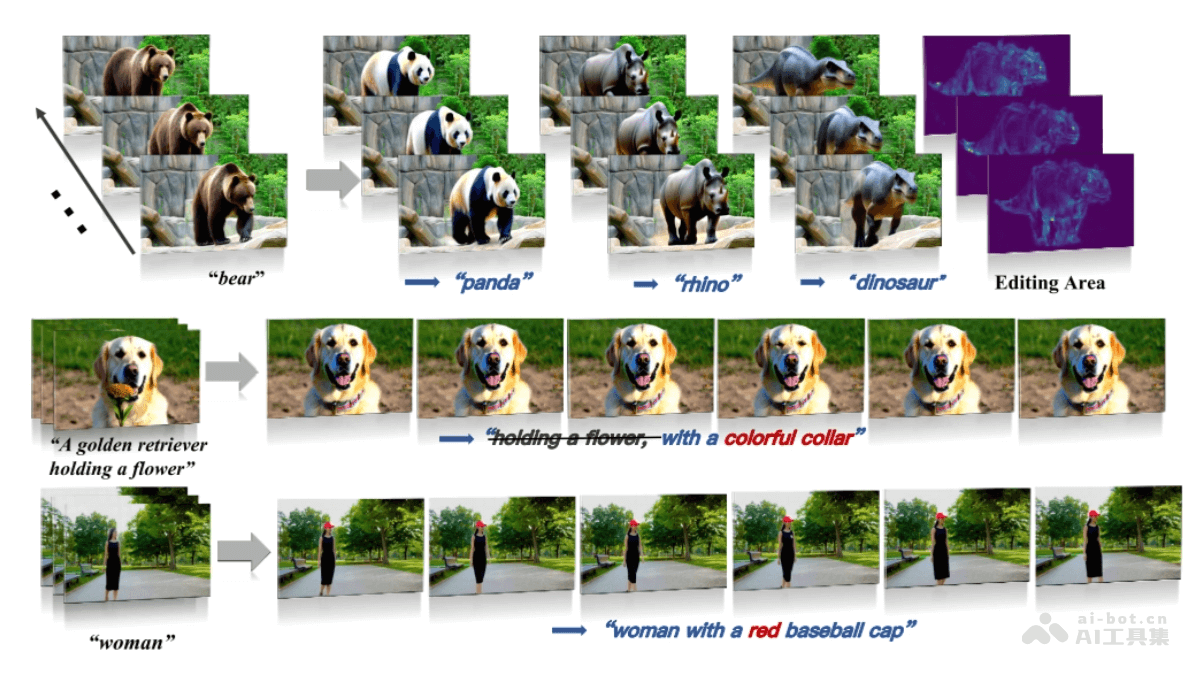
FlowDirector's Main Features
- Precise Semantic Editing: Semantically modifies video content according to natural language instructions, for example, replacing the "bear" in a video with a "dinosaur".
- Spatiotemporal Consistency Preservation: Maintains the temporal coherence and spatial structural integrity of the video during the editing process, avoiding content misalignment or style inconsistency.
- Local Editing and Global Preservation: Based on the spatial attention mechanism, edits only the target region and preserves the original content and dynamics of unedited regions.
- Efficient Training-Free Editing: Requires no additional training and directly uses a pretrained text-to-video (T2V) model for editing, reducing editing costs and improving efficiency.
- Supports Multiple Editing Tasks: Supports handling various complex video editing tasks such as object replacement, texture transformation, local attribute modification, and object addition/deletion.
FlowDirector's Technical Principles
- Editing Flow Generation: Based on a pretrained text-to-video (T2V) model, calculates the difference in velocity fields between the source video and the target video, generating an editing path directly from the source video to the target video. Based on a smooth transition path driven by ordinary differential equations (ODEs), it avoids the structural distortion issues caused by latent space inverse mapping in traditional methods.
- Spatially Attentive Flow Correction (SAFC): Introduces an attention-guided mask mechanism, which generates a mask to precisely control the editing region by extracting attention maps relevant to the editing task. During the ODE-driven editing process, the mask is applied to the velocity field to freeze non-target regions, ensuring that those regions remain unchanged during the editing process.
- Differential Averaging Guidance (DAG): Inspired by Classifier-Free Guidance (CFG), it enhances semantic alignment capability by generating multiple candidate editing flows and computing the differential signal among them. Based on the differential signal, it adjusts the editing trajectory, making the editing result closer to the target semantics while maintaining structural consistency.
FlowDirector's Project Address
- Project Website:https://flowdirector-edit.github.io/
- GitHub Repository:https://github.com/Westlake-AGI-Lab/FlowDirector
- arXiv Technical Paper:https://arxiv.org/pdf/2506.05046
FlowDirector's Application Scenarios
- Video Special Effects Production: Quickly generates special effects based on simple text instructions, replacing objects in ordinary scenes with fantasy elements (such as replacing a "car" with a "dragon"), adding creativity to film and television works.
- Advertising Video Production: Quickly adjust video content based on advertising copy, replacing the product appearance or background environment with elements that match the advertising theme, enhancing the appeal and relevance of the advertisement.
- Animation Production: Quickly modify characters or scenes in animated videos, changing a character's clothing from "red" to "blue," or changing the scene from a "forest" to a "city," accelerating the animation creation process.
- Personalized Video Editing: Users quickly edit short videos according to their own needs, replacing pets in the video with other animals, or adding fun special effects to the video, enhancing the video's fun and appeal.
- Creative Content Generation: Creators quickly generate video content that matches a specific theme or style, converting ordinary landscape videos into "cyberpunk style," meeting social media users' demand for creative content.