
What is Florence-VL
Florence-VL is an innovative multimodal large language model (MLLMs), jointly launched by the University of Maryland and Microsoft Research. Florence-VL uses the generative vision foundation model Florence-2 to enrich visual representations, can capture visual features at different levels and aspects of images, and adapts to diverse downstream tasks. Florence-VL introduces the Depth-Breadth Fusion (DBFusion) technique, which integrates visual features extracted at different depths and under multiple prompts, achieving deep fusion of visual and language understanding.
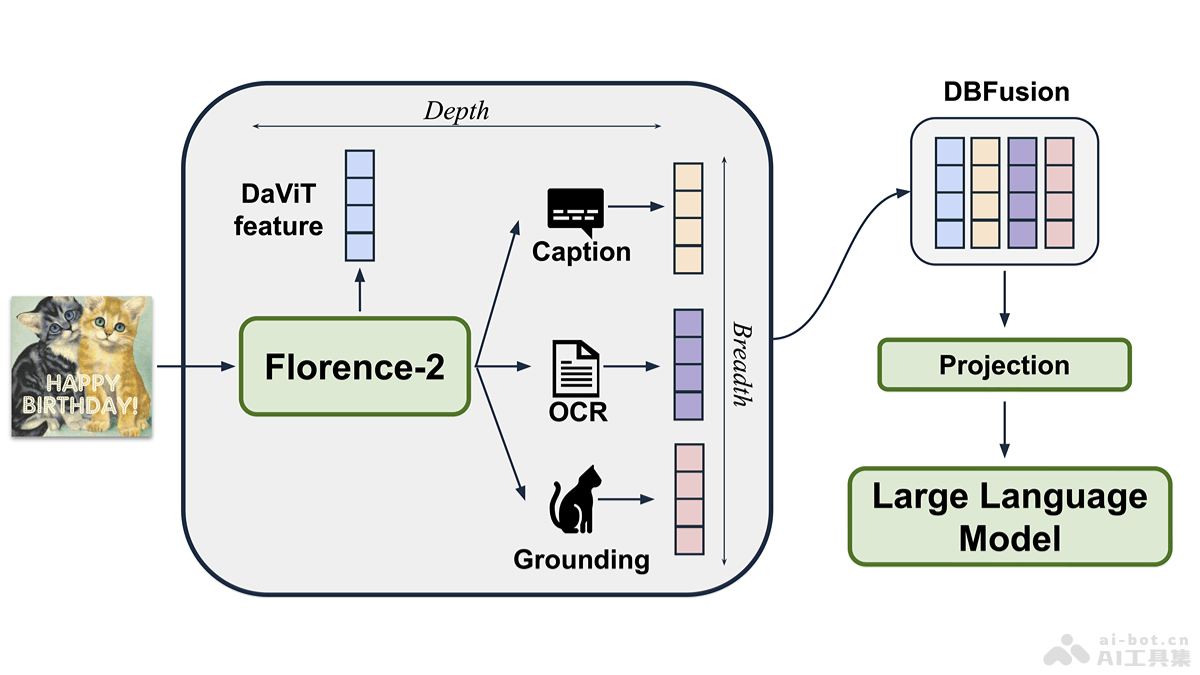
Main features of Florence-VL
- Multimodal understanding: Florence-VL can understand and process image and text data, achieving deep fusion of vision and language.
- Visual feature extraction: Uses the Florence-2 model to extract rich visual features from images.
- Depth-Breadth Fusion (DBFusion): Combines visual features from different levels (depth) and different task prompts (breadth), adapting to a variety of downstream tasks.
- Performance improvement: Achieves performance improvements on multiple multimodal and vision-centric benchmarks, including VQA, OCR, image captioning, and more.
Technical principles of Florence-VL
- Generative visual encoder: Uses Florence-2 as the visual encoder, generating visual features based on different task prompts, and is suitable for a variety of visual tasks.
- Feature fusion architecture: Introduces a novel feature fusion architecture that combines the visual features extracted from Florence-2 with a pretrained language model.
- Depth-Breadth Fusion (DBFusion):
- Depth: Integrates visual features from different levels, capturing conceptual details from low-level to high-level.
- Breadth: Uses multiple task-specific visual features, each emphasizing different perceptual information in the input image.
- End-to-end pretraining: The entire model is pretrained end-to-end, achieving optimal alignment between the visual and language modalities.
- Fine-tuning: After pretraining, the projection layer and language model are fine-tuned to adapt to specific downstream tasks.
Project address of Florence-VL
- Project official website:jiuhaichen.github.io/florence-vl
- GitHub repository:https://github.com/JiuhaiChen/Florence-VL
- arXiv technical paper:https://arxiv.org/pdf/2412.04424
Application scenarios of Florence-VL
- Researchers and scientists: Scholars and researchers in the fields of artificial intelligence, computer vision, and natural language processing explore new algorithms, model architectures, and multimodal learning techniques.
- Software developers: Developers enhance applications, for example by improving user experience through image recognition and processing capabilities.
- Data analysts: In fields such as finance and market research, data analysts analyze and understand chart data to extract valuable information.
- Educators: Teachers and educational technology specialists create interactive educational content to assist students in learning and understanding complex concepts.
- Content creators: Writers, journalists, and content producers generate image descriptions or provide inspiration for creating image content.