
What is Florence-2
Florence-2 is a多功能视觉模型 launched by the Microsoft Azure AI team, capable of performing multiple computer vision tasks such as image captioning, object detection, visual grounding, and image segmentation. Florence-2 is based on the Transformer architecture and uses a sequence-to-sequence learning method, where the encoder converts images into sequence representations, and the decoder then converts the representations into text output. Florence-2 training uses the ultra-large dataset FLD-5B, which contains 126 million images and 5.4 billion annotations, combined with automated image annotation technology and model iteration to ensure the high quality and diversity of the data.
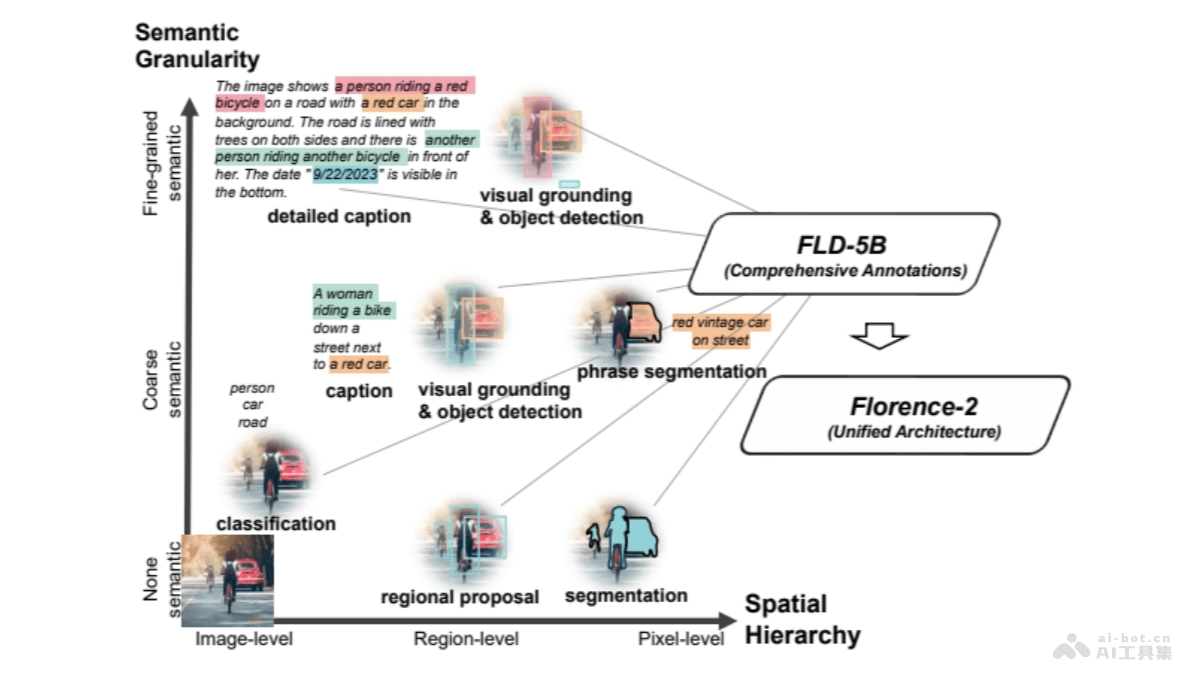
Main features of Florence-2
- Image captioning: Generate detailed descriptions of images, similar to image captions.
- Object detection: Identify specific objects in images and determine the location of the targets.
- Visual grounding: Locate objects or regions in images related to text prompts.
- Image segmentation: Segment images into different regions for identifying and separating specific objects in the images.
Technical principles of Florence-2
- Unified representation: Florence-2 is designed as a unified model that handles multiple visual tasks, integrating different types of visual and language information based on a unified framework.
- Sequence-to-sequence learning (Seq2Seq): The model uses a sequence-to-sequence learning method and consists of an encoder and a decoder. The encoder is responsible for converting input images into sequence representations, and the decoder converts the representations into output text.
- Transformer architecture: Based on the Transformer architecture, it uses self-attention mechanisms to process visual and language data and achieve the fusion of multimodal information.
- Image encoder: Uses DaViT as the image encoder to capture image features and convert them into visual token embeddings.
- Multimodal encoder-decoder: Based on the standard Transformer architecture, it uses self-attention mechanisms to achieve the fusion of image and text information, and to understand and generate text related to visual content.
- Positional encoding: Provides region-level spatial information, which is crucial for tasks such as object detection and segmentation, enabling the model to identify specific regions in images.
Project address of Florence-2
- Project official website:florence-2.com
- GitHub repository:https://github.com/retkowsky/florence-2
- HuggingFace model library:https://huggingface.co/microsoft/Florence-2-large
- arXiv technical paper:https://arxiv.org/pdf/2311.06242
Application scenarios of Florence-2
- Image and video analysis: In the field of security monitoring, Florence-2 identifies and tracks specific objects in videos and performs abnormal behavior detection.
- Content moderation: Automatically detect and filter inappropriate content, such as violent, pornographic, or other images and videos that violate platform policies.
- Assisted driving and autonomous driving: In autonomous driving systems, it helps identify road signs, pedestrians, vehicles, and other obstacles, improving driving safety.
- Medical imaging analysis: Assists doctors in identifying abnormalities in medical images, such as tumors and lesions, improving the accuracy and efficiency of diagnosis.
- Retail and inventory management: In retail environments, it is used for shelf analysis and automatically monitors inventory levels and product placement.